Mary Ainsworth
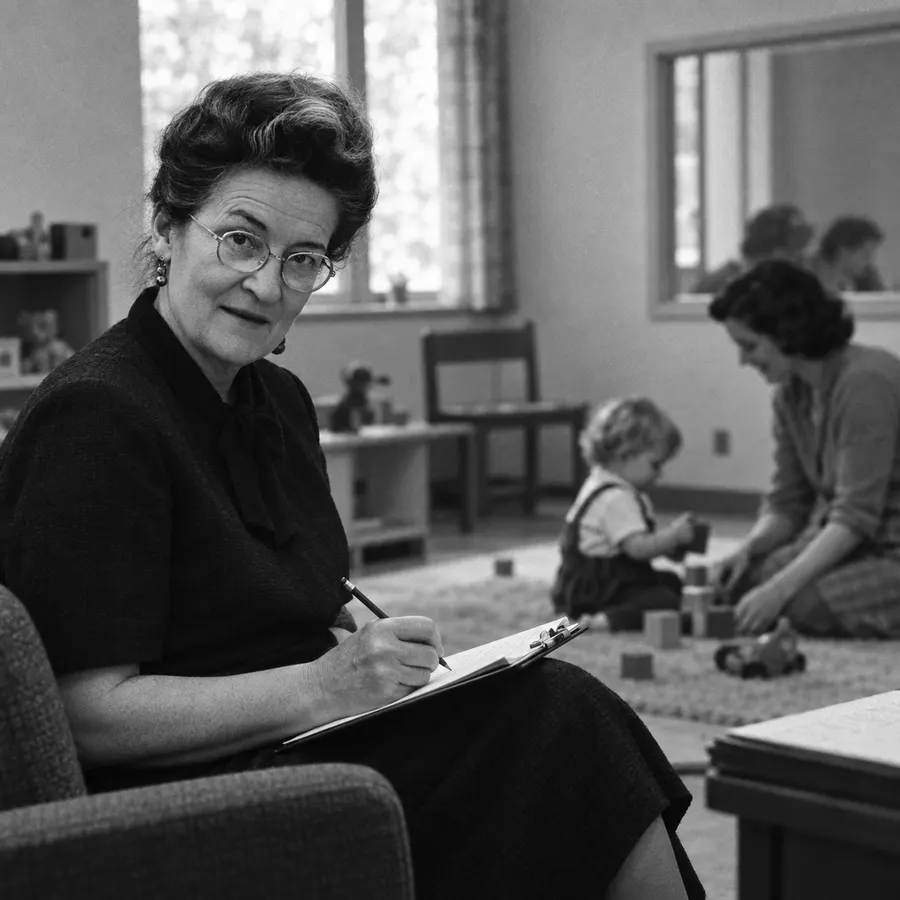
Mary Ainsworth, 1913 to 1999, built the instrument that made attachment measurable, and identified the caregiver behaviour that causes it. The Strange Situation is hers, the secure, avoidant and resistant classifications are hers, and so is the sensitivity construct, which has held up better than almost anything else in the field.
Who they are
Ainsworth's method came out of observation before it came out of a laboratory. She spent 1954 and 1955 in Uganda watching mothers and infants in their own homes, then repeated the approach in Baltimore. What she noticed was that mothers differed reliably in how accurately they read a baby's signals, and that babies differed correspondingly in how they used the mother when distressed.
The Strange Situation, developed with Barbara Wittig, compresses that into about twenty minutes. A mother and a one-year-old enter an unfamiliar playroom with toys. A stranger enters. The mother leaves. The mother returns. It happens twice. What gets scored is the reunion, not the crying: what the baby does in the first seconds after the door opens.
Three patterns came out. Babies who sought the mother, settled quickly and went back to the toys she called secure. Babies who barely acknowledged her, staying with the toys with an indifference that turns out to be effortful, she called avoidant. Babies who could not settle, seeking contact and resisting it at once, she called resistant. A fourth, disorganised, was added by Mary Main and Judith Solomon in 1990.
The proportions everyone quotes, roughly two thirds secure, come from 106 pooled infants who were white, middle-class and American in the early 1960s. They are still repeated as facts about human babies, and they travel less well than that. When 32 samples from 8 countries were pooled in 1988, security was the most common pattern everywhere, but two samples from the same country differed from each other about one and a half times as much as countries differed from each other.
Her more durable contribution is the sensitivity construct, and it is the one this site would keep if it could keep only one thing.
Key papers
Key papers
Ainsworth, M. D. S., & Bell, S. M. (1970). Child Development, 41(1), 49-67. The Strange Situation procedure, and the original three-way classification into secure, avoidant and resistant.
Ainsworth, M. D. S., Blehar, M. C., Waters, E., & Wall, S. (1978). Patterns of Attachment. Lawrence Erlbaum. The Baltimore study and the book the classification system travels in. The much-quoted distribution comes from 106 pooled infants who were white, middle-class and American in the early 1960s.
van IJzendoorn, M. H., & Kroonenberg, P. M. (1988). Child Development, 59(1), 147-156. Thirty-two samples from eight countries pooled. Security was the most common pattern everywhere, and two samples from the same country differed from each other about one and a half times as much as countries differed from each other. Cited here because it bounds the distribution figures rather than confirming them.
De Wolff, M. S., & van IJzendoorn, M. H. (1997). Child Development, 68(4), 571-591. The meta-analytic estimate behind the sensitivity construct, and the reason this site treats sensitivity as the best-evidenced thing in the literature and a partial cause rather than the whole of it.
Article titles are not recorded in the vault for the journal entries above and are not supplied here.
Key ideas
Score the reunion. The insight that made the procedure work: separation distress tells you little, and what a baby does when the parent returns tells you a great deal.
Sensitivity, meaning noticing a signal, reading it correctly and responding promptly. The best-evidenced cause of security, at about six parts in a hundred of the variation.
The secure base. A child explores further when there is somewhere to return to, which is the image the whole theory runs on.
Concepts on this site
Sources
- Ainsworth, M. D. S., & Bell, S. M. (1970). Child Development, 41(1), 49-67.
- Ainsworth, M. D. S., Blehar, M. C., Waters, E., & Wall, S. (1978). Patterns of Attachment. Lawrence Erlbaum.
- van IJzendoorn, M. H., & Kroonenberg, P. M. (1988). Child Development, 59(1), 147-156.
- De Wolff, M. S., & van IJzendoorn, M. H. (1997). Child Development, 68(4), 571-591.