Noam Mairon
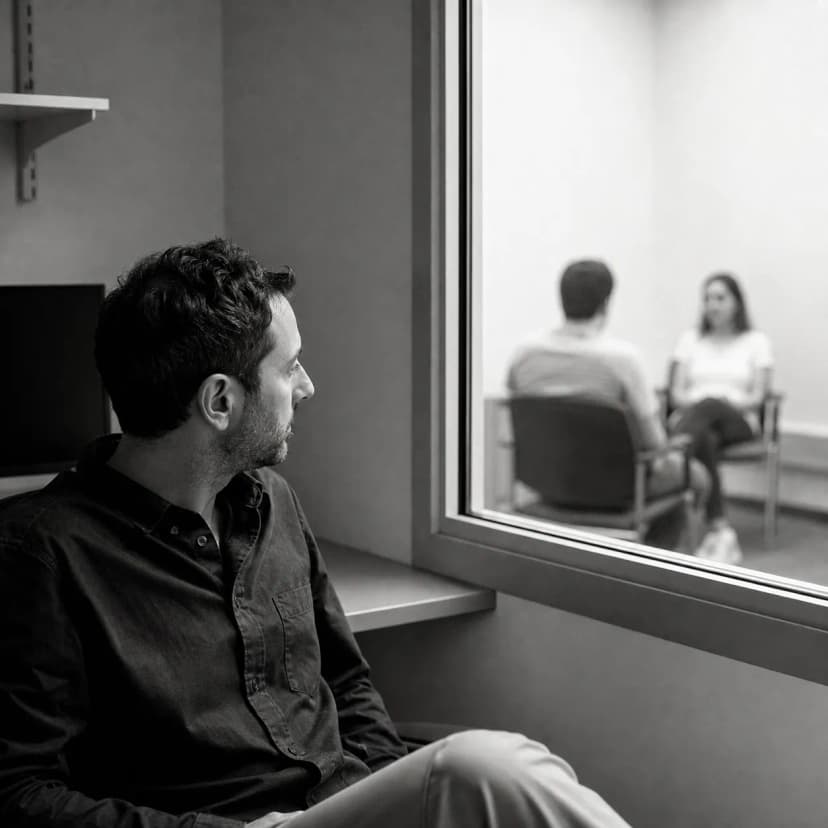
Noam Mairon is the first author of the 2020 study that tested whether attending to something alongside another person amplifies attention and memory, and found that it does not. The paper matters out of proportion to its size because it is the most careful objective-measure test of a claim that popular writing about crowds, stadiums and shared screens leans on constantly. Its finding is a null with evidence behind it, not a failure to find anything, and it is the reason this site treats the psychology of mass simultaneous attention as unproven rather than established.
Who they are
Mairon is a researcher in social cognitive neuroscience, working in Anat Perry's Social Cognitive Neuroscience Lab at the Hebrew University of Jerusalem, where his interests centre on the mechanisms behind social cognition, particularly the separation of self from other that empathic perception depends on. The 2020 shared-attention paper was run with the Berkeley group around Robert T. Knight, and its participants were University of California, Berkeley undergraduates. He is early in his publishing career, and this page deliberately rests on the one paper that bears on the site's argument rather than implying a larger body of work than exists.
The study is worth describing in full, because the detail is what carries the argument. Forty-two undergraduates were run in pairs, seated at opposite sides of a table, each about 90 centimetres from a screen they both watched. Their task was to count images of flowers, in silence, for around ten minutes a run and roughly an hour in total, sometimes with the other person attending to the same screen and sometimes not. Attention and memory were measured behaviourally and with EEG. Shared attention produced no amplification of either. The Bayes factors, between 0.13 and 0.64, are positive evidence for the null rather than an absence of evidence, which is the distinction most reporting of a non-significant result gets wrong.
There was one solid social effect, and it ran the wrong way for the amplification story. Accuracy on the flower count was higher alone, 94.35 per cent, than shared, 86.25 per cent, t(39) = 5.62, d = 1.04. Having another person at the table made people measurably worse at the task, which is ordinary social facilitation and distraction rather than anything exotic.
Mairon and his co-authors are careful about what this does not settle, and this site follows them. They never asked participants how anything felt, so no subjective measure was collected at all. The amplification findings they were testing against, Garriy Shteynberg's, largely concern self-reported emotion under mediated co-presence, so this is not a direct replication of him and does not claim to be. The honest summary is that the door is open on feeling and closed on performance. Two strangers at one table for ten minutes is the evidence available; a stadium is an extrapolation from it, and the extrapolation should be labelled as one every time it is used.
Key papers
Mairon, N., Nahum, M., Stolk, A., Knight, R. T. & Perry, A. (2020), "Behavioral and EEG Measures Show no Amplifying Effects of Shared Attention on Attention or Memory," Scientific Reports, 10, 8458, published 21 May 2020. N = 42, run in pairs at a shared screen, behavioural and EEG measures, Bayes factors 0.13 to 0.64 supporting the null. Mairon is first author; Anat Perry is senior and corresponding author.
Key ideas
Shared attention, tested with objective measures under physical co-presence, does not amplify attention or memory.
Bayes factors in that range are evidence for the null hypothesis, not merely a failure to reject it, which is a stronger and rarer result than a non-significant p value.
The one reliable social effect in the study is negative: people counted more accurately alone, 94.35 per cent against 86.25 per cent shared, d = 1.04.
The study measured performance and not feeling, by design, and its authors say so. It constrains the joint-attention literature without closing it.
Concepts on this site
Find them elsewhere
The X account's bio gives his Hebrew University doctorate and his research areas, and the Scholar profile lists the 2020 shared attention paper. No Bluesky or LinkedIn account could be confirmed
Checked 2026-09-10. Handles and affiliations go out of date, so treat this block as a snapshot rather than a standing fact.
Sources
- Mairon, N., Nahum, M., Stolk, A., Knight, R. T. & Perry, A. (2020), "Behavioral and EEG Measures Show no Amplifying Effects of Shared Attention on Attention or Memory," Scientific Reports, 10, 8458. Full text read.
- Social Cognitive Neuroscience Lab, Hebrew University of Jerusalem, lab members page. Affiliation and research interests.
- Shteynberg, G. (2015), "Shared Attention," Perspectives on Psychological Science, 10(5), 579-590. The amplification literature the null was tested against.