Philip Zimbardo
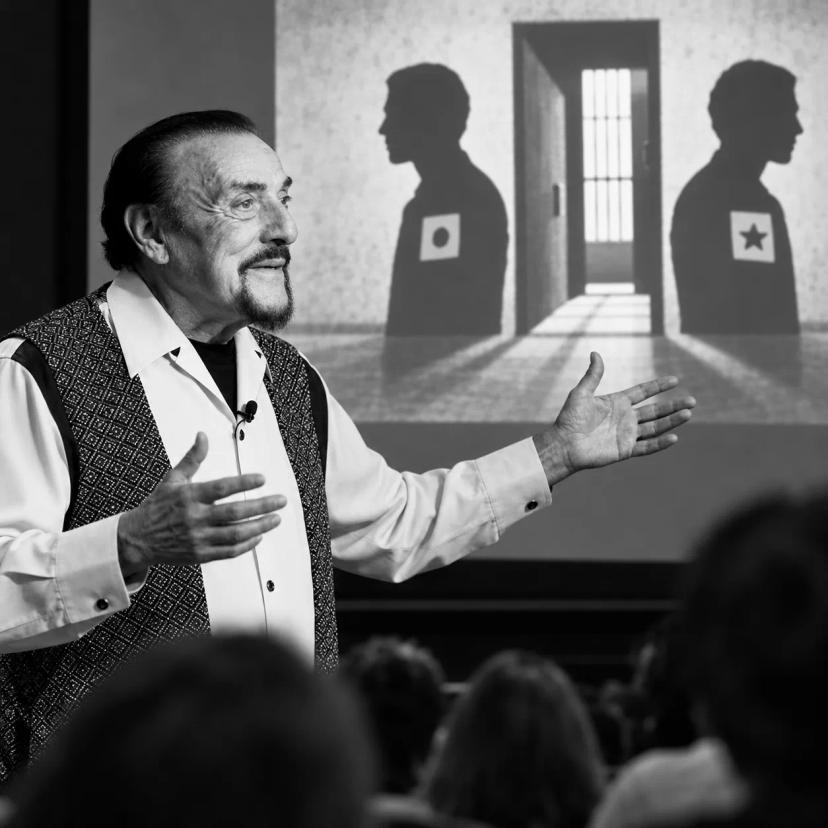
Philip Zimbardo (1933 to 2024) was a social psychologist who led the Stanford Prison Experiment in 1971 and acted as the experiment's superintendent. The study made him one of the best-known psychologists of his era, and it remains the work on which his public reputation rests. Its interpretation is now debated, and he took part in that debate directly: he signed the joint statement of 28 August 2018 that called for open and respectful debate, and he and Craig Haney replied to the 2019 papers in a 2020 comment.
Who they are
Zimbardo was a professor of psychology at Stanford when he ran the Stanford Prison Experiment, with Craig Haney and Curtis Banks as co-investigators. The vault's account of the study, drawn from Robert Sapolsky's Behave, describes his part in it plainly. Sapolsky, who knows him as a colleague and friend, writes that Zimbardo was not a detached observer but served as the experiment's superintendent, set ground rules, including telling the guards they could make prisoners feel afraid and helpless, and met regularly with the guards. Sapolsky describes him as a humane and decent man, a friend and colleague, and as someone the guards would very much wish to please (Behave).
According to a Scientific American account of the 2019 identity-leadership paper, Zimbardo later gave evidence in congressional testimony on prison riots and on the Abu Ghraib abuses. The critique of the Stanford study is aimed at the conclusions drawn from it and not at his character, and this page treats it in that way.
Key papers
The study was reported first for a military research audience and then more widely. The vault note records appearances in Naval Research Reviews, a criminology journal, the New York Times Magazine and American Psychologist. Sapolsky observes that Zimbardo published remarkably little of the data in professional journals and wrote mostly for a general readership (Behave).
The critical literature that now frames the study includes Le Texier (2019), Haslam, Reicher and Van Bavel (2019) and Carnahan and McFarland (2007). Zimbardo's own site lists a 2020 comment by Zimbardo and Haney in American Psychologist that replies to the 2019 critiques. Its text was not opened for this page.
Key ideas
The idea Zimbardo's name is attached to is that a situation can override disposition: that putting people into roles with unequal power is enough to produce cruelty from some of them. The archive evidence has weakened the strong form of that claim. Le Texier reports that at the guard orientation Zimbardo described the aim of producing boredom, frustration and powerlessness and said that the staff had total power in the situation and the prisoners had none (Le Texier, 2019). On that evidence the guards were told what the study was for.
The weaker form survives. Sapolsky writes that a far higher percentage of perfectly normal people than most would predict succumb and do awful things, and that there are always those who resist (Behave). The statement of 28 August 2018, signed by Zimbardo, Haney, Alexander Haslam and Stephen Reicher, agrees that the new information suggests the experimenters intervened more than traditional accounts allow, that their leadership helped drive the guards' brutality, and that people may not slip into roles as easily as once thought. It asks for debate that stays with ideas and not personalities.
Zimbardo and Haney have not conceded the broader point. Their position, as listed on Zimbardo's site, is that dehumanising environments remain powerful. Both positions are part of the record, and this page does not decide between them. The vault also holds Zimbardo and John Boyd's work on time perspective (1999), a separate programme that is not connected to the Stanford Prison Experiment.
Sources
- Sapolsky, R. M. (2017). Behave. Penguin Press. Vintage 2018 edition.
- Le Texier, T. (2019). American Psychologist, 74(7), 823-839. https://doi.org/10.1037/amp0000401
- Haslam, S. A., Reicher, S. D., & Van Bavel, J. J. (2019). American Psychologist, 74(7), 809-822. https://doi.org/10.1037/amp0000443
- University of St Andrews (28 August 2018). Researchers call for open and respectful debate around Stanford Prison Experiment.
- philipzimbardo.com, page on the Stanford Prison Experiment, read 2026-10-25.
- Scientific American, Observations blog, "Rethinking the Infamous Stanford Prison Experiment", read 2026-10-25.
Articles that cite Philip Zimbardo
- What is deindividuation?
What the original idea of a lost self claimed, and what experiments on anonymity, group norms and shared identity found in its place.
- The Stanford Prison Experiment Reread
The Stanford Prison Experiment is taught as proof that roles make ordinary people cruel. Sorted into three claims, the evidence supports the first, weakens the second and leaves the third contested.
Concepts on this site
- The BBC Prison Study
The BBC Prison Study is an eight-day experiment run by Stephen Reicher and Alexander Haslam, filmed in December 2001, broadcast by the BBC in 2002 and published in 2006 in the British Journal of…
- The Stanford Prison Experiment
The Stanford Prison Experiment is a 1971 study led by Philip Zimbardo in which student volunteers were assigned to be guards or prisoners in a mock prison in a Stanford basement. It was planned for…
- Time Perspective
A person's habitual orientation toward the past, present and future, including how far ahead they look.