Robert Sapolsky
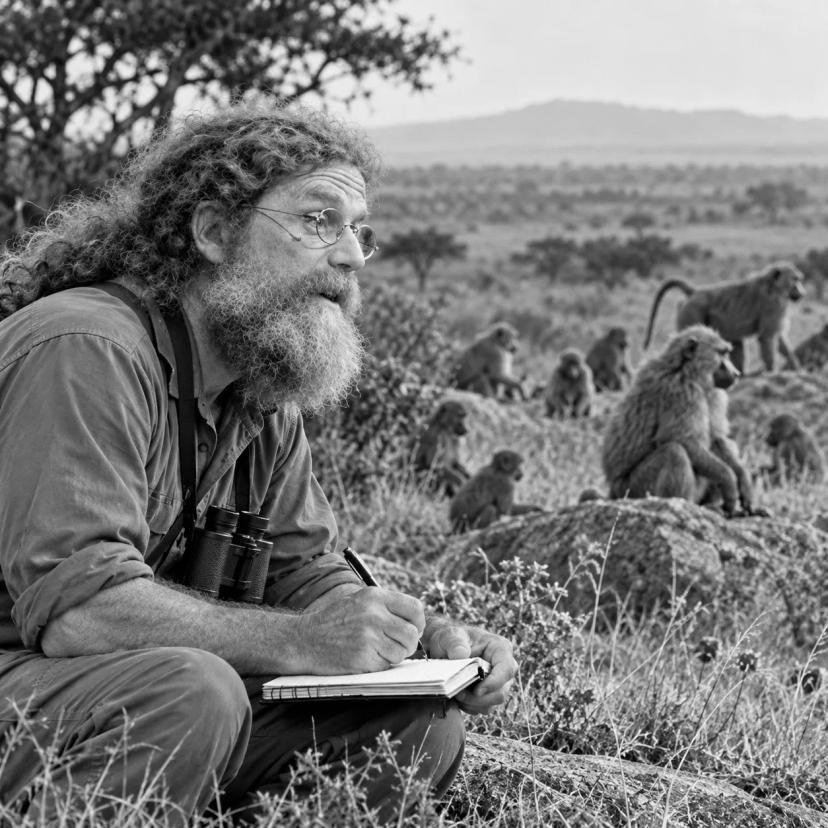
Robert Sapolsky is a neurobiologist and primatologist, a professor of biology and neurology at Stanford, and the author of Behave: The Biology of Humans at Our Best and Worst (2017). In this publication he is the source for the Stanford Prison Experiment's citation counts and for a compact account of its challenges. His treatment is useful because it comes from a colleague at the same university and is not hostile to the study's author.
Who they are
The vault describes Sapolsky as a neurobiologist and primatologist whose book Behave ranges across biology, psychology and social behaviour. The vault's audit of the book, completed in October 2026, found a low rate of self-citation, roughly 1.5 to 1.8 per cent, which it judged unusual for a working scientist writing in his own field. The audit also found that he gives effect sizes where they cut against his own thesis, and that he marks uncertain findings with notes attached to the specific claims they threaten.
The audit recorded a limit as well. His cautions about uncertain findings sit in endnotes that may be fifty to a hundred pages away from the claims they qualify, so a reader of the main text can miss them. His discussion of the Stanford Prison Experiment is an exception, because he sets out the challenges in the text itself.
Key papers
The relevant work is a book and not a paper. Behave is a 670-page trade book, and the Stanford Prison Experiment material appears in a late section of the Vintage 2018 edition.
There he reports that the experiment has been cited more than 58,000 times, against more than 27,000 for Milgram and more than 4,000 for Asch. He then sets out three challenges: the experimenter's role as superintendent, the self-selection of volunteers, and the thin publication of the data. He ends with the BBC Prison Study and with what he thinks survives.
Key ideas
Sapolsky's reading has three features that make it a good seed for an article. The first is that he states the experimenter-effect point from the design alone, without archival work. Zimbardo served as the experiment's superintendent, set ground rules that told guards they could make prisoners feel afraid and helpless, and was someone whom guards would wish to please. Two years before Le Texier's archival study, he reached the same conclusion by a different route.
The second is that he argues against his own side where the evidence is not clean. He reports the Carnahan and McFarland finding that volunteers for a study advertised in the 1971 way scored higher on aggressiveness, authoritarianism and social dominance and lower on empathy and altruism, and then notes that if both guards and prisoners shared that makeup it is unclear why it would tilt toward brutality.
The third is that he states a positive residue. What survives, as he puts it, is that far more perfectly normal people than most would expect give in and do terrible things, and that some always resist. On the BBC Prison Study he reads the final regime as the work of participants who scored highest on authoritarianism beforehand, which points to bad apples rather than bad barrels. Reicher and Haslam, who ran the study, read it differently, and both readings are kept in this publication.
Sources
- Sapolsky, R. M. (2017). Behave: The Biology of Humans at Our Best and Worst. Penguin Press. Page references to the Vintage 2018 edition.
- Vault audit of Behave, 14 October 2026.
- Carnahan, T., & McFarland, S. (2007). Personality and Social Psychology Bulletin, 33(5). https://doi.org/10.1177/0146167206292689
Studies on this site by Sapolsky
- Behave: The Biology of Humans at Our Best and Worst
Sapolsky (2017)
Articles that cite Robert Sapolsky
- Why Giving Money Away Feels Better Than Spending It
People predict that a windfall spent on themselves would please them most. Studies of prosocial spending find the reverse in many settings, and the largest replications show where the effect weakens.
- Why is yawning contagious?
What experiments found about catching a yawn, why closeness shapes who catches it, and what is still debated.
- What is deindividuation?
What the original idea of a lost self claimed, and what experiments on anonymity, group norms and shared identity found in its place.
- What is an engram? How memories are stored
How researchers tag the cells that hold a memory, what changes inside them, and why a stored trace can still be updated.
- Neuromarketing Definition: How Brands Read the Buyer's Brain
The word began in a 2002 lecture and now carries two meanings. What each means, and what brain measures can and cannot tell a brand.
- What is compassion fatigue?
The phrase has an everyday meaning and a research history. A review of 90 healthcare studies and a brain-imaging training study show where the vocabulary and the measurement part ways.
- Does the implicit association test work?
The implicit association test returns a difference in milliseconds. Comparisons of its reliability and pooled analyses of its link to behaviour give a mixed answer that depends on the claim.
- The Stanford Prison Experiment Reread
The Stanford Prison Experiment is taught as proof that roles make ordinary people cruel. Sorted into three claims, the evidence supports the first, weakens the second and leaves the third contested.
Concepts on this site
- Reverse Inference
Reverse inference is reading a mental state off brain activity: seeing a region light up and concluding that a particular feeling or thought is happening. Because most brain regions do many things…
- The BBC Prison Study
The BBC Prison Study is an eight-day experiment run by Stephen Reicher and Alexander Haslam, filmed in December 2001, broadcast by the BBC in 2002 and published in 2006 in the British Journal of…
- The Stanford Prison Experiment
The Stanford Prison Experiment is a 1971 study led by Philip Zimbardo in which student volunteers were assigned to be guards or prisoners in a mock prison in a Stanford basement. It was planned for…