Rupert Murdoch
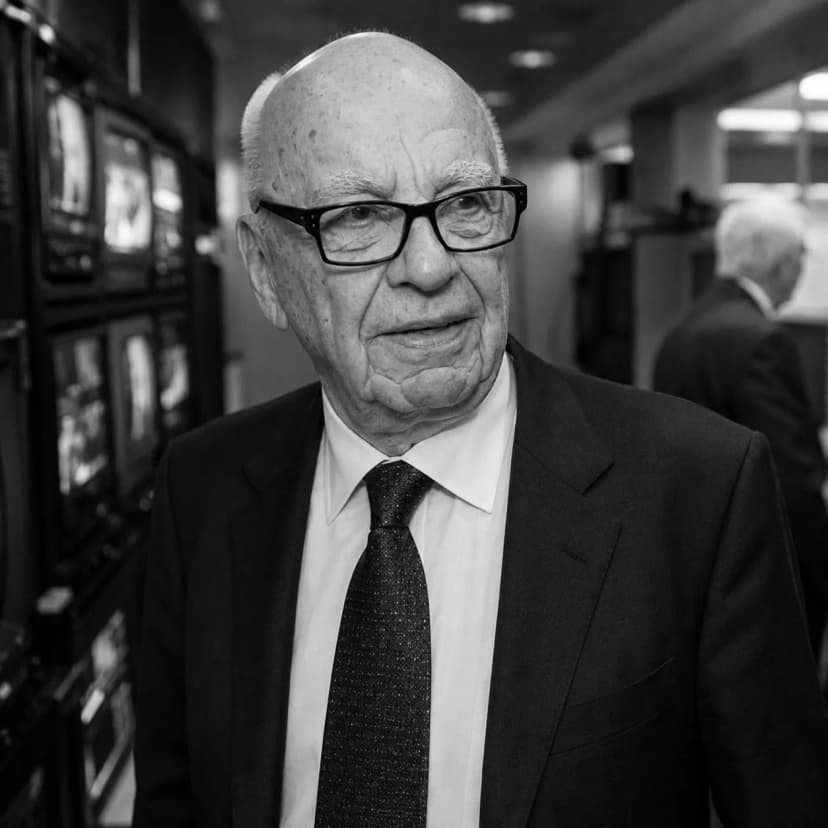
Rupert Murdoch is an Australian-born media proprietor, born in 1931, who with Barry Diller built Fox into a fourth American television network in the 1980s. Fox is the reason narrowcasting stopped being a cable-only idea. It took the strategy that MTV, BET and Bravo had proved on niche channels, deliberately serving the audiences the three incumbent networks had left alone, and ran it at broadcast scale against ABC, CBS and NBC. This page covers that launch and the media history the article cites. It takes no position on any other part of his career.
Who they are
Murdoch built his media holdings outward from Australian newspapers into British and then American publishing and broadcasting. The relevant sequence here is short. In 1985 his company acquired the Metromedia group of independent American television stations, which supplied the owned-and-operated backbone a network needs. In May 1986 the plan for a Fox Broadcasting Company was announced, with Diller as its chairman, and Fox went on air on 9 October 1986 with a late-night talk show hosted by Joan Rivers. At launch it reached roughly 80 per cent of American households through a lineup of around 96 stations, most of them existing independents.
The strategic content is what matters for this site. A fourth network in 1986 could not win by competing for the same undifferentiated national audience the incumbents had spent thirty years assembling. Fox instead went after the segments the big three had underserved, younger viewers in particular, and programmed to them rather than to a general household. Tim Wu places the launch alongside MTV, BET, Bravo and the Playboy Channel as part of the same movement: the deliberate replacement of the mass audience with a set of separately addressed slices (pp. 175-176). The intellectual equipment for that had already been built by Jonathan Robbin, whose clustering made an audience describable as types rather than as a nation.
Fox is therefore the commercial proof of the fragmentation thesis, which in this publication's argument is the strongest case against our own conclusion. If the mass audience really was replaced by segments, and a network could be built by refusing to chase everyone, then the free simultaneous audience of the Paley era was not a permanent feature of media but a phase. We accept that half. What we contest is the further step, that the underlying appetite for simultaneous attention went away with the free version of it. Fox proved the free mass audience was breakable. It did not prove that people stopped wanting to be in the same room.
Key works
Murdoch is a proprietor rather than an author or a researcher. What is cited here is a set of business decisions in television, and the account of them is external.
Acquisition of the Metromedia independent television stations, 1985. The station group Fox was assembled on.
Fox Broadcasting Company, announced May 1986, on air from 9 October 1986, with Barry Diller as chairman. Around 96 stations at launch, reaching roughly 80 per cent of American households.
The historical treatment this site relies on:
Wu, T. (2016), The Attention Merchants, Knopf, pp. 175-176.
Key papers
Murdoch is a media proprietor rather than an author or a researcher, and there are no books or papers by him for this page to list. Saying so is more honest than padding the section.
He is on this site for one episode, the Fox launch, and the record for it is external:
Wu, T. (2016), The Attention Merchants: The Epic Scramble to Get Inside Our Heads, Knopf, pp. 175-176. MTV, BET, Bravo and Fox, and the Murdoch and Diller launch.
Fox Broadcasting Company, reference entries. The Metromedia acquisition in 1985, the May 1986 announcement, the 9 October 1986 launch with Barry Diller as chairman, and the station count and household reach at launch.
Fox Corporation official biography page, for his roles and dates.
Key ideas
Narrowcasting works at broadcast scale, not only on cable. Fox is the proof, and it is the strongest evidence for the fragmentation account of television.
A new entrant does not beat incumbents by competing for the same general audience. It wins the audiences the incumbents have not bothered to serve.
The free mass audience was a commercial arrangement rather than a permanent fact, and it was dismantled deliberately by people who could see the arithmetic.
That dismantling is evidence about the supply of mass attention, not about the demand for it, and this site's argument turns on the difference.
Concepts on this site
Find them elsewhere
Official corporate biography page. No social account could be confirmed as genuinely his
Checked 2026-09-10. Handles and affiliations go out of date, so treat this block as a snapshot rather than a standing fact.
Sources
- Wu, T. (2016), The Attention Merchants: The Epic Scramble to Get Inside Our Heads, Knopf. MTV, BET, Bravo and Fox, and the Murdoch and Diller launch, pp. 175-176.
- Fox Broadcasting Company, reference entries. Metromedia acquisition in 1985, the May 1986 announcement, the 9 October 1986 launch, and the station count and household reach at launch.