William Paley
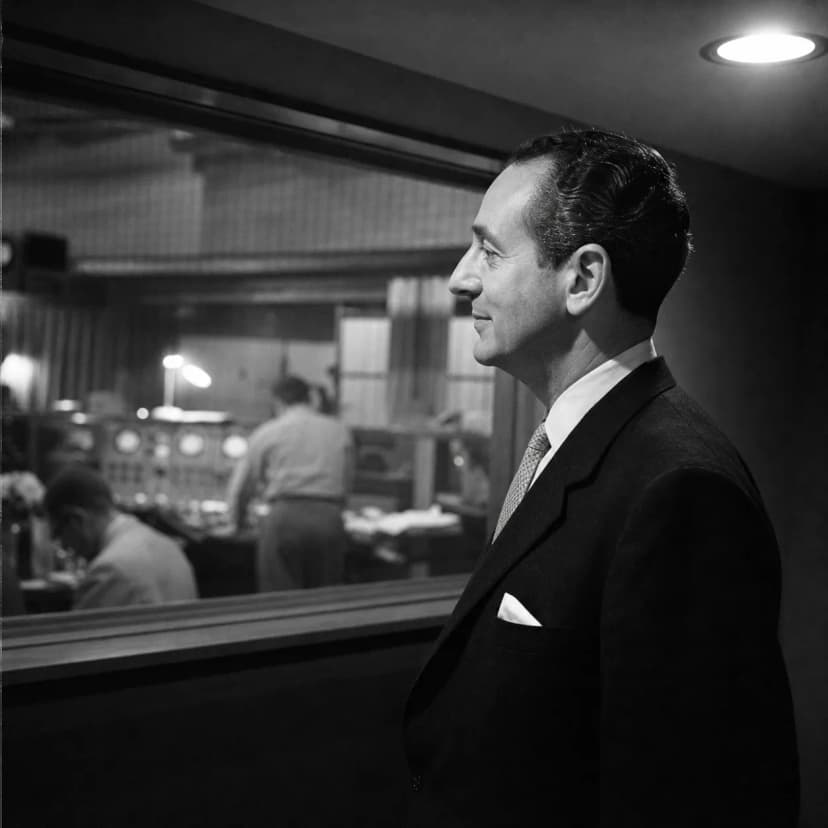
William Paley bought a failing radio chain in 1928 and turned it into CBS, which held the American ratings lead from 1955 to 1976. He matters to the psychology of attention because of what he understood earlier and more clearly than his competitors: the programmes were not the product. The audience was. Everything CBS did under him, the scheduling, the serials, the prestige broadcasts, the news division, was in service of gathering attention into predictable blocks that could be measured, sold and priced. Prime time as a commercial instrument is largely his construction.
Who they are
William S. Paley, 1901 to 1990, bought control of the struggling United Independent Broadcasters network in 1928, when he was still in his twenties, and renamed the business around the Columbia Broadcasting System. He ran it for the next half-century. Tim Wu's account has CBS holding the ratings lead from 1955 to 1976, an unbroken run of dominance that no competitor matched (pp. 128-141).
The contrast that explains him is with David Sarnoff at NBC. Sarnoff came from the hardware side and treated broadcasting substantially as a way of selling radio sets, the network as a pipe that justified the equipment (p. 99). Paley started from the opposite end. He grasped that what the company actually manufactured was assembled human attention, and that the buyer was the advertiser. Once that is the premise, everything follows: schedule for habit, build serials that oblige people to come back tomorrow, measure the result, sell the result. This is the commercial logic that Irna Phillips had already proved could be extended into daytime, and it is what made the evening hours worth the name prime time.
The prestige programming is the part worth reading closely, because it is easy to mistake for a competing value. CBS carried unsponsored New York Philharmonic broadcasts, the experimental Columbia Workshop, and a serious news division. The reputation that earned, the Tiffany Network, bought the company cover against the charge that commercial broadcasting was a race to the bottom, while the commercial machine underneath ran harder than anyone else's. Prestige was an asset in the same ledger as the ratings, not a check on them. Wu's verdict on the ending is the one worth keeping: Paley built the system, and in the end the system swallowed him (p. 141). The same machine that made him rich is the one that eventually had no room in it for Edward R. Murrow.
For this site, Paley is the point at which mass simultaneous attention stops being a by-product of broadcasting and becomes an inventory. He did not discover the psychology. He discovered that the psychology could be scheduled.
Key works
Paley was a broadcaster, not a writer or a researcher, and he published no scholarly work. His own account of his career exists in a single memoir, which should be read as a company founder's version of events rather than as a disinterested history.
Paley, W. S. (1979), As It Happened: A Memoir, Doubleday. His account of buying and building CBS, including the early years and his wartime work with Edward R. Murrow.
The historical treatment this site relies on is external:
Wu, T. (2016), The Attention Merchants, Knopf. Paley, Sarnoff and CBS's ratings dominance, pp. 128-141.
Key papers
Paley was a broadcasting executive rather than an author or a researcher, and he published one book, a memoir. The historical treatment this site relies on is somebody else's.
Paley, W. S. (1979), As It Happened: A Memoir, Doubleday. His own account of buying and building CBS, including the early years and his wartime work with Edward R. Murrow. A memoir is a participant's account and is read here as one.
Wu, T. (2016), The Attention Merchants: The Epic Scramble to Get Inside Our Heads, Knopf. Sarnoff and the hardware model, p. 99; Paley and CBS ratings dominance from 1955 to 1976, pp. 128-141; Wu's closing verdict on him, p. 141.
Dates and biographical detail are taken from the Simon & Schuster publisher page, an EBSCO research entry for William S. Paley, and the history page of the Paley Center for Media, the institution he founded.
Key ideas
The product of a broadcast network is the audience, not the programme. Paley understood this from the start, and organised a company around it.
Prime time became an inventory rather than a description of the evening: a block of attention that could be measured, guaranteed to advertisers and priced.
Prestige programming, unsponsored concerts and serious news, worked as protective cover for the commercial operation rather than as a limit on it.
His run of CBS ratings dominance, 1955 to 1976, is the high-water mark of the free, advertising-funded mass audience in the United States.
Concepts on this site
Find them elsewhere
Lifespan: 1901 to 1990. No social accounts, and none are claimed on their behalf.
Deceased, so no social accounts. Reference is the history page of the Paley Center for Media, the institution he founded, which records his death in 1990 aged eighty-nine
Checked 2026-09-10. Handles and affiliations go out of date, so treat this block as a snapshot rather than a standing fact.
Sources
- Wu, T. (2016), The Attention Merchants: The Epic Scramble to Get Inside Our Heads, Knopf. Sarnoff and the hardware model, p. 99; Paley and CBS ratings dominance 1955-1976, pp. 128-141; Wu's closing verdict, p. 141.
- Paley, W. S. (1979), As It Happened: A Memoir, Doubleday.
- Simon & Schuster publisher page and EBSCO research entry for William S. Paley. Dates and biographical detail.