The Candle Never Changes
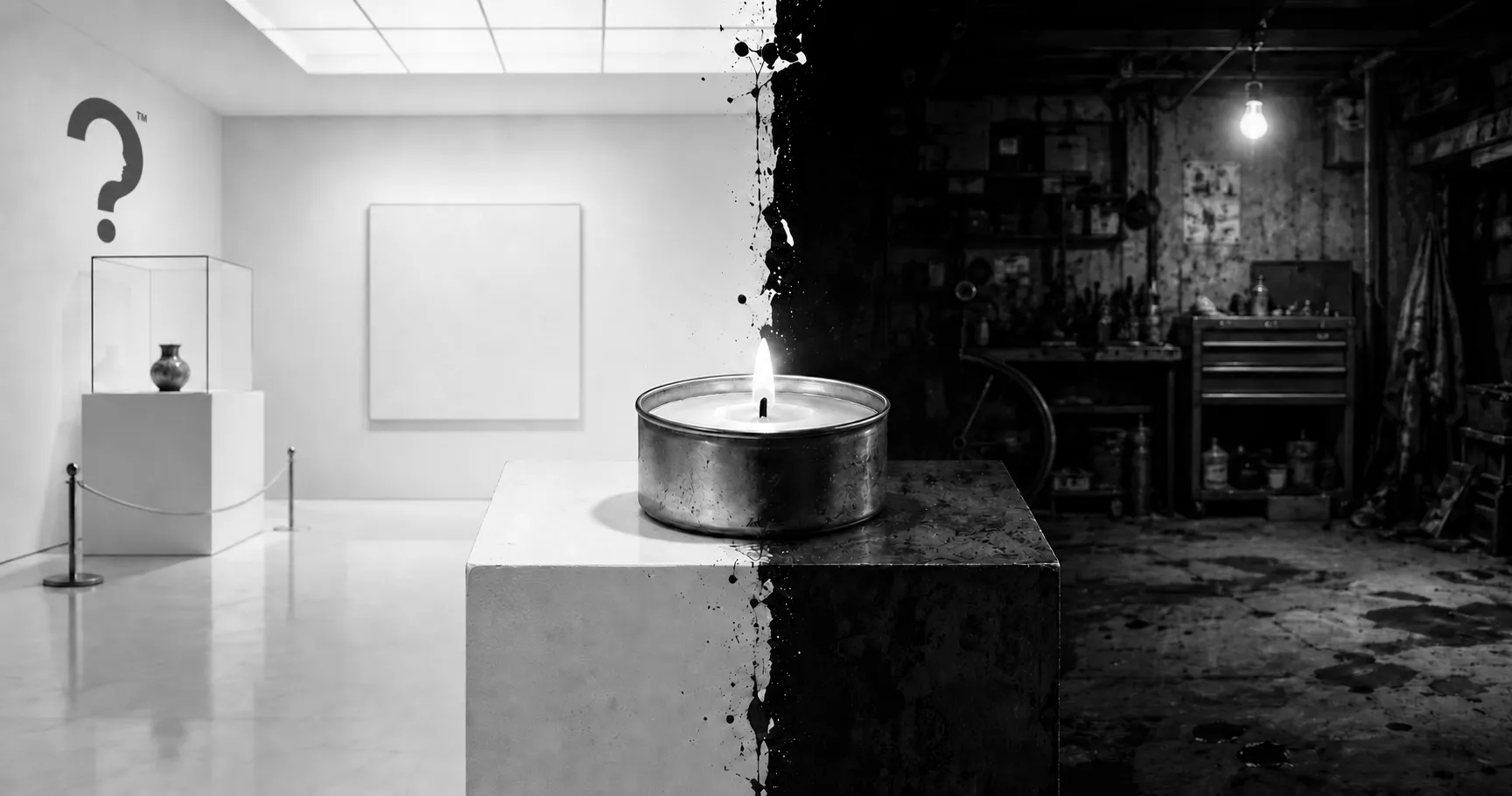
Why the room decides what counts as art
Key takeaways
- We compute value relationally, against a backdrop, a price and an expectation, rather than reading it off the object the way we read its mass.
- Marcel Duchamp's Fountain was mass-produced plumbing until a plinth and a title reframed it. Brian O'Doherty later named the gallery a machine for conferring status that hides the fact it is a machine.
- In Hilke Plassmann and Antonio Rangel's 2008 fMRI study, the same wine labelled $90 rather than $10 produced both higher reported pleasantness and stronger medial orbitofrontal activity.
- A Bordeaux team dyed a white wine red with odourless colouring and fifty-four oenology students described it in red-wine vocabulary. The colour overrode the nose.
- Most makers over-invest in the object and starve the context that determines how it lands. Virgil Abloh inverted that ratio on purpose.
Virgil Abloh liked to make his point with a candle. Not a designer object, a cheap one, the kind that comes in a tin. Put in an all-white gallery, he said, it looks like a piece of art. Put in a garage, it looks like rubbish. Then came the point that mattered more: he could spend his time designing the candle, or he could spend it designing the room the candle sits in.
It sounds like a throwaway remark from a designer who trafficked in aphorisms. It is also experimentally true.
What Abloh is not saying
He is not saying the candle secretly improves in the gallery. The wax is identical. The wick is identical. Nothing about the object changes as it crosses the threshold from garage to white room. What changes is everything around it. The gallery is not a neutral container that lets us see the candle clearly. It is an argument, and we lose it before we walk in.
Artists worked this out a long time before designers did. In 1917 Marcel Duchamp bought a mass-produced urinal, signed it “R. Mutt,” titled it Fountain, and submitted it to an exhibition. It was plumbing. Placed on a plinth and framed as a proposition, it became one of the most influential artworks of the twentieth century. The urinal never changed. The room did. Half a century later the critic Brian O’Doherty named the mechanism in his essays Inside the White Cube: the modern gallery’s blank walls and controlled light are a ritual space engineered to strip an object of its ordinary life and re-present it as Art. The white cube is a machine for conferring status, and it hides the fact that it is a machine.
The wine that tasted like its price tag
We perceive value relationally, against a backdrop, a price, a frame, an expectation, rather than as a fixed property of objects the way we perceive their mass. So the candle line is not a trick played on gullible gallery-goers. Change the context and you have not fooled the judgment, you have changed the input the judgment runs on.
The cleanest evidence comes from a wine glass. In 2008 a team led by Hilke Plassmann and Antonio Rangel put people in an fMRI scanner and gave them wine to taste, telling them the price of each pour. Some wines were served twice, once labelled cheap and once labelled expensive. When subjects believed they were drinking the $90 bottle rather than the $10 one, they reported it as more pleasant, and their medial orbitofrontal cortex, a region that encodes experienced pleasantness, lit up more strongly. It was the same wine. The price tag changed the neural signature of the pleasure itself.
A Bordeaux team led by Gil Morrot, with Frédéric Brochet, had shown the flip side seven years earlier with a blunter stunt. They dyed a white wine red using an odourless colouring and gave it to fifty-four oenology students, who then described it in the vocabulary of red wine: jammy, crushed red fruit. The liquid told them nothing they trusted. The colour told them everything. We taste the story, then attribute it to the substance.
Designing the room instead
Abloh’s bet was that most makers over-invest in the candle. They pour effort into the object, a slightly better formula, one more feature, a marginally nicer finish, and starve the context that determines how the object is received. Abloh came out of architecture and inverted the ratio. Off-White and his work at Louis Vuitton were exercises in room-design: the quotation marks, the industrial tags, the drop culture, the mythology. The products were often deliberately simple. The room around them was extravagant.
Rory Sutherland has spent a career on the same point from the marketing side. Context does not decorate the product, he argues, it is part of the product. The right room can make a plain object feel significant, and the wrong room can do the reverse to something genuinely good. A watch sold in a velvet-lined boutique and the identical movement sold in a blister pack are, functionally, different products. The blister pack is a garage.
Where the argument goes wrong
Duchamp’s urinal only works because someone still had to choose the frame, the title, the timing, the gallery. The room was the craft. Quality and context are not separable ledgers, and pretending otherwise is how good work goes unseen and mediocre work gets crowned. You are always, whether you admit it or not, allocating between the candle and the room. Most of us default to the candle because it feels honest, like real work, while designing the room feels like manipulation.
Abloh’s provocation is to notice that the room was never optional. Every object you have ever judged arrived inside one. The only question is whether someone designed it on purpose, or left you standing in the garage, looking at trash that might have been art.
Sources
Plassmann, H., O’Doherty, J., Shiv, B., & Rangel, A. (2008). “Marketing actions can modulate neural representations of experienced pleasantness.” PNAS, 105(3), 1050–1054.
Morrot, G., Brochet, F., & Dubourdieu, D. (2001). “The Color of Odors.” Brain and Language, 79(2), 309–320.
O’Doherty, B. Inside the White Cube: The Ideology of the Gallery Space (1976 / 1986).