Why Sharing a Meal Builds Trust
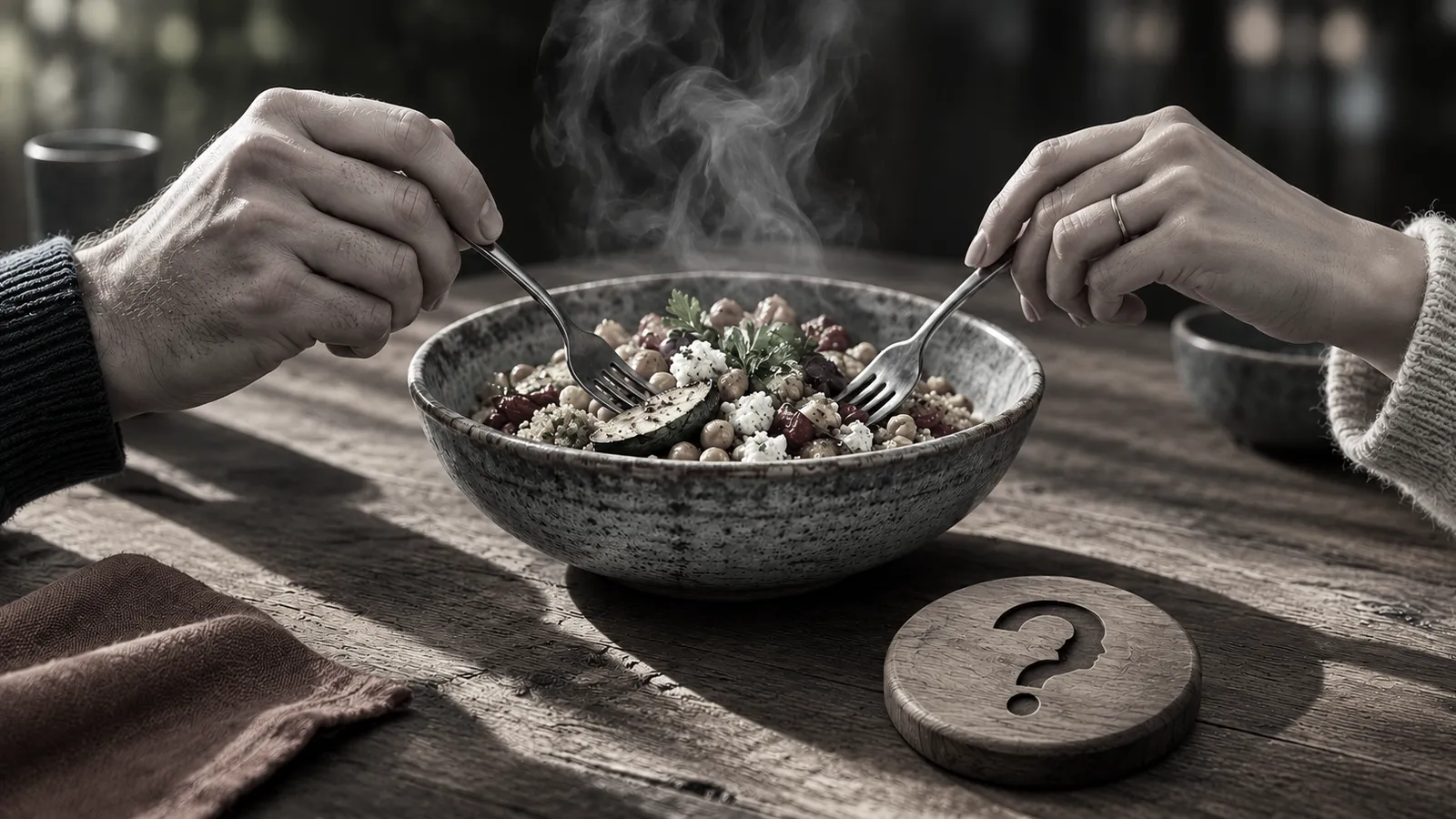
Surveys link shared meals with more trust, and experiments show strangers cooperating more over one bowl. The studies also show what eating together cannot prove alone.
Does eating together build trust?
Eating together goes with more trust in others in survey data, and strangers who shared one bowl cooperated more in experiments than strangers with separate portions. The survey evidence is correlational and the experiments measured cooperation, so eating together looks like a helpful condition for trust, not a guarantee.
Key takeaways
- In a national survey of 2,000 adults, people who ate with others more often reported more trust in others and more people to rely on (Dunbar, 2017).
- Strangers who shared one bowl or bag of food settled a wage negotiation in fewer strike days and cooperated in more rounds of a pricing game than strangers with separate portions (Woolley and Fishbach, 2019).
- Shared-plate pairs reported more coordination while eating, and the effect was similar for friends and strangers (Woolley and Fishbach, 2019).
- Viewers read food sharing as a sign of a friendly relationship and feeding as a sign of a closer one (Miller, Rozin and Fiske, 1998).
- A field study of firehouses found a positive association between sharing meals and work-group performance (Kniffin and colleagues, 2015).
Two strangers sit down to bargain over a wage, every day of strike costs them both, and the only difference between pairs is how they were fed. In a study with 200 participants, pairs who shared a single bowl of snacks settled after about 9 days of strike on average, against about 13 for pairs with separate portions. Eating together is a familiar sign of friendship, yet it is not clear that it does anything beyond showing that a friendship already exists.
One shared bowl and two bargaining strangers
Kaitlin Woolley and Ayelet Fishbach ran that wage game as the first of a set of experiments, with pairs eating either from one bowl or from separate portions before they bargained. In a second, strangers ate crackers either from one shared bag or from separate bags and then played 20 rounds of a pricing dilemma. Pairs who shared a bag cooperated in about 63 per cent of rounds, against about 43 per cent for pairs with separate bags. A third study recruited 240 participants, some friends and some strangers, and again found fewer strike days with a shared plate, about 6 against about 10, with a similar effect for friends and strangers.
The route ran through coordination. Shared eating raised perceived coordination during the meal, which carried into the negotiation, and video coding backed this up: shared-plate pairs ate at the same moment for about 92 per cent of the meal, against about 82 per cent for pairs with separate portions.
The shared bag did not significantly raise self-reported closeness to the partner, so what eating together changed was how in step the pair felt, more than how warm. The measure throughout was cooperation, not trust as such, and the samples were mostly students eating small snacks in controlled tasks. The authors also named conditions where the effect may weaken: a buffet with plenty of food, or one shared slice of cake, may need little coordination, and very small portions may bring competition to the surface.
Regular shared meals and trust in a national survey
A national survey of 2,000 adults in the United Kingdom, analysed by Robin Dunbar, found that people who ate with others more often also reported more trust in others, more engagement with their local community and more friends or relatives they could count on. The sample came from an online panel in April 2016, balanced for region, age and gender. The number of people in a respondent's support network was the social measure most closely tied to how often that person ate socially, and evening meals that left people feeling closer to their companions tended to involve more diners, more laughter and more reminiscing.
Chocolate eating, which Dunbar used as a control, showed no such pattern.
A path analysis on the regression results suggested that eating together leads to stronger bonds more than the reverse, although the link between shared meals and network size ran in both directions. Dunbar proposed that sharing food may be an evolved way of building social bonds.
The survey is correlational and rests on self-reports and on recall of the most recent meal, so it cannot say which comes first for any one person, and he called for experiments, which the bowl and bag studies supplied. Belonging is a need people act on, as Why Do We Need to Belong sets out, and a regular meal is a cheap, repeatable occasion for acting on it. What company does to the way people eat is a separate question, taken up in Social Eating and the Cue to Stop.
What shared food signals about closeness, teams and culture
Onlookers take shared food as a message about the people eating together. Lisa Miller, Paul Rozin and Alan Page Fiske classified food transfers into sharing, feeding and food that the giver had already touched or tasted. In two studies with American college students, one asking what students did and thought normal, the other asking viewers to rate a videotaped pair eating at a restaurant, sharing suggested a positive, friendly relationship. Feeding suggested a stronger one, often romantic, and food the giver had already tasted added a modest rise in perceived closeness.
That message reaches into working life. Field research in firehouses in a large city, carried out by Kevin Kniffin and colleagues with qualitative and quantitative methods, found a significant positive association between sharing meals and work-group performance. The authors argued that everyday eating can serve team performance without asking staff for extra effort away from the worksite, and the setting was the working firehouse itself, not a laboratory.
| Situation | What was compared | Result |
|---|---|---|
| Strangers bargaining over a wage | One shared bowl or separate portions | Fewer strike days with the shared bowl |
| Strangers in a 20-round pricing game | One shared bag or separate bags | More cooperative rounds with the shared bag |
| Viewers watching a pair at a restaurant | No sharing, sharing or feeding | Sharing read as friendly, feeding as closer |
| Crews in firehouses | Meals eaten together | Positive link with work-group performance |
| Adults across a national survey | How often they ate with others | More trust in others and more people to rely on |
Woolley and Fishbach also surveyed about 100 people alongside their experiments. Respondents expected strangers who shared a bowl to cooperate more, yet about 73 per cent said they would still prefer to eat from separate plates themselves.
What counts as shared also depends on the food culture, a point Bee Wilson makes in Consider the Fork. Tools at the table carry manners, and in Japanese dining fresh disposable chopsticks are handed to each diner because an item that has touched a person's mouth is felt to be that person's own. A shared bowl works where a shared utensil would not. Rituals around meals add a shared script, a point that Do rituals make food taste better raises from the flavour side.
Common questions
Does eating together build trust?
Surveys link eating together with more trust in others and more people to rely on, and experiments find that strangers who share one bowl cooperate more. The survey evidence is correlational, and the experiments measured cooperation, so eating together looks like a helpful condition for trust, not a guarantee of it.
Why does sharing food change how people cooperate?
Woolley and Fishbach traced the effect to coordination. Pairs eating together from one plate reported more coordination while eating, ate at the same moments for more of the meal, and then negotiated with fewer strike days. The effect was similar for friends and strangers.
Do work meals improve team performance?
Field research in firehouses in a large city, using qualitative and quantitative methods, found a significant positive association between sharing meals and work-group performance. It is an association and not a measured cause, and the authors argued that everyday eating can support team performance without extra effort away from the worksite.
Does sharing food signal a close relationship?
In two studies with American college students, one asking about their own habits and one asking viewers to rate a videotaped pair, sharing food suggested a friendly relationship, feeding suggested a closer and often romantic one, and food the giver had already tasted added a modest rise in perceived closeness.
Sources
Wilson, B. Consider the Fork. Seed book.
Dunbar, R. I. M. (2017). Breaking bread: The functions of social eating. Adaptive Human Behavior and Physiology, 3(3), 198-211. doi:10.1007/s40750-017-0061-4 https://doi.org/10.1007/s40750-017-0061-4
Woolley, K., & Fishbach, A. (2019). Shared plates, shared minds: Consuming from a shared plate promotes cooperation. Psychological Science, 30(4), 541-552. doi:10.1177/0956797619830633 https://doi.org/10.1177/0956797619830633
Kniffin, K. M., Wansink, B., Devine, C. M., & Sobal, J. (2015). Eating together at the firehouse: How workplace commensality relates to the performance of firefighters. Human Performance, 28(4), 281-306. doi:10.1080/08959285.2015.1021049 https://doi.org/10.1080/08959285.2015.1021049
Miller, L., Rozin, P., & Fiske, A. P. (1998). Food sharing and feeding another person suggest intimacy; two studies of American college students. European Journal of Social Psychology, 28(3), 423-436. doi:10.1002/(SICI)1099-0992(199805/06)28:3<423::AID-EJSP874>3.0.CO;2-V https://doi.org/10.1002/(SICI)1099-0992(199805/06)28:3<423::AID-EJSP874>3.0.CO;2-V
People
More articles
- Why We Give Chatbots a Name
A name, plain wording and a voice are small signals, and the research shows how readily they start social habits. The effect depends on the person, the cues and how the agent is introduced.
- Why Rolling the Dice Yourself Feels Luckier
A die lands the same way whoever throws it, yet people prefer to throw it themselves. The research on the illusion of control shows how acting and planning raise the sense of influence, and what…
- Why Giving Money Away Feels Better Than Spending It
People predict that a windfall spent on themselves would please them most. Studies of prosocial spending find the reverse in many settings, and the largest replications show where the effect weakens.
- Why We Order the Same Lunch Every Day
A lunch plan made on Sunday and a lunch ordered on Thursday are different choices. Studies of variety-seeking behaviour show how timing, audience and memory pull between variety and routine.