Why a Round Price Feels Premium
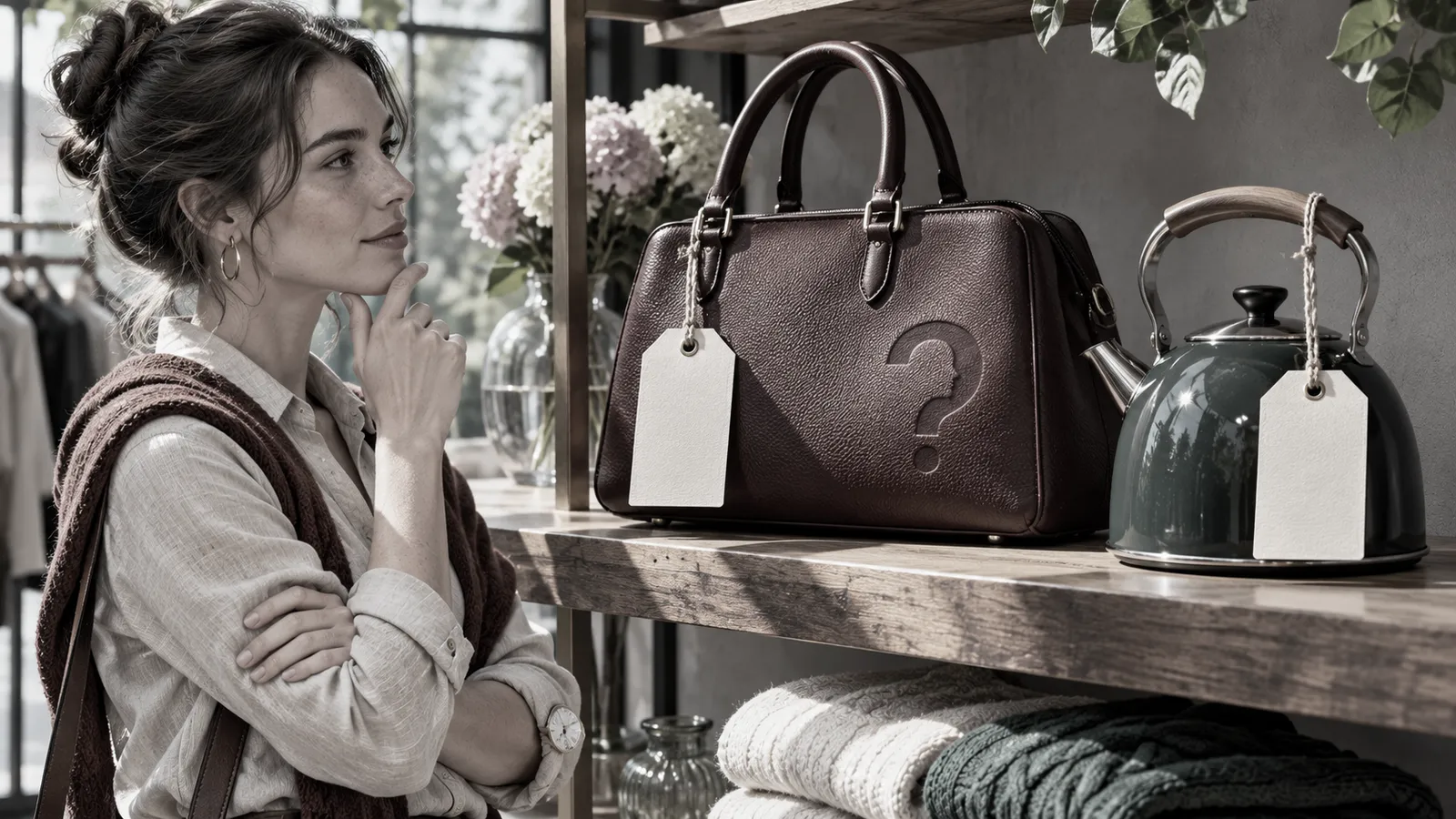
A round figure on a high price reads differently from an untidy one. Studies tie round prices to feeling-led buying and to higher-priced goods, and a replication attempt keeps part of the case open.
What is prestige pricing?
Prestige pricing is the practice of setting a high price, often at a round figure, so the price signals quality and status. Studies find round prices more often on higher-priced goods and a fit between round figures and buying by feeling, though a replication attempt did not reproduce that fit, and luxury price endings carry different meanings by sector.
Key takeaways
- Across five studies, round prices fit purchases decided by feeling and untidy prices fit purchases decided by thought, and a sense of feeling right carried the effect (Wadhwa and Zhang, 2015).
- In a model where price signals quality, firms charging high prices were more likely to set round prices, and higher-quality products tended to carry them, most where quality is hard to judge before buying (Stiving, 2000).
- Prices ending in 99p were 9 per cent more likely to be seen as good value than prices a penny or two higher in a test with 650 respondents reported by Richard Shotton in The Choice Factory.
- On luxury handbags and in a second experiment, price endings carried meanings specific to a luxury sector and differing across consumer segments (Fraccaro and Macé, 2020).
- A replication attempt with 588 participants did not find the fit effect or its mediation through feeling right (Harms and colleagues, 2018).
Walk through a department store and a pattern shows up in the price tags: the dearest goods carry tidy figures, and the everyday ones carry endings that look calculated. Prestige pricing, the habit of letting a tidy figure carry status, has drawn two lines of research. One studies buyers, who process a round figure with ease and lean on feeling when they meet one. The other studies sellers, who set round figures more often on higher-priced goods, most of all in categories where quality is hard to judge before buying.
Round figures are read with feeling, not arithmetic
Monica Wadhwa and Kuangjie Zhang proposed in the Journal of Consumer Research that a round price is processed fluently, and that this ease nudges people toward judging a product by how they feel about it. A price made of untidy digits takes more effort to read and nudges people toward working things out. The account rests on processing fluency, the ease with which something is read or parsed, which people tend to treat as a sign about the thing itself and not about the reading.
The key step is fit. When the form of the price matches the way the buyer is deciding, a sense that the number feels right follows. A round figure feels right when the purchase is driven by feeling, and an untidy figure feels right when it is driven by thought. Across five studies, that fit shaped product evaluations, making positive reactions to a product more positive and negative reactions more negative, and the sense of feeling right carried the effect statistically. The authors call the pattern the rounded price effect.
It is a claim about the buyer's state of mind at the moment of reading, which is why the studies measured feelings of rightness and not only choices, and why the same number can be easy to read for one buyer and effortful for another.
Priming people with round numbers in an unrelated task produced the same pattern, which points to the ease of the number rather than anything about the product. Applied to a leather handbag and a small kettle, the account predicts that a bag bought for how it feels meets a buyer deciding by feeling, so a round tag fits, and that a kettle bought for what it does meets a buyer deciding by comparison, so an untidy tag fits.
Prestige pricing favours round numbers on dearer goods
The seller's side comes from Mark Stiving, who built a model in Management Science in 2000 in which price signals quality and asked what that does to the digits on the tag. In his model, firms charging high prices were more likely to set round ones, which is the seller's logic behind prestige pricing, and he noted that price endings are not necessarily quality signals in themselves.
He also reported empirical evidence that higher-quality products tend to carry round prices, with the pattern stronger in categories where buyers struggle to judge quality before they buy. Where the price is most of what a buyer has to go on, the form of the price becomes part of the message. His findings held in a simulation that allowed demand to spike at prices ending in nine, and his model is the seller-side counterpart of the price-quality heuristic, the buyer's rule that a dearer product is a better one.
Shops use more than one price form
Shop practice is more varied than a single rule suggests. Richard Shotton reports in The Choice Factory that 650 tracked supermarket prices were three times more likely to end in zero than in nine, which puts round figures on everyday shelves as well as in luxury windows.
A separate test he reports, with 650 respondents across six products, found prices ending in 99p 9 per cent more likely to be seen as good value than prices a penny or two higher. He adds that the survey probably understates the effect in real shops, because real shoppers are rushed. A nine ending speaks to value, and Why do prices ending in 99 work shows the left digit doing that work, while prestige pricing speaks to quality through round figures, which is how one shop can use both.
A tag can take one of three forms, and each has drawn its own reading in the studies above:
- A round figure such as 1,200: processed fluently and suited to buying by feeling (Wadhwa and Zhang), and more often found on higher-priced, higher-quality goods (Stiving).
- A figure just under a round one such as 1,199: suited to judgements of value, since nine endings were more often seen as good value (Shotton).
- An untidy figure such as 1,187.40: processed with more effort and suited to buying by thought (Wadhwa and Zhang).
Luxury price endings carry meanings that vary
Odd pricing, which sets a price just below a round number, is common in shops, yet luxury goods usually carry round prices, in keeping with the markdown-free habits discussed in Why Luxury Brands Hold Their Prices, and that makes the odd ending look like a paradox for them. Annalisa Fraccaro and Sandrine Macé put it to the test in Recherche et Applications en Marketing. A first experiment on luxury handbags tested three kinds of price ending and their effect on how luxurious a brand looked, with quality, prestige, uniqueness and expensiveness proposed as the links between the ending and the overall image.
A second experiment found that price endings carry meanings specific to a luxury sector and that these meanings differ across consumer segments.
That second result matters most for anyone reading a tag, because it means prestige pricing is not a single signal with a single meaning. The same ending can be read differently in different sectors and by different kinds of buyer, and the authors close with advice to match price endings to the target segment. A figure that signals craft in one sector can signal inflated pricing in another, so a seller who borrows the ending from a neighbouring sector borrows its meaning only if the buyers are the same.
Luxury sellers that avoid markdowns have few signals left in the price itself apart from its level and its form. That gives the form more weight in prestige pricing than it carries on an everyday item, where promotions and nine endings crowd the shelf edge.
A replication attempt leaves the effect open
The fit effect did not reappear when Christopher Harms, Hanna Genau, Carolin Meschede and André Beauducel tested it again with 588 participants, using the original product and one alternative product. They found neither the interaction between price, roundedness and decision context nor the mediation through the sense of feeling right. The authors read the result as pointing to an effect that is either smaller than first reported or dependent on factors not yet tested, and they call for larger samples to look at those factors.
The evidence for prestige pricing therefore sits in two grades. The sorting of round figures toward higher-priced goods rests on Stiving's model and the empirical evidence he reports, while the claim that a round figure makes a product feel right has a mixed record. The two answer different questions, since Stiving asks which prices firms choose and Wadhwa and Zhang ask how buyers respond to them. Precision is a separate matter again: how far a buyer moves from a precise or round asking price, the subject of The Price That Isn't Round, concerns negotiation rather than what a tag says about quality.
The two bodies of evidence also differ in kind. What sellers print on tags can be counted from shelves and catalogues, which is why the seller-side pattern could be checked category by category, while the buyer's sense of rightness lives in a rating scale and has to be inferred from it. The sector and segment split found in the luxury experiments is the point on which the evidence is clearest, and it suggests that the next useful counts are of the same tags in different sectors and among different kinds of buyer, since the meaning of an ending depends on who is reading it and where.
Common questions
What is prestige pricing?
Prestige pricing is the practice of setting a high price, often at a round figure, so that the price itself signals quality and status. Research finds that higher-priced and higher-quality products are more often given round prices, and one set of studies found that round figures fit purchases decided by feeling, though a replication attempt did not reproduce that fit.
Does a round price make a product look more premium?
Prestige pricing does not run on the digits alone. The studies here do not show that a round figure alone makes a product look better. One set of studies found that round prices fit decisions driven by feeling, and a paper on luxury handbags found that price endings carry different meanings across luxury sectors and consumer segments, so the effect depends on the sector and the buyer.
Why do shops still use prices ending in 99?
Nine endings speak to value rather than prestige. In a test reported by Richard Shotton, prices ending in 99p were 9 per cent more likely to be seen as good value than prices a penny or two higher. Round figures and nine endings do different jobs, which is why both appear on shop floors.
Sources
Shotton, R. The Choice Factory. Seed book.
Wadhwa, M., & Zhang, K. (2015). This number just feels right: The impact of roundedness of price numbers on product evaluations. Journal of Consumer Research, 41(5), 1172-1185. doi:10.1086/678484 https://doi.org/10.1086/678484
Stiving, M. (2000). Price-endings when prices signal quality. Management Science, 46(12), 1617-1629. doi:10.1287/mnsc.46.12.1617.12078 https://doi.org/10.1287/mnsc.46.12.1617.12078
Fraccaro, A., & Macé, S. (2020). Never too rich to care about prices: Effects of price endings on customer perceptions of luxury. Recherche et Applications en Marketing (English Edition), 35(3), 7-28. doi:10.1177/2051570720908036 https://doi.org/10.1177/2051570720908036
Harms, C., Genau, H. A., Meschede, C., & Beauducel, A. (2018). Does it actually feel right? A replication attempt of the rounded price effect. Royal Society Open Science, 5(4), 171127. doi:10.1098/rsos.171127 https://doi.org/10.1098/rsos.171127
Related concepts
People
More articles
- Why Cute Things Make Us Reach for Our Wallet
Large heads, large eyes and rounded cheeks make faces look cute and draw care. In product research the same proportions slowed hands, narrowed attention and, when playful, shifted choices towards…
- Why Doing Someone a Favour Makes Us Like Them
A person who does a small favour often comes to like the one helped. The research on how people explain their own behaviour shows where in the chain that change happens.
- Why Closing the Menu Makes Us Happier
A lid on a tray, a closed menu, a turned page: small physical acts that tell the mind a choice is over. Studies of choice closure and of reversible decisions show what that sense of an ending does…
- Why Elite Status Keeps Us Loyal
A status tier is a position, not a balance. The research on tiers finds a reward in visible standing and a recurring effort in holding it.