Why Their Gain Feels Like Our Loss
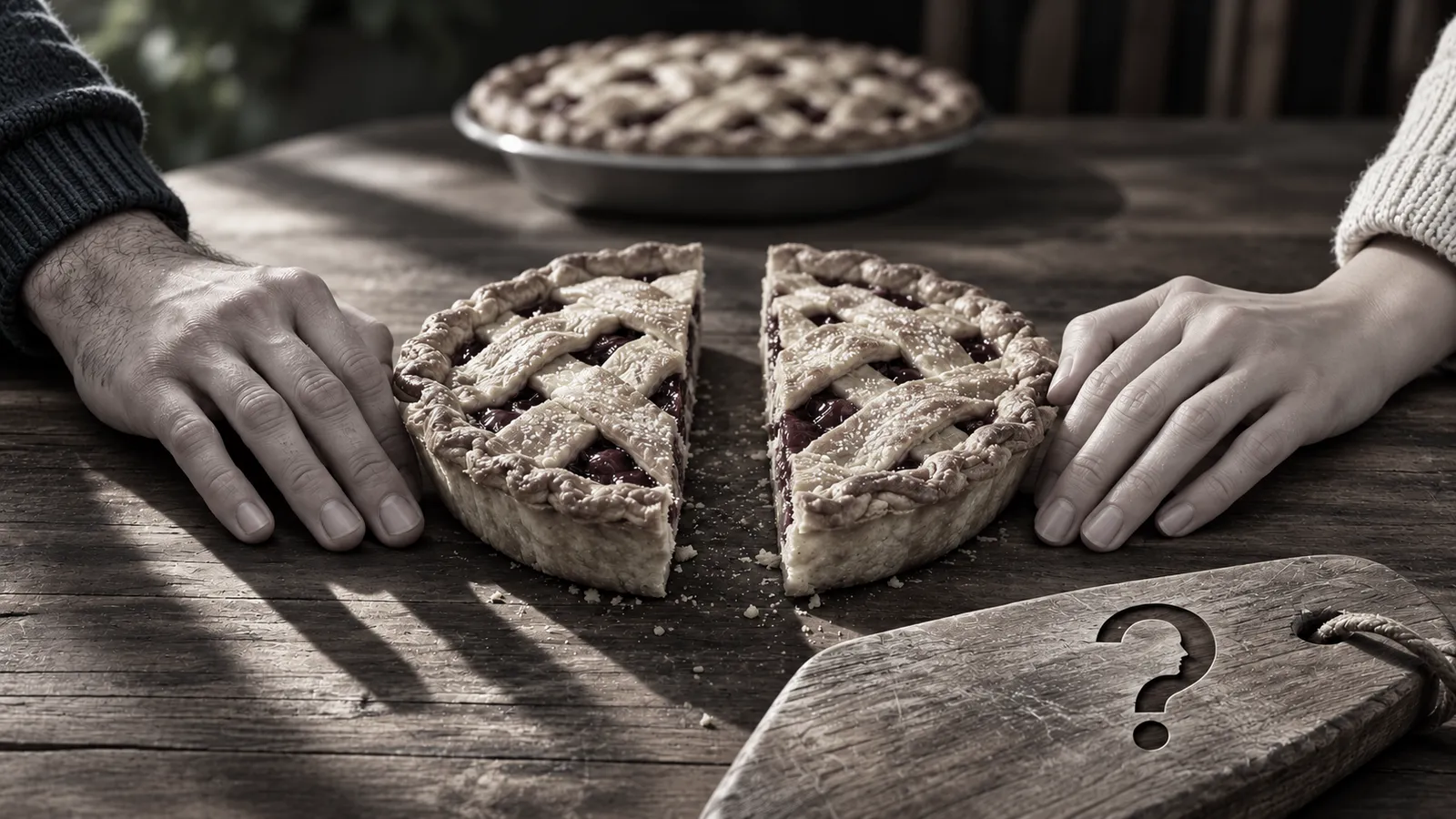
A fixed pie is true in a contest for rank and false at a shop counter. Zero-sum bias carries the first logic into the second, and the research shows four steps where it can be tested.
What is zero-sum bias?
Zero-sum bias is the habit of treating a situation as a fixed pie, so that one side's gain must be another's loss, when it is not. In experiments, people judged voluntary exchanges to leave one side worse off, and a reason for the purchase, a reminder of the grading rule or accountability in a negotiation reduced the effect.
Key takeaways
- In an experiment with 86 adults rating twelve ordinary exchanges, buyers were rated as worse off in an average of 2.54 of eight money transactions, against 0.49 for sellers, and 88 per cent judged at least one exchange zero-sum or worse (Johnson and colleagues, 2022).
- Students who saw many high grades predicted more low grades for the next presenter even though grades were set against a fixed standard, and a reminder of the standard reduced the effect (Meegan, 2010).
- Belief in a zero-sum game was measured with a scale supported across 37 nations and was tied to societal cynicism (Różycka-Tran and colleagues, 2015).
- Worse economic periods went with a stronger zero-sum view of success, and participants led to believe their economy was doing poorly were less willing to help (Sirola and Pitesa, 2017).
- Holding negotiators accountable reduced fixed-pie perceptions and produced more agreements (de Dreu and colleagues, 2000).
Someone else's good result starts a quiet sum: if they gained, something was taken. That is zero-sum bias, reading a fixed pie into a situation where the pie can grow. It runs in four steps.
- A gain appears on the other side of a trade, a deal or a contest.
- The mind looks for the matching loss, and the nearest candidate is whoever stands opposite.
- The sum is never checked against the real size of the pie.
- The conclusion steers what happens next, from helping a colleague to proposing a split.
Why one side's gain seems to need a loser
The first step of zero-sum bias shows up in the plainest exchanges. In one experiment by Samuel Johnson and colleagues, 86 adults read twelve short accounts of ordinary transactions, such as buying a shirt or a car, paying for a haircut, or swapping one food for another, and rated how much better or worse off each party ended up. In Johnson's results, buyers were rated as worse off in an average of 2.54 of the eight transactions that involved money, against 0.49 for sellers.
Altogether, 88 per cent of the group judged at least one of the twelve exchanges to be zero-sum or worse overall, and 94 per cent judged that at least one person in at least one transaction had not gained.
The buyer pattern held for goods and for services, and it was stronger for goods. A plain way to read this is that the eye lands on what each party handed over, money from one side and an item from the other, and not on what each party received. The sum then looks as if it must come out even, with one person's gain sitting in the other's pocket.
Swaps with no money involved drew the strongest effect. Most participants, 79 per cent, judged at least one barter to produce no overall gain, even though both traders had chosen it freely. Economics treats gains from trade for both sides as a basic principle, and this pattern runs against it: it is zero-sum bias at the market stall. The authors suggest that the denial comes partly from an intuition that money is worth more than the goods it buys and partly from a failure to take the buyer's point of view.
Zero-sum bias and the pie that nobody ever checks
A zero-sum game is one in which the payoffs always add up to nothing, so every gain has an exact loss behind it. Zero-sum bias, as Daniel Meegan defined it in 2010, is the habit of treating a situation as that kind of game when it is not.
His test used a setting where the sum plainly does not hold. At the university involved, grades were set against a fixed standard, so one presenter's high mark took nothing from anyone else. In three experiments with 556, 308 and 368 students, participants saw the grades earlier presenters had received and predicted the grade of the next presenter.
When the earlier grades were mostly high, participants predicted more low grades for the next presenter. When the earlier grades were mostly low, they did not predict more high grades. The bias ran in one direction only: a crowd of winners suggested that winning had run short, while a crowd of losers suggested nothing at all. Meegan suggests that the bias may be a rule of thumb shaped by competition over limited resources, which would explain why it switches on at the sight of winners and stays quiet at the sight of losers, and he points to its relevance for relations between groups.
A reminder broke the pattern. In the third experiment, participants who were told that the grading was absolute predicted fewer low grades. A similar result appeared for purchases: when people in the exchange study were given a reason for the purchase, their zero-sum judgements dropped substantially. The step that goes missing is the check, and a prompt can restore it. Cues that stress limited supply, such as those described in Which Kind of Scarcity Works on You, work from the opposite side, because they supply the fixed pie ready-made.
Rank is the one place where the sum really holds
The reasoning behind zero-sum bias has a true home, and Will Storr describes it in The Status Game. Status, in his account, is standing in a hierarchy: it is relative, it is given by other people, and people can turn almost anything into a marker of it. Rank is positional. Only one person can be first in a group, so a step up for one person is a step down in place for another. That is why a good whose value rests on rank, a positional good, behaves like a fixed pie. It is also why comparison between people, covered in Why do we compare ourselves to others, feels like a ledger.
A contest for a single item has the same shape. When one bidder takes the prize, the others do not, which is the setting examined in Why the Auction Winner Often Overpays. Zero-sum thinking is accurate there. The difficulty is that a mind practised in rank and in contests may carry the same arithmetic into places where nothing is fixed, such as a shop counter, a shared project or a new market.
Joanna Różycka-Tran and colleagues treated the habit as a belief that people hold, and proposed belief in a zero-sum game as a general conviction that one person's gain can only come at another's expense. They built a scale for it and found psychometric support for using it across many samples. In their analysis the belief was tied to a cynical outlook on others. The authors place it at the level of personal conviction, a stance a person brings to each new situation, and the one that zero-sum bias draws on.
How the same belief steers helping and deals
The fourth step turns zero-sum bias into behaviour. Signs of scarcity change how people read success. In a dataset of 59,694 respondents over 17 years, harder times went with a stronger view that one person's success leaves less for others. In two experiments, participants who were led to believe that times were hard became less willing to help. In a field experiment with freelance professionals, those who saw wider economic conditions as getting worse helped less.
Nina Sirola and colleagues read the drop in helping as the work of a zero-sum construal of success, a view in which another person's achievement counts as a subtraction from one's own prospects. Helping is a small act that depends on the other person's win being welcome, and the experiments suggest that the belief about the pie reached that act.
Deals show the same assumption at work. Negotiators who believe that their interests and the other side's are directly opposed rarely find agreements that suit both, because a split is all that a fixed pie can offer. A deal in which one side gives ground on what it values least and gains on what it values most needs a pie that can be reshaped, and the assumption of opposition hides that option.
Carsten de Dreu and colleagues called this fixed-pie perception, and they tested what loosens it. Holding negotiators accountable for how they negotiated produced more agreements, even with the amount of information exchanged held constant. In two experiments, accountability reduced fixed-pie perceptions.
Common questions
What is zero-sum bias?
Zero-sum bias is the tendency to treat a situation as zero-sum, where one side's gain must equal another's loss, when it is not. In experiments, people predicted more low marks for the next presenter after seeing many high marks, even though grades were set against a fixed standard.
Why does someone else's gain feel like our loss?
The mind searches for the loss that matches a gain, and the person on the other side is the nearest candidate. In one study, buyers were rated as worse off far more often than sellers, and most people judged at least one voluntary swap to leave nobody ahead.
Can zero-sum thinking be reduced?
Prompts that restore the check on the pie have helped in experiments. Reminding students that grading was absolute reduced the bias, giving a reason for a purchase reduced zero-sum judgements, and holding negotiators accountable reduced fixed-pie perceptions and produced more agreements.
Sources
Storr, W. The Status Game. Seed book.
Johnson, S. G. B., Zhang, J., & Keil, F. C. (2022). Win-win denial: The psychological underpinnings of zero-sum thinking. Journal of Experimental Psychology: General, 151(2), 455-474. doi:10.1037/xge0001083 https://doi.org/10.1037/xge0001083
Meegan, D. V. (2010). Zero-sum bias: Perceived competition despite unlimited resources. Frontiers in Psychology, 1, 191. doi:10.3389/fpsyg.2010.00191 https://doi.org/10.3389/fpsyg.2010.00191
Różycka-Tran, J., Boski, P., & Wojciszke, B. (2015). Belief in a zero-sum game as a social axiom: A 37-nation study. Journal of Cross-Cultural Psychology, 46(4), 525-548. doi:10.1177/0022022115572226 https://doi.org/10.1177/0022022115572226
Sirola, N., & Pitesa, M. (2017). Economic downturns undermine workplace helping by promoting a zero-sum construal of success. Academy of Management Journal, 60(4), 1339-1359. doi:10.5465/amj.2015.0804 https://doi.org/10.5465/amj.2015.0804
de Dreu, C. K. W., Koole, S. L., & Steinel, W. (2000). Unfixing the fixed pie: A motivated information-processing approach to integrative negotiation. Journal of Personality and Social Psychology, 79(6), 975-987. doi:10.1037/0022-3514.79.6.975 https://doi.org/10.1037/0022-3514.79.6.975
People
More articles
- Why We Leave Things in the Basket
A full cart that nobody pays for looks like a failed sale. The studies describe a shopper who is browsing, researching, hesitating or putting off a choice, and each of those leaves the same trace.
- Why Sharing a Meal Builds Trust
Surveys link shared meals with more trust, and experiments show strangers cooperating more over one bowl. The studies also show what eating together cannot prove alone.
- Why We Give Chatbots a Name
A name, plain wording and a voice are small signals, and the research shows how readily they start social habits. The effect depends on the person, the cues and how the agent is introduced.
- Why Rolling the Dice Yourself Feels Luckier
A die lands the same way whoever throws it, yet people prefer to throw it themselves. The research on the illusion of control shows how acting and planning raise the sense of influence, and what…