Why We Love The Lord of the Rings Movies
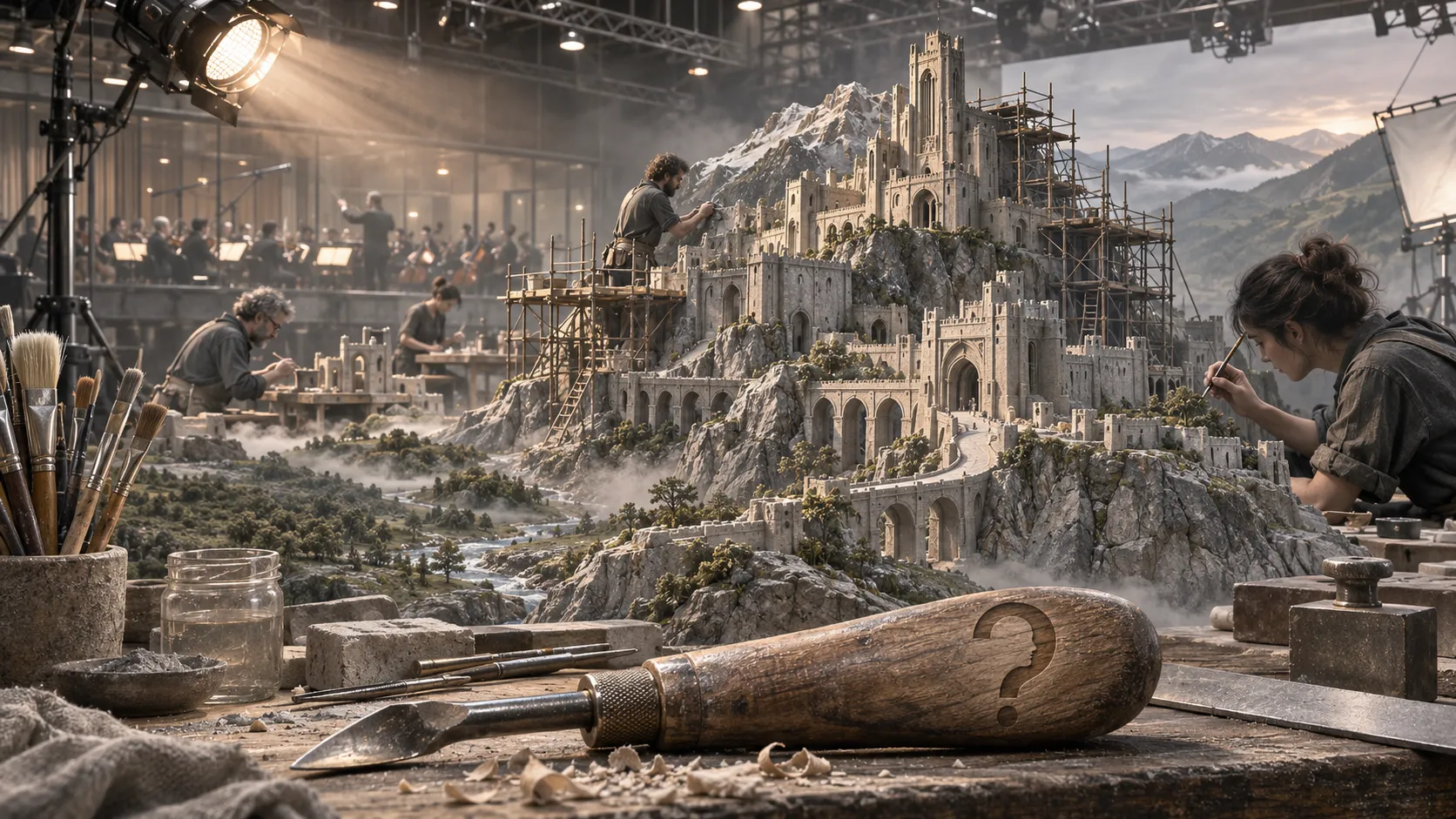
How visible craft, real locations and a recurring score shape what viewers make of The Lord of the Rings movies, and what research on the effort heuristic and film music suggests.
Why are The Lord of the Rings movies so good?
Viewers of The Lord of the Rings movies point to visible craft: one long production in New Zealand, large handmade miniatures, real landscapes and a score of recurring themes. Research on the effort heuristic and on film music suggests visible effort raises judgements of quality and recurring music helps scenes stay in memory.
Key takeaways
- Britannica reports that Peter Jackson shot the three films together over about fifteen months in New Zealand, with Wētā Workshop building oversized miniatures called bigatures.
- American Cinematographer reported in December 2001 that the first film's effects team built more than sixty large miniature environments across the trilogy and about 1,800 orc suits.
- Justin Kruger and colleagues described the effort heuristic in 2004: people rate work as higher in quality and worth when they believe more effort went into it. A 2023 replication with 1,405 participants supported the effect on liking and quality but not on monetary value.
- The effort heuristic is about judging somebody else's work. Effort justification is about liking something more because of effort you spent yourself.
- The Canadian Encyclopedia reports more than fifty leitmotifs in the film score, and a 1991 experiment found that music helped participants recognise filmed scenes they could not otherwise recall.
Peter Jackson shot the three films together over about fifteen months in New Zealand, and Wētā Workshop built oversized miniatures for the largest structures, according to Britannica. That one long production, with real landscapes and handmade models, is what viewers mention when they ask why The Lord of the Rings movies are so good.
What Was Actually Built?
American Cinematographer published a detailed account of the first film's effects, and its archive page presents the account today. It reports that Wētā Workshop built more than sixty large miniature environments across The Lord of the Rings movies, which the team called bigatures because the models were so big. The tower of Barad-dûr was built nearly three stories tall. Rock faces for the miniatures were moulded from the Wellington coastline. For backgrounds, a New Zealand landscape photographer was hired to photograph sunrises, sunsets and vistas across the country in place of digital backdrops.
The same account, from the magazine's December 2001 issue, describes how the hobbits were made smaller than the people around them. The crew used forced perspective, oversized set pieces and sliding platforms, and the article credits one technician's methods with achieving 60 to 70 percent of the hobbit shots in camera, with the remainder finished by bluescreen compositing. Showing how a thing was made is a design choice in its own right, a subject taken up in What Showing the Work Actually Does.
People made things as well as models. The article reports about 1,800 orc suits built in foam latex and silicone. Wētā Workshop's own project page says the company designed and built armour, specialty costumes, prosthetics, miniatures and weapons for the three films, and describes the work for the first of The Lord of the Rings movies as tens of thousands of pieces.
Computers had a part too. Crowd software multiplied captured movement into armies of thousands, and Britannica notes that the actor who played Gollum worked on set, which helped the other cast act opposite a character who was not physically there. The physical and digital work were planned together, and the physical parts are the ones a viewer can picture being made.
Does Visible Effort Matter?
A 2023 replication paper describes the 2004 proposal by Justin Kruger and colleagues, the effort heuristic, as the tendency to rate an object higher in quality and worth when more effort is believed to have gone into making it. The heuristic concerns an observer judging somebody else's work. That separates it from effort justification, where a person's own sacrifice raises their liking for the thing they sacrificed for, a finding examined in Does Effort Justification Hold Up. A viewer of The Lord of the Rings movies is in the first position, judging the work of a large crew.
The result of testing it again is mixed. In 2023, Ignazio Ziano and colleagues ran two preregistered replications with 1,405 participants from the United States. One replication supported the original's second experiment but not its first. A revised version of the first experiment found an effect of effort on liking and quality but none on monetary value.
Context shapes the shortcut as well. In 2008, people linked high effort to high quality only when the belief that good art takes effort was active in their minds, according to Hyejeung Cho and Norbert Schwarz. Their reading is that people build such judgements on the spot from whichever belief a task brings to mind, and do not apply a fixed rule.
For The Lord of the Rings movies, these experiments suggest that a viewer who knows the landscapes were real places and the models were physical objects is likely to rate their quality more favourably, and that the effect on liking is firmer than any effect on what a viewer would pay. The experiments used other objects. What the research supports is narrower and more useful: the effort a viewer can see or has been told about is the effort that counts, so a surface that [looks handmade](https://thewhyweproject.com/articles/why-do-we-pay-more-for-handmade) carries information that a seamless one does not.
How Does a Theme Travel?
Howard Shore composed the score for The Lord of the Rings movies. The Canadian Encyclopedia reports that it uses the leitmotif technique associated with Wagner, linking characters and situations to musical phrases, and that the film version holds more than fifty leitmotifs developed across the trilogy. Shore won Academy Awards for the scores of The Fellowship of the Ring and The Return of the King, and a symphony drawn from the film music premiered in 2003.
Experiments on film and memory point to what a recurring phrase can do. In 1991, Marilyn Boltz, Matthew Schulkind and Suzanne Kantra tested the effect of music on the remembering of filmed events. Music played with a scene's outcome and matching its mood helped participants remember the scene, music played before a scene and clashing with its mood also helped, and scenes that participants could not recall were recognised when their music was played. The authors attributed the effects to music directing selective attention. How a melody can also move the body is the subject of Why a Song Gives You Chills.
Charan Ranganath argues in Why We Remember that memory ties an event to the context in which it happened, and that distinctive, attended experiences are the ones that last. A phrase heard in one scene and again in another gives the two scenes a shared cue. Read alongside the film-music experiments, that account suggests why a viewer can hear a few notes from The Lord of the Rings movies and recover a whole scene.
What Viewers Respond To
The Lord of the Rings movies were made as one production, in places a camera could reach, with objects a person could hold, and a score that let scenes recall each other. Each of those is something a viewer can notice without technical knowledge, and each has a plausible route through the research above: visible effort for judgements of quality, recurring themes for memory.
| Term | What it means | Where it applies here |
|---|---|---|
| Effort heuristic | An observer rates work higher in quality and worth when told more effort went into it | A viewer judging the crew's miniatures, locations and costumes |
| Effort justification | A person likes a thing more after spending effort or enduring hardship to get it | A viewer's own sacrifice, not the film makers' work |
| Bigature | An oversized miniature built to stand in for a vast structure or landscape | The models Wētā Workshop built for The Lord of the Rings movies |
| Leitmotif | A recurring musical phrase linked to a character or situation | The score's phrases that return across the trilogy |
A viewer who wants to test the music idea on The Lord of the Rings movies can replay a favourite scene with the sound turned off and notice how much of the feeling the score was carrying.
Common questions
Why are The Lord of the Rings movies so good?
Viewers of The Lord of the Rings movies point to visible craft: a single long production in New Zealand, large handmade miniatures, real landscapes and costumes built by hand. Research on the effort heuristic suggests visible effort raises judgements of quality, and film-music experiments suggest recurring themes help scenes stay in memory.
What is the effort heuristic?
It is the tendency to rate an object as higher in quality and worth when told that more effort went into making it. Kruger and colleagues described it in 2004, and a 2023 replication found support for quality and liking but not for monetary value.
How is the effort heuristic different from effort justification?
The effort heuristic is about judging somebody else's work. Effort justification is about liking something more because of effort or hardship you spent yourself to obtain it.
What is a leitmotif in the Lord of the Rings score?
A leitmotif is a recurring musical phrase tied to a character or situation. The Canadian Encyclopedia reports more than fifty in the film version of Howard Shore's score, developed across the trilogy.
Sources
Ranganath, C. Why We Remember: Unlocking Memory's Power to Hold on to What Matters. Seed book; vault hub Books/Why We Remember.
Kruger, J., Wirtz, D., Van Boven, L., & Altermatt, T. W. (2004). “The effort heuristic.” Journal of Experimental Social Psychology, 40(1), 91-98. doi:10.1016/S0022-1031(03)00065-9 https://doi.org/10.1016/S0022-1031(03)00065-9
Ziano, I., Yeung, S. K., Lee, C. S., Shi, J., & Feldman, G. (2023). “The effort heuristic revisited: Mixed results for replications of Kruger et al. (2004)'s Experiments 1 and 2.” Collabra: Psychology, 9(1). doi:10.1525/collabra.87489 https://doi.org/10.1525/collabra.87489
Cho, H., & Schwarz, N. (2008). “Of great art and untalented artists: Effort information and the flexible construction of judgmental heuristics.” Journal of Consumer Psychology, 18(3), 205-211. doi:10.1016/j.jcps.2008.04.009 https://doi.org/10.1016/j.jcps.2008.04.009
Boltz, M., Schulkind, M., & Kantra, S. (1991). “Effects of background music on the remembering of filmed events.” Memory & Cognition, 19(6), 593-606. doi:10.3758/BF03197154 https://doi.org/10.3758/BF03197154
Britannica. The Lord of the Rings (film trilogy by Jackson). https://britannica.com/topic/The-Lord-of-the-Rings-film-trilogy-by-Jackson (accessed 2026-11-03).
Magid, R. Imagining Middle-earth for The Lord of the Rings. American Cinematographer, December 2001; archive page dated 2026-01-29. https://theasc.com/article/lord-of-the-rings-fellowship-of-the-rings-vfx/
Wētā Workshop. The Lord of the Rings, project page. https://www.wetaworkshop.com/projects/lord-of-the-rings/ (accessed 2026-11-03).
The Canadian Encyclopedia. Howard Shore. Published online 2009-12-07, last edited 2013-12-16. https://thecanadianencyclopedia.ca/en/article/howard-shore-emc
Related concepts
People
More articles
- What a Sustainable Branding Agency Actually Does
The work starts with an audit of what a brand can show. Two studies explain why buyers' green intentions fall short and what makes an environmental claim believable.
- How to Write Brand Identity Guidelines
The eight sections a set of brand identity guidelines needs, and what research on goals, plans, defaults and choice says about writing rules that people follow.
- Red in Branding: Urgency, Appetite and Power
Brands use red for urgency, appetite and power. Studies of auctions, price tags, plates, walls and contests show which of those jobs the evidence supports and which it does not.
- What are WEIRD samples in psychology?
A label from 2010 gave psychology a way to describe who takes part in its studies. Counting, testing in more places and building networks have since widened what the field can say.
In these themes
- Advertising and Storytelling
How messages win attention, stay in memory, and why stories hold us.