Why can you feel lonely in a crowd?
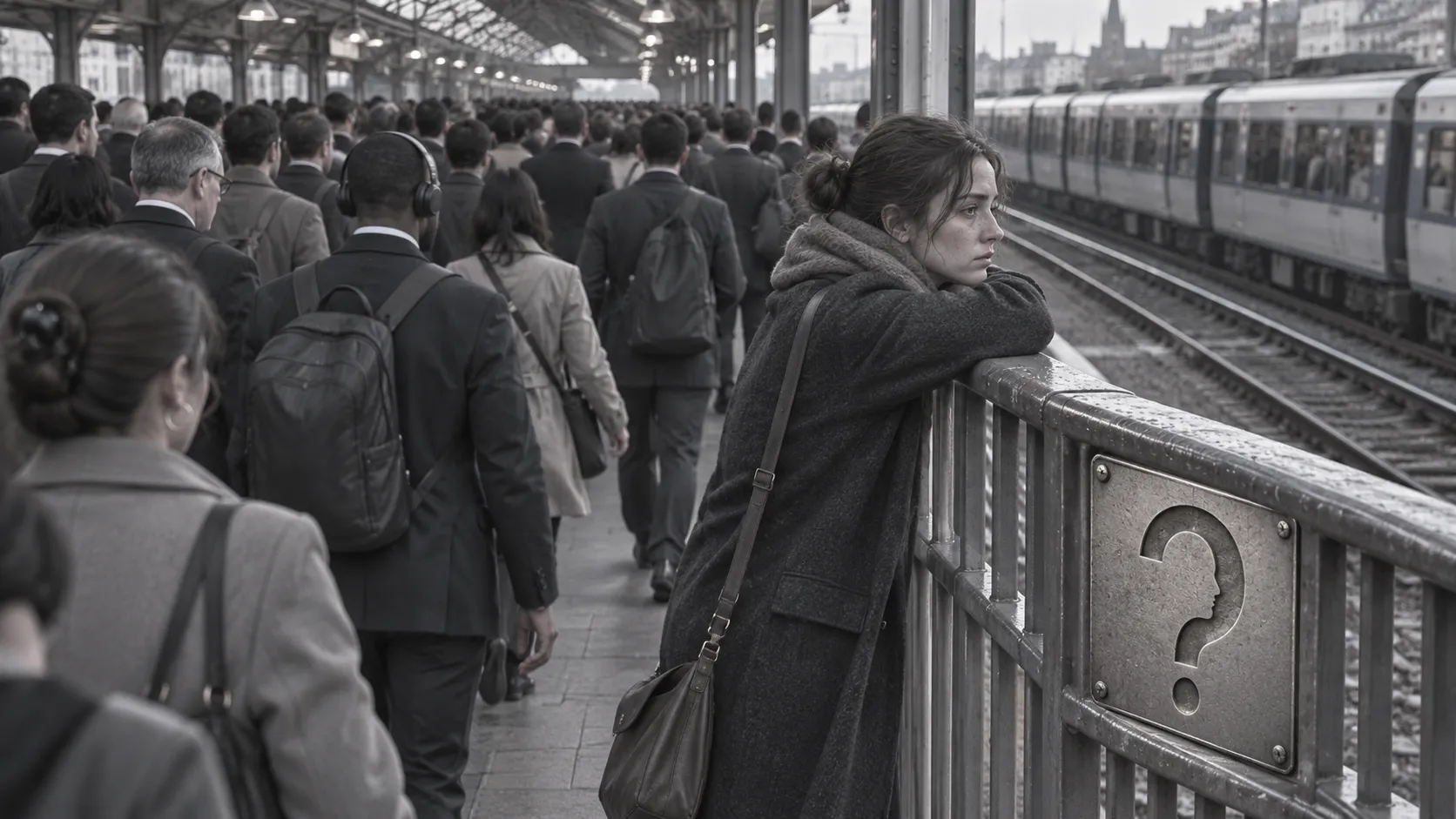
One statement on a loneliness scale asks about people who are around but not with you. A 1979 definition and two sets of commuter studies explain why a full carriage can still be a lonely place.
You can feel lonely in a crowd because research defines loneliness as a gap between the relationships a person has and the ones they want, not as a count of people nearby. The UCLA Loneliness Scale includes a statement about people being around but not with the respondent, and 2014 train studies found commuters underestimated how much others wanted to talk.
Key takeaways
- Peplau and Perlman's 1979 chapter defines loneliness as a social deficiency: a person's network of relationships is smaller or less satisfying than the person wants, with the desired level of contact measured directly.
- The third version of the UCLA Loneliness Scale, published in 1996, has 20 statements rated from never to always; one concerns people being around but not with the respondent, and none asks how many people were present.
- In Epley and Schroeder's 2014 train study, 118 commuters agreed to take part and 97 were analysed: those told to talk to a stranger reported a more positive commute than those told to keep to themselves, with no difference in productivity.
- Separate commuters predicted the opposite: 66 completed the train prediction survey and 61 the bus prediction survey, and both groups expected talking to make the journey worse.
- In a laboratory waiting room, Epley and Schroeder found that people who were talked to enjoyed the interaction as much as people who were told to talk.
One of the twenty statements on the third version of the UCLA Loneliness Scale, published in 1996, asks how often a person feels that people are around them but not with them.
The scale treats being lonely in a crowd as one sign among others because the research defines loneliness as a judgement about relationships and not as a head count.
What Loneliness Measures When Nobody Is Counting Heads
The definition used here is set out by Letitia Anne Peplau and Daniel Perlman in a 1979 chapter on a social psychological theory of loneliness. They describe loneliness as a social deficiency. It arises when a person's network of relationships is smaller or less satisfying than the person wants it to be. The desired level of contact is measured directly, by asking, and is not compared with an outside standard of how much contact someone ought to need.
That definition separates loneliness from being alone. The chapter points out that low contact can feel positive when it is what the person wants. The same logic runs the other way. A person with many people nearby can still fall short of the relationships they want, and that shortfall is what feeling lonely in a crowd refers to. Two people on the same platform, in the same crowd, can therefore give different answers, because each is comparing the platform with a different wish. Whether someone is lonely in a crowd is settled by asking about relationships, and not by counting heads.
Bobby Duffy reaches the same place in Generations, where he describes loneliness as the felt gap between the connection a person has and the connection they want, which makes it depend on expectations. The older Why We article on being alone versus feeling lonely follows that split into the mortality research. This one stays with the experience of company, and the piece on why people have a need to belong covers why relationships are wanted in the first place.
The scale asks people to rate each statement on a four-point frequency scale that runs from never to always, and several of the statements are worded positively and scored in reverse. Many concern people who are physically present: how often someone feels in tune with the people around them, how much they have in common with them, whether their interests and ideas are shared by those around them, and whether they feel part of a group of friends.
Others ask about companionship, having someone to turn to, and whether anyone really knows them well. A few concern the respondent's own manner, such as feeling outgoing and friendly or feeling shy, so the scale covers how a person sits among others as well as who is there.
Read as a list, the statements ask about fit and not about numbers. None asks how many people were in the room today, or how many hours were spent in company. A person answering reports on the match between the people available and the people wanted, so being lonely in a crowd, on this scale, means giving answers that show a poor match whatever the number of people present. The statement about being surrounded without being accompanied comes closest to naming the crowd, and it frames the crowd as a mismatch.
Commuters on Trains and Buses Predicted the Wrong Journey
A train carriage is a crowd in the plainest sense: strangers in close quarters who, as the authors of one 2014 paper note, often ignore each other. Nicholas Epley and Juliana Schroeder took the question onto trains and buses in field experiments. Commuters boarding inbound morning trains at a station in Homewood, Illinois, were randomly assigned to talk to a stranger, to keep to themselves, or to commute as usual. Of 118 who agreed, 97 were analysed, with a mean age of 49, and about three in five were women. Those told to connect reported a more positive commute than those told to keep to themselves, and productivity did not differ across the three groups.
In a prediction survey that Epley and Schroeder ran with similar commuters, 66 completed the task of imagining each of the three conditions. They predicted a less positive and less productive journey if they talked than if they kept to themselves, the opposite of what the first group reported. A second pair of studies by the same authors used people from a downtown Chicago laboratory pool who travelled to the lab by public transit. Seventy-five completed the study, with a mean age of 27 and with instructions given by phone, and connecting again rated more positive than keeping to oneself, with no difference in productivity. Sixty-one others, surveyed online, again predicted that talking would be worse.
The authors traced part of the misprediction to underestimating how interested other people are in talking, which keeps people from finding out what a conversation is like. The studies measured the quality of a journey and not loneliness. What they add is an account of how a carriage stays full of silent people: each commuter expects the others to prefer silence, so the expectation is never tested. They bear on the question only indirectly, by showing how a space can be crowded and still contain no exchange, which is the setting in which someone could be lonely in a crowd.
Four Terms That Keep the Crowd and the Relationship Apart
The research above uses a few terms in specific ways. The table sets them side by side, so that the phrase lonely in a crowd can be read in research terms, with the crowd kept apart from the relationships in the definition.
| Term | Meaning in this research |
|---|---|
| Being alone | A fact about contact: few or no people present. |
| Loneliness | A judgement that one's relationships fall short of the ones wanted, as defined by Peplau and Perlman. |
| A crowd | People present nearby, which the definition does not count as relationships by themselves. |
| Connection | Talking with a stranger on the journey, as instructed in the field studies. |
Each source covers a narrow slice. The 1979 chapter is a theoretical statement. The scale is a self-report instrument, so it records what people say about their own relationships. The field studies involved adults who agreed to take part, in and around Chicago, over single journeys, and they did not measure loneliness. None of this shows what happens to a person who feels lonely in a crowd over months, and the article makes no claim about outcomes.
The Waiting-Room Study and Who Has to Speak First
A laboratory study in the same 2014 paper adds a detail about who has to start. In a waiting room, Epley and Schroeder found that people who were talked to enjoyed the interaction as much as people who were told to do the talking. It is a modest finding about one room and one kind of exchange. The pleasure was shared between both sides of the conversation, so a conversation can be as welcome to the person who did not start it as to the person who did, which matters to anyone asking how people end up lonely in a crowd.
Common questions
Why can you feel lonely in a crowd?
Because research defines loneliness as a gap between the relationships a person has and the ones they want, and a crowd supplies people without supplying those relationships. The UCLA Loneliness Scale includes a statement about people being around but not with the respondent.
Is feeling lonely in a crowd the same as being alone?
No. In the 1979 definition, being alone is a matter of contact, and low contact can feel positive when it is wanted. Loneliness is the judgement that relationships fall short of what is wanted.
Does talking to a stranger change how a journey feels?
In the 2014 field studies, commuters told to talk to a stranger reported a more positive journey than commuters told to keep to themselves, with no difference in productivity. Other commuters predicted the opposite.
Sources
Duffy, B. Generations. Seed book; vault hub Books/Generations.
Peplau, L. A., & Perlman, D. (1979). “Blueprint for a social psychological theory of loneliness.” In M. Cook & G. Wilson (Eds.), Love and Attraction. Pergamon.
Russell, D. W. (1996). “UCLA Loneliness Scale (Version 3): Reliability, validity, and factor structure.” Journal of Personality Assessment, 66(1). doi:10.1207/s15327752jpa6601_2 https://doi.org/10.1207/s15327752jpa6601_2
Epley, N., & Schroeder, J. (2014). “Mistakenly seeking solitude.” Journal of Experimental Psychology: General, 143(5). doi:10.1037/a0037323 https://doi.org/10.1037/a0037323
Related concepts
People
More articles
- Why We Can't Get Enough of Harry Potter
How a ten-year series, four houses, collective assimilation and nostalgia combine to make Harry Potter a place readers belong to and hand on.
- What is the fundamental attribution error?
A ten-item scale, a busy-viewer experiment and a study of suspicion show that the fundamental attribution error is not one fixed habit but a judgement that moves with the person, the moment and the…
- What is the spotlight effect?
The spotlight effect is the tendency to overestimate how much other people notice your actions and appearance. A 2000 experiment counted what a room remembered, and later studies tested whether the…
- Food Branding Psychology: Taste Starts With the Eye
Shape, label and plate set an expectation before the first bite. Studies of packs, plating, tasting and four countries show how far those cues reach and where they need local testing.
In these themes
- Belonging and Community
Why we need groups, and what we give up to stay in them.