Nicholas Epley
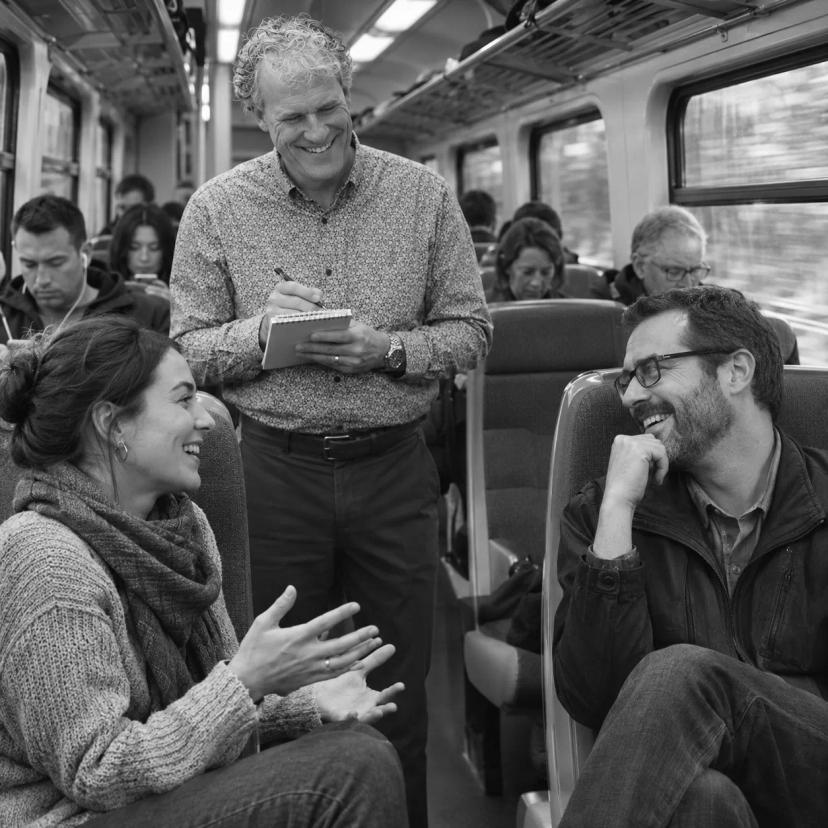
Nicholas Epley is the first author, with Juliana Schroeder, of Mistakenly Seeking Solitude, a 2014 paper in the Journal of Experimental Psychology: General. Its field experiments on trains and buses found that commuters told to talk to a stranger reported a more positive journey than commuters told to keep to themselves, while other commuters predicted the opposite.
Who they are
The work on this page is a single paper, Mistakenly Seeking Solitude, published in the Journal of Experimental Psychology: General in 2014 (volume 143, issue 5). No institution or wider career is described here.
Key papers
Epley, N., & Schroeder, J. (2014). Mistakenly seeking solitude. Journal of Experimental Psychology: General, 143(5).
Key ideas
Strangers who share close quarters, such as commuters on trains and buses, often ignore each other.
In field experiments on trains and buses, commuters told to talk to a stranger reported a more positive journey than commuters told to keep to themselves, and productivity did not differ.
Separate people asked to predict the outcome expected talking to make the journey worse. The authors attribute part of this to underestimating how interested others are in talking.
In a laboratory waiting room, people who were talked to enjoyed the interaction as much as people who were told to talk.
Sources
- Epley, N., & Schroeder, J. (2014). Mistakenly seeking solitude. Journal of Experimental Psychology: General, 143(5). https://doi.org/10.1037/a0037323
Studies on this site by Epley
- Bonus or rebate?: The impact of income framing on spending and saving
Epley (2006) · Journal of Behavioral Decision Making
- On seeing human: A three-factor theory of anthropomorphism
Epley (2007) · Psychological Review
- When we need a human: Motivational determinants of anthropomorphism
Epley (2008) · Social Cognition
- Mistakenly seeking solitude
Epley (2014) · Journal of Experimental Psychology: General
Articles that cite Nicholas Epley
- Why Doing Someone a Favour Makes Us Like Them
A person who does a small favour often comes to like the one helped. The research on how people explain their own behaviour shows where in the chain that change happens.
- Why We Give Chatbots a Name
A name, plain wording and a voice are small signals, and the research shows how readily they start social habits. The effect depends on the person, the cues and how the agent is introduced.
- Why Money in a Labelled Jar Lasts Longer
A name on a jar gives a sum a job and a boundary. Research on savings, category budgets and labelled payments shows what that does to money, and why the same device can tighten or loosen spending.
- Why is gift-giving so stressful?
Where givers and recipients read the same gift differently, why a wide shelf makes the shop harder, and what narrows the gap.
- Why We See Faces in Products
What experiments on cars, phones and autonomous products show about faces in product design, and why a friendly face changes both first liking and long-term attachment.
- Why can you feel lonely in a crowd?
One statement on a loneliness scale asks about people who are around but not with you. A 1979 definition and two sets of commuter studies explain why a full carriage can still be a lonely place.
Concepts on this site
- Anthropomorphism
The tendency to attribute humanlike traits, motives, intentions or emotions to nonhuman agents.
- Effectance Motivation
The account that a need for control raises the tendency to anthropomorphise things that seem unpredictable.
- Mistakenly Seeking Solitude
Mistakenly seeking solitude is the finding, from a 2014 paper by Nicholas Epley and Juliana Schroeder, that commuters expect talking to a stranger to make a journey worse, although commuters who…