Why do influencers sell?
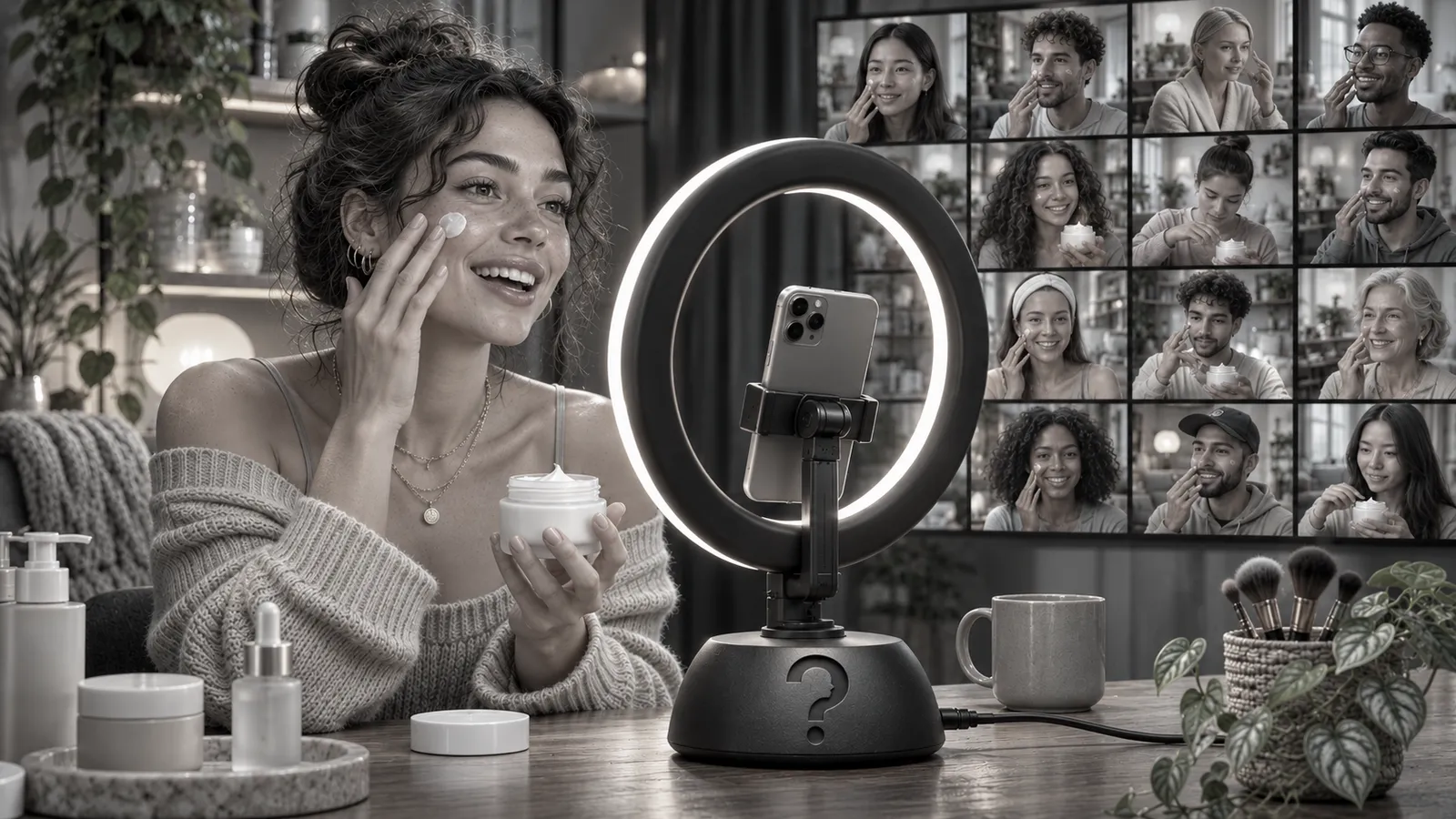
What experiments say about similarity, identification and trust, why audience size changes how a message lands, and where the habit of selling through people comes from.
Answer to the question
Why do influencers sell?
Influencers sell because followers identify with them, feel similar to them and trust them. In two experiments with 131 and 446 participants, people trusted influencers more than celebrities, and similarity and trust helped explain stronger advertising results, measured as attitudes and purchase intention.
Key takeaways
- In two experiments with 131 and 446 participants, people identified more with influencers than celebrities, felt more similar to them and trusted them more; similarity, wishful identification and trust helped explain stronger advertising results (Schouten and colleagues, 2020).
- Fit between endorser and product did not explain those links in the same experiments.
- A survey of followers linked the informative value of content and the influencer's trustworthiness, attractiveness and similarity to trust in branded posts, and that trust to brand awareness and purchase intention (Lou and Yuan, 2019).
- Intense wording raised engagement for smaller influencers and lowered it for larger ones, with perceived trustworthiness carrying the effect (Cascio Rizzo and colleagues, 2024).
- A review of 154 publications found most treat influencers as a commercial tactic, and few examine behavioural change or public opinion (Hudders and colleagues, 2021).
Why do influencers sell? A real feed bundles three things together: who the person is, how many people follow them and what they are promoting. Experiments pull the three apart, and the answers point less to reach than to the feeling of knowing someone who resembles you.
Why do followers trust influencers more than celebrities?
Two experiments, with 131 and 446 participants, set celebrity endorsers against influencer endorsers. One promoted a beauty and fitness product and the other a food and fashion product, and each paired the endorser with a good or a poor fit to the product. Participants identified more with influencers, felt more similar to them and trusted them more. Similarity, wishful identification and trust each carried part of the link between the type of endorser and how well the advertising worked, which was measured by attitudes toward the advertisement and the product and by purchase intention. Fit between endorser and product did not explain any of those links (Schouten and colleagues, 2020).
That puts trust at the centre of why influencers sell, and it matches how researchers define credibility: trustworthiness plus expertise, the two parts of source credibility. A survey of social media users who followed at least one influencer added a second ingredient. The informative value of the content, together with the influencer's trustworthiness, attractiveness and similarity to followers, was linked to trust in the influencer's branded posts, and that trust was linked to brand awareness and purchase intention (Lou and Yuan, 2019).
The bond underneath is the one-sided attachment an audience builds with a media figure, covered in What is a parasocial relationship. Followers do not need to meet the person for the resemblance to count. They need the feed to feel like a view into an ordinary life that is close enough to their own, which is also why influencers sell advice that a polished advertisement cannot carry.
Does a smaller following sell better?
Audience size changes how the same message lands. A team led by Giovanni Luca Cascio Rizzo combined automated analysis of text, images, video and audio from thousands of sponsored posts with controlled experiments. Intense, high-arousal wording raised engagement for smaller influencers and lowered it for larger ones. Perceived trustworthiness carried the effect: the same wording made smaller accounts seem more trustworthy and larger accounts less so. Larger accounts could offset the drop by pairing the wording with a positive tone or by signalling that the post was meant to inform and not to promote (Cascio Rizzo and colleagues, 2024).
Read next to the first experiments, the result says that closeness is something a message can build or lose. A follower who feels close to a small account takes enthusiasm as warmth. The same follower, watching an account with a very large audience, may take it as a pitch. The sentence is identical in both cases, and what changes is the relationship it arrives inside. That is one reason influencers sell in different ways at different sizes. Followers also read the size of an audience as a signal in its own right, a cue taken up in What is social proof in marketing.
| Study | What was varied | What carried the effect |
|---|---|---|
| Schouten and colleagues, 2020 | Celebrity or influencer endorser | Similarity, wishful identification, trust |
| Lou and Yuan, 2019 | Value and credibility of influencer content | Trust in the branded post |
| Cascio Rizzo and colleagues, 2024 | Account size and arousing wording | Perceived trustworthiness |
Where did selling through people begin, and what is unknown?
Tim Wu argues in The Attention Merchants that selling has followed attention from one medium to the next, from the penny newspaper to radio, television and the networked feed. Fame is part of that history. In his account, an industry grew around turning interest in famous people into something a business could sell against, and the newest step moves the same logic inward, to the individual. Follower counts make even a small audience visible and comparable, so a person with a few thousand followers can be approached as a channel in the way a broadcaster once was.
The older version of this idea sits in Why Do Celebrity Objects Sell for More, where the value of an object follows the person who held it. The influencer version differs in one respect that the experiments make plain: the person is not remote. The audience sees the morning routine, the kitchen and the unscripted aside, and it files the recommendation under advice from someone like me, not under advertising. In Wu's frame the audience itself is what gets resold, which is why a person who holds a loyal one matters to a brand.
We read the papers as one chain, and influencers sell when each link holds. Resemblance and credibility raise trust, and trust raises the intention to buy. Wu supplies the long history that explains why a brand would look for people who hold an audience, and the experiments supply the reason the audience listens. The outcome measured in most of these studies is purchase intention, a stated willingness and not a record of sales, so the chain shows what makes a recommendation persuasive and stops short of a forecast of revenue.
A review of 154 peer-reviewed publications on influencer marketing, most of them from 2018 to 2020, mapped what researchers had studied. Most of the studies were empirical, using surveys, experiments, content analysis or interviews. Most treated influencers as a commercial tactic, and few examined whether influencers can drive behavioural change or shape public opinion. The authors sorted the work by source, message and audience characteristics, and several studies in the review addressed transparency, so how openly a post signals its commercial purpose is an active research question (Hudders and colleagues, 2021).
Common questions
Why do influencers sell?
Influencers sell because followers identify with them, feel similar to them and trust them. In two experiments, participants trusted influencers more than celebrities, and similarity and trust helped explain better advertising results.
Do influencers sell better than celebrities?
In two experiments with 131 and 446 participants, influencer endorsers produced stronger identification, similarity and trust than celebrity endorsers, and those factors mediated advertising effectiveness.
Does follower count change how influencers sell?
It changes how a message is read. Intense wording raised engagement for smaller influencers and lowered it for larger ones, with perceived trustworthiness carrying the effect.
Does trust in an influencer lead to buying?
A survey linked trust in an influencer's branded posts to brand awareness and purchase intention. The outcome was intention, not recorded sales, and research suggests influencers sell through trust more than through reach.
Sources
Wu, T. The Attention Merchants. Seed book; vault hub Books/The Attention Merchants.
Schouten, A., Janssen, L., & Verspaget, M. (2020). Celebrity vs. Influencer endorsements in advertising: the role of identification, credibility, and Product-Endorser fit. International Journal of Advertising, 39(2), 258-281. doi:10.1080/02650487.2019.1634898 https://doi.org/10.1080/02650487.2019.1634898
Lou, C., & Yuan, S. (2019). Influencer marketing: how message value and credibility affect consumer trust of branded content on social media. Journal of Interactive Advertising, 19(1), 58-73. doi:10.1080/15252019.2018.1533501 https://doi.org/10.1080/15252019.2018.1533501
Cascio Rizzo, G. L., Villarroel Ordenes, F., Pozharliev, R., De Angelis, M., & Costabile, M. (2024). How high-arousal language shapes micro- versus macro-influencers' impact. Journal of Marketing, 88(4), 107-128. doi:10.1177/00222429231207636 https://doi.org/10.1177/00222429231207636
Hudders, L., De Jans, S., & De Veirman, M. (2021). The commercialization of social media stars: a literature review and conceptual framework on the strategic use of social media influencers. International Journal of Advertising, 40(3), 327-375. doi:10.1080/02650487.2020.1836925 https://doi.org/10.1080/02650487.2020.1836925