Why the Middle of the Shelf Wins
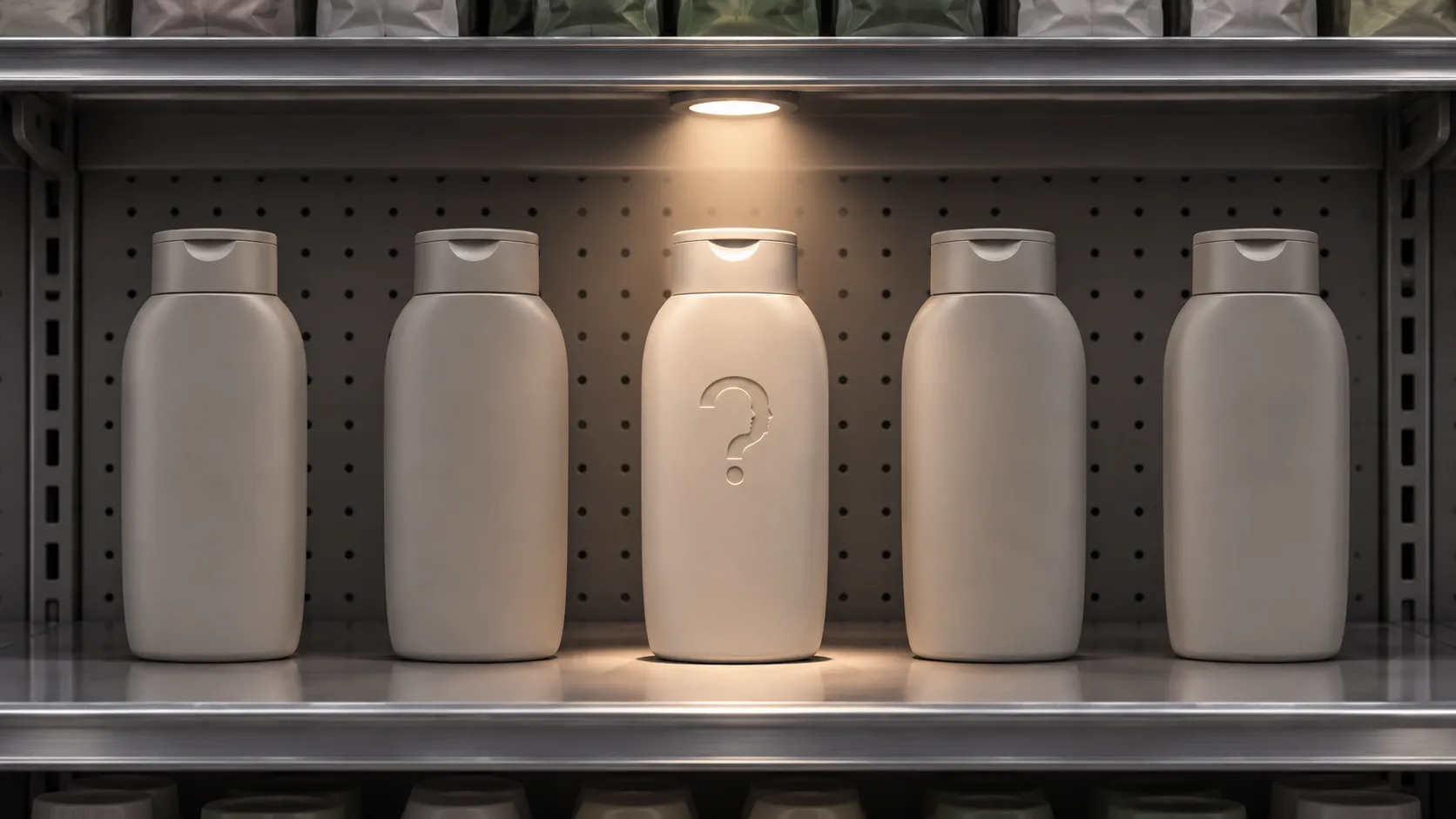
What experiments on lines of pictures, eye tracking and virtual aisles say about why the middle gets chosen, where the top and the edges win instead, and when the pull fades.
Why do shoppers choose products in the middle of the shelf?
Shoppers choose products in the middle of the shelf because a central position reads as popular and draws the eye first. In experiments the middle item of a row was picked more often, but top shelves and eye level can beat the centre, and the pull fades once people know what they want.
Key takeaways
- In a line of five pictures, and again with five pairs of identical socks, people preferred the middle item, in horizontal and vertical lines (Rodway, Schepman and Lambert, 2012).
- Shoppers assume centre options in a display seen all at once are the most popular and choose them more often (Valenzuela and Raghubir, 2009), and in two eye-tracking studies brands in the horizontal centre drew more looks and were more likely to be chosen (Atalay, Bodur and Rasolofoarison, 2012).
- On supermarket shelves, top and middle positions drew more attention than low ones, but only the top shelf lifted brand evaluation; in a virtual aisle, pick-ups were higher at eye and waist level (Chandon and colleagues, 2009; Porcheddu, 2011).
- The centre pull weakened when layout carried no information and when people had more access to their own preferences or to the product's attributes.
Shown five pairs of identical socks in a row, people preferred the pair in the middle. Position alone, with nothing else changed, moved the choice. That result matters to anyone who has stood in front of a shelf. The middle of the shelf wins more often than chance allows, and the reason has less to do with the product than with what a central place seems to say about it.
Why does the middle of the shelf read as popular?
Paul Rodway, Astrid Schepman and Jordana Lambert ran the five-item test with the line laid out across and again with the line running up, and the middle item came out ahead both times. Because the preference held for pictures and for socks, and in both directions, the authors favoured an account tied to location itself over explanations built on one side of the brain or one side of the body. That makes the middle of the shelf a position with a documented pull, and not a quirk of one display.
Ana Valenzuela and Priya Raghubir tied the pull to a belief. Shoppers assume that an option placed in the centre of a display seen all at once is the most popular, and they choose central options more often than those at the sides. Their results pointed to inferences about popularity, not to extra attention on the central products. The inference grew stronger when people thought about what others like, which fits a reading of the middle of the shelf as a vote already cast by earlier shoppers.
Where does the first glance land?
Attention offers a second route. In two eye-tracking studies, A. Selin Atalay, H. Onur Bodur and Dina Rasolofoarison found that brands in the horizontal centre of an array drew more looks and were more likely to be chosen. Eyes began at the centre, then settled on the item the person went on to pick, a pattern the authors named the central gaze cascade. A further study with tangible products showed the same lean toward central items. The lean did not depend on a screen or a lab picture alone, since handling real objects produced it too. On a shelf, the first glance would fall where the eyes began in these studies, on the middle of the shelf.
The two accounts differ on whether belief or looking does the work, and they need not exclude each other. A shopper whose eyes land first on the centre then has a ready reason to stay there. On both accounts the shopper need not notice the pull. We read them as steps in one sequence, with the look coming before the inference, and both routes lead to the middle of the shelf.
Do the top and the edges ever win?
A shelf matters at all because the shop is where many brand choices are settled. In Consumer Behaviour, Cathy Neal, Pascale Quester and Del Hawkins describe displays, layout and stockouts as forces that shift brand choice at the point of sale, so a few centimetres of position can carry real weight in a category where shoppers have no firm favourite.
A shelf is not a single row, and its vertical axis has winners of its own. Pierre Chandon and colleagues tracked eyes on supermarket shelves, a method set out in Eye Tracking in Neuromarketing: What Customers Really See, and found that top-shelf and middle-shelf positions drew more attention than low-shelf positions. Only the top shelf lifted how a brand was evaluated. Attention reached the middle of the shelf, and the lift in evaluation reached the top.
Daniele Porcheddu reached a similar place from another side. In a virtual-store experiment with 600 shoppers, pick-ups were not spread evenly: they were higher at eye level and at waist level, and higher for items in the first half of the shelving unit. He judged that the effort of reaching was probably not the explanation for the pattern.
Set side by side, the centre and the edges win by different rules. The centre wins in a row seen all at once, where position works as a cue to popularity. The top, eye level and the opening stretch of a unit win where the shopper moves through the space and meets some places first and others at a convenient height. One shelf asks for both rules at the same moment, so the middle of the shelf suits the shopper who scans a block from a distance, while the top and the opening stretch suit the shopper who walks past it.
When does the middle of the shelf stop winning?
The Valenzuela and Raghubir results also set the limits. The central pull was weaker when the layout carried no information, meaning that shoppers had no reason to think the arrangement told them anything. It weakened as well when people had more access to their own preferences or to the intrinsic attributes of the product. The experiments used pictures, socks, eye trackers and virtual aisles alongside real shelves, so each one shows a pull that appears under controlled conditions and does not give a fixed share of sales for any product. A shopper who already knows which item to take passes the middle of the shelf toward the end of the row without feeling any pull.
Other kinds of order bring other winners. When options arrive one after another and not side by side, the first often leads, a pattern covered in Why the First Option Gets Picked and explained in terms of primacy and recency in What is the serial position effect. When the options sit on a price range, the middle gains a different appeal, that of the safe choice, which The Compromise Effect on the Wine List sets out. Position in space, position in time and position in price each have a favoured seat, and they are not the same seat.
Three checks help tell position from preference at a shelf:
- Scan the whole row, ends included, before looking for a reason to take the middle item.
- Ask whether the same item would still be chosen if it sat at the far end.
- Read the attributes on the label first, since attribute information reduced reliance on position in the research.
Across the studies, the central place held steady while shoppers were still deciding, in rows seen all at once where a central position passed for a vote, and it lost its grip once a preference existed, when the layout carried no signal or the label said more than the place did.
Common questions
Why do shoppers choose products in the middle of the shelf?
A central position reads as popular and draws the eye first. Research found that people assume centre options in a display are the most popular and choose them more often, and eye tracking showed gaze starting at the centre and settling on the chosen item.
Is the middle of the shelf always the best place for a product?
No. Top-shelf positions lifted brand evaluation in an eye-tracking study where middle-shelf positions drew attention but did not lift evaluation, and a virtual-store experiment found more pick-ups at eye and waist level and in the first half of a shelving unit.
When does the centre effect weaken?
It weakened when the layout carried no information about popularity and when people had greater access to their own preferences or to the product's attributes. In the five-item studies it held in horizontal and vertical lines.
Sources
Neal, C. M., Quester, P. G., & Hawkins, D. I. Consumer Behaviour. Seed book; vault hub Books/Consumer Behaviour.
Rodway, P., Schepman, A., & Lambert, J. (2012). Preferring the one in the middle: Further evidence for the centre-stage effect. Applied Cognitive Psychology, 26(2), 215-222. doi:10.1002/acp.1812 https://doi.org/10.1002/acp.1812
Valenzuela, A., & Raghubir, P. (2009). Position-based beliefs: The center-stage effect. Journal of Consumer Psychology, 19(2), 185-196. doi:10.1016/j.jcps.2009.02.011 https://doi.org/10.1016/j.jcps.2009.02.011
Atalay, A. S., Bodur, H. O., & Rasolofoarison, D. (2012). Shining in the center: Central gaze cascade effect on product choice. Journal of Consumer Research, 39(4), 848-866. doi:10.1086/665984 https://doi.org/10.1086/665984
Chandon, P., Hutchinson, J. W., Bradlow, E. T., & Young, S. H. (2009). Does in-store marketing work? Effects of the number and position of shelf facings on brand attention and evaluation at the point of purchase. Journal of Marketing, 73(6), 1-17. doi:10.1509/jmkg.73.6.1 https://doi.org/10.1509/jmkg.73.6.1
Porcheddu, D. (2011). Choices from identical options in a virtual shopping aisle. The Open Business Journal, 4(1), 36-45. doi:10.2174/1874915101104010036 https://doi.org/10.2174/1874915101104010036
Related concepts
People
More articles
- Why We Say Yes to the Add-On
Why a small extra offered after the main choice is so easy to accept, and what research says about framing, order and benefit.
- Does an Easy Returns Policy Make Us Buy More?
What a pooled review of 21 studies, a model of the option to return and experiments on guarantees say about easy returns, buying and keeping.
- Buy One Get One Free or Half Price?
Two offers that cost the same per unit, why shoppers still lean toward the free item, and the one check that separates them at the shelf.
- Why a Famous Name Can't Sell Everything
Why a well-known name moves some products easily and others not at all, what the research finds drives a brand extension, and what a poor fit can do to the parent.
In these themes
- Shopping and Retail
How the shop, the shelf and the checkout shape what ends up in the basket.
- Choice and Decision-Making
How we choose, and how the way options are laid out chooses for us.