Why We Say We Won When Our Team Wins
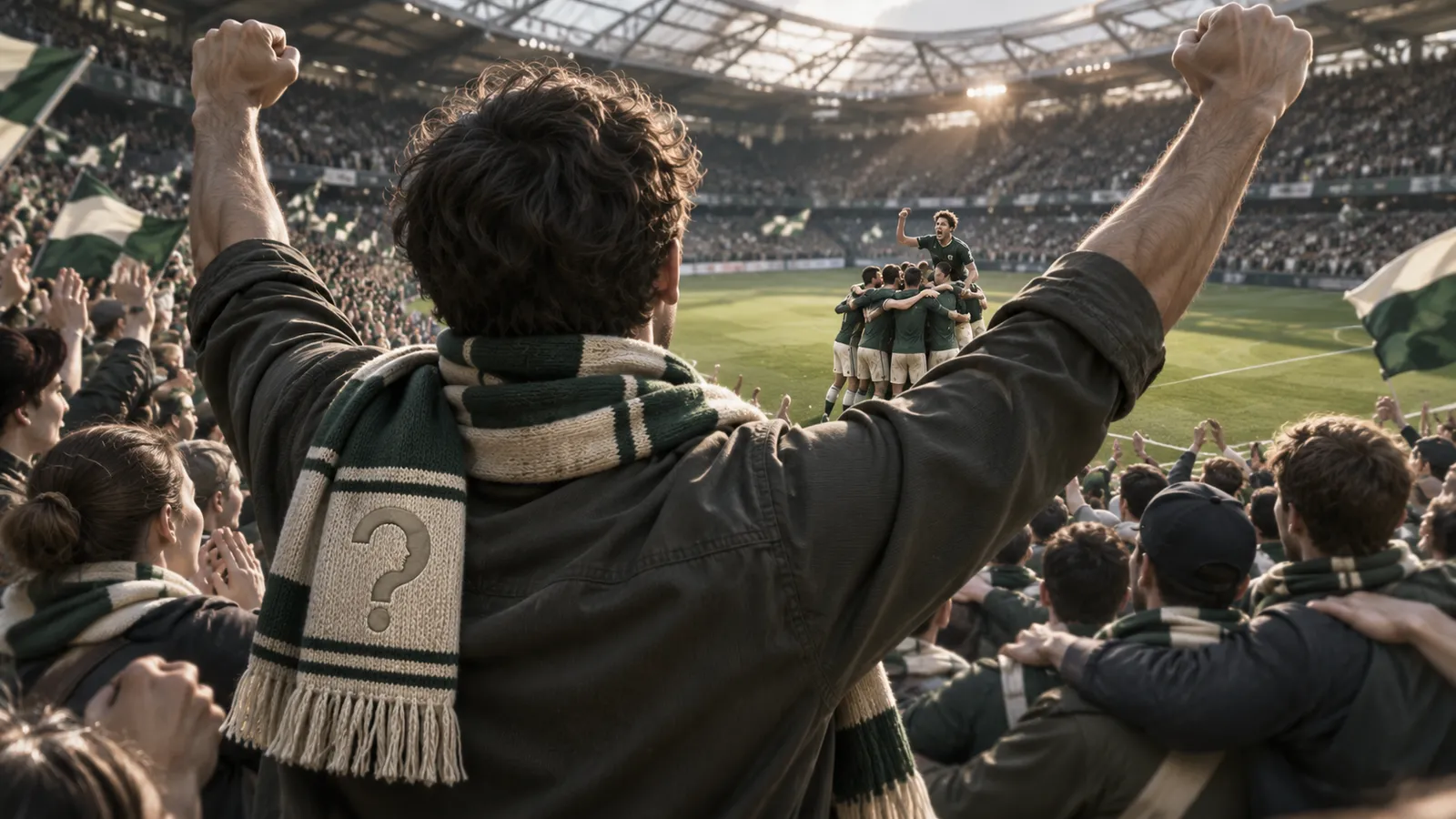
How pronouns, clothing and the strength of a bond follow a team's results, and what field studies of basking in reflected glory found.
Why do sports fans say "we won"?
Sports fans say we won because a shared success improves how the speaker looks and feels. Cialdini and colleagues found in 1976 that students used we more after a win than a loss, and proposed this protects public image. Later work added the mirror move, distancing after a loss, and showed that a stronger bond keeps fans close.
Key takeaways
- Robert Cialdini and five colleagues reported three field studies in 1976: university students were more likely to wear school-identifying clothing after a football win than a loss, and used the word we more often to describe a win than a loss.
- The authors proposed that basking in reflected glory protects or improves public image, and two of the studies found people were keenest to claim a link to success when their image was under threat.
- C. R. Snyder, MaryAnne Lassegard and Carol Ford tested basking and its mirror image, cutting off reflected failure, in a sample of university students in 1986.
- A 2012 pair of studies of French rugby fans, with 153 casual spectators and 64 die-hard fans, found team identification was a strong driver of loyal reactions after a defeat.
- In Influence, Cialdini notes that the original research has been replicated with French and English soccer fans and with voters in the Netherlands and the United States.
Sports fans describe a victory in the first person plural and a defeat in the third person. The team beat its rival and we won, so the result sounds like something the speaker did. After a loss the pronoun tends to move: they lost, and the speaker steps back a pace. Psychologists measured that shift in field studies decades ago, and the findings explain how sports fans can claim a result they had no hand in producing without any sense of overreaching. The habit is so ordinary that it passes unnoticed, yet it holds a small act of identity.
Why Do Sports Fans Say We Won?
The first clear answer came from university football weekends. Researchers recorded what students wore and said after a game their team had won, and set that against what the same kind of students wore and said after a loss.
In 1976, Robert Cialdini and five colleagues reported three field studies of what they called basking in reflected glory, meaning that people publicly announce their links to successful others. The effect appeared even when the person was not responsible for the success. In the first study, university students were more likely to wear clothing that identified their school after the football team had won than after it had lost. The second and third studies found that students used the word we more often when describing a win than when describing a loss.
The authors proposed that basking is a way of protecting or improving a person's public image, and two of the studies supported that reading: people were keenest to claim a connection to a successful source when their own image was under threat. The claim is about display. A shirt and a pronoun are both visible to other people, and both can change from one week to the next.
Cialdini returns to this work in Influence. He describes a version in which students were telephoned and asked about the result of a game their team had won or lost: wins drew the plural we, losses drew they. He also notes that his team ran the original research on American football fans, and that it has been replicated with French and English soccer fans and with voters after elections in the Netherlands and the United States.
What Changes After a Loss?
A result happens once, but sports fans can respond to it in two ways. The first is basking, which draws the person closer to a success. The second is the mirror image, which C. R. Snyder, MaryAnne Lassegard and Carol Ford named cutting off reflected failure. In 1986 they tested both tendencies in a sample of university students: enjoying a group's success by association, and distancing from the group after its failure.
Put together, the two moves show that sports fans are adjusting distance, not reporting a fact. The team's result stays the same whichever pronoun is chosen. What moves is how near the speaker stands to it. That is why the glory is called reflected: it reaches the supporter from somewhere else, and the supporter earns none of it. A fan who says we is not making a mistake about who scored. The word is closer to a statement about membership.
Does Every Fan Pull Away?
Distancing is not the only response to a defeat, and the research on identification shows why. In 2012, Iouri Bernache-Assollant and Raphael Laurin published two studies of French rugby fans. The first involved 153 casual spectators, and the authors report that team identification was a strong driver of loyal reactions after the team lost. The second involved 64 die-hard fans, and team identification was again the best predictor of one family of loyal reactions, while attachment to the home territory best predicted the first strategies they used.
Read next to the earlier work, this suggests that identification works like a dial. Among sports fans whose bond is weak, a defeat is a reason to loosen it. Where the bond is strong, a defeat is something the fan carries, because the team is part of how that person understands the self. The first studies measured how pronouns follow results across a group of students. The rugby studies add that the strength of the bond changes how each of these sports fans responds.
The Pronoun as Signal
A pronoun is the cheapest signal sports fans have. It costs nothing, it is public, and it can be reversed in the next sentence. A listener hears at once who the speaker has placed inside the circle. Cialdini's finding that people claim a link most readily when their image is under threat fits that picture, because a borrowed success is a quick way to appear in a better light.
The plural may also do something quieter for sports fans: it places the result inside the speaker's own circle, which could make a win feel larger and a loss feel shared. That is an interpretation, since the studies above recorded pronouns and clothing, not feelings. The wider topic of why people want a group at all is covered in Why Do We Need to Belong. What this article describes is narrower: how people use a group's results after the fact, when the scoreboard has already settled.
Cialdini's discussion of unity in Influence gives the same pattern a name from another angle. The we he discusses there is a shared identity, a sense that another person's outcomes are partly the speaker's own. The studies of sports fans show that sense being turned up and down by results. The related question of how strongly people attach to groups is taken up in What is group identification.
Because the original research has been repeated with soccer fans in two countries and with voters in two others, the pattern is not confined to one sport or one team. The common element is a visible result that belongs to a group the person has chosen to identify with. A match, an election and a school rivalry all provide one. The participants differed from study to study, and the results pointed the same way. How people favour their own group in general is covered in What is in-group bias.
The studies do not say that every fan does this every week. They describe a tendency in groups of sports fans, strongest where the bond is strongest and most visible when a result is fresh. The tendency also has an obvious upside. Many sports fans celebrate together, and the shared we is part of what makes a crowd of strangers feel like a single audience.
| Term | What it means | Where it shows up in the studies |
|---|---|---|
| Basking in reflected glory | Publicly linking oneself to a successful group | School clothing and the word we after a win |
| Cutting off reflected failure | Putting distance between oneself and a group after its failure | The shift to they after a loss |
| Team identification | How strongly a supporter sees the team as part of the self | The strongest predictor of loyal reactions after a defeat |
| Public image | How a person wants to appear to others | Claiming a link was strongest when the image was under threat |
Notice which pronoun arrives first the next time a friend describes a result.
Common questions
Why do sports fans say "we won"?
Sports fans use we after a win because a success shared with a team improves how the speaker appears and feels. Cialdini and colleagues found in 1976 that students used we more often after a win than after a loss, and they proposed that this is a way of protecting or improving public image.
What is basking in reflected glory?
It is the tendency to announce a link with a successful person or group, even when you had no part in the success. Cialdini and colleagues described it in 1976 in three field studies of university football supporters.
What is cutting off reflected failure?
It is the matching tendency to create distance from a group after it fails. C. R. Snyder, MaryAnne Lassegard and Carol Ford tested it alongside basking in 1986 in a study of university students.
Do all supporters distance themselves after a loss?
No. A 2012 pair of studies of French rugby supporters found that team identification was a strong driver of loyal reactions after a defeat, so supporters with a stronger bond tended to stay close.
Sources
Cialdini, R. B. Influence: The Psychology of Persuasion, New and Expanded. Seed book; vault hub Books/Influence.
Cialdini, R. B., Borden, R. J., Thorne, A., Walker, M. R., Freeman, S., & Sloan, L. R. (1976). “Basking in reflected glory: Three (football) field studies.” Journal of Personality and Social Psychology, 34(3), 366-375. doi:10.1037/0022-3514.34.3.366 https://doi.org/10.1037/0022-3514.34.3.366
Snyder, C. R., Lassegard, M., & Ford, C. E. (1986). “Distancing after group success and failure: Basking in reflected glory and cutting off reflected failure.” Journal of Personality and Social Psychology, 51(2), 382-388. doi:10.1037/0022-3514.51.2.382 https://doi.org/10.1037/0022-3514.51.2.382
Bernache-Assollant, I., & Laurin, R. (2012). “Casual spectators and die-hard fans' reactions to their team defeat: A look at the role of territorial identification in elite French rugby.” International Journal of Psychological Research, 5(1), 122-132. doi:10.21500/20112084.768 https://doi.org/10.21500/20112084.768
Related concepts
People
More articles
- What is the self-serving bias?
The self-serving bias is the tendency to credit ourselves for good outcomes and look elsewhere for bad ones. The research agrees that it is common and disagrees on why, and shared work shows it most…
- What is attachment theory?
A 1951 report for the World Health Organization did not contain it. A playroom procedure in 1970 made it measurable. Here is how the idea was built, extended and questioned.
- Do the 36 questions really make people fall in love?
A 1997 study found that 45 minutes of escalating questions left pairs feeling closer than small talk did. Closeness is what it measured.
- Why We Enjoy Horror Films
What studies of haunted attraction visitors and horror movie viewers suggest about the sweet spot of fear, the dose people choose and the frame that keeps it enjoyable.
In these themes
- Belonging and Community
Why we need groups, and what we give up to stay in them.