Why We Tip
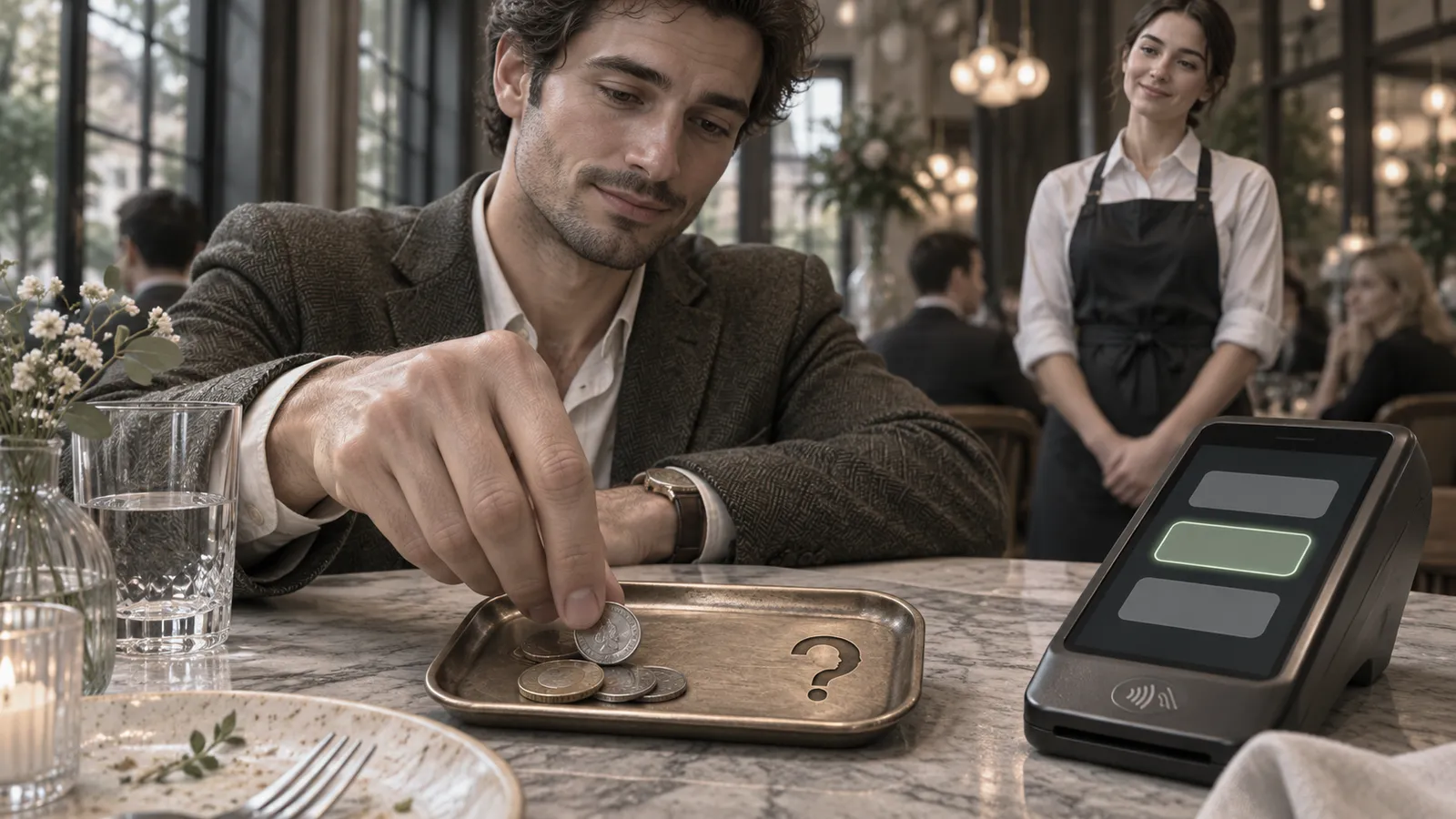
What a pooled analysis of thirteen studies, a norm-based model and thirteen million taxi rides say about the habit of leaving a tip.
Why do we tip?
Mostly because of a social norm, with a smaller wish to reward good service and a push from how the payment is presented. A pooled analysis of thirteen studies found only a weak link between service ratings and tip size, while default suggestions on a payment screen raised tips substantially.
Key takeaways
- A pooled analysis of seven published and six unpublished studies, covering 2,547 dining parties at twenty restaurants, found a positive link between service ratings and tip size that was much weaker than commonly assumed.
- Michael Conlin, Michael Lynn and Ted O'Donoghue modelled customers as weighing their own money against the discomfort of breaking the tipping norm.
- In more than thirteen million New York City taxi rides, default tip suggestions substantially raised tip amounts.
- Higher suggested amounts also led more customers to leave no card tip at all.
- Simler and Hanson's argument in The Elephant in the Brain, that visible generosity also serves how we appear to others, fits a norm that costs discomfort when broken, though the tipping studies measured amounts and not motives.
Why would a payment meant to reward good service follow the service so loosely? In a pooled analysis of thirteen studies, the size of the tip had only a weak link to how well customers said they were served. The pooled data covered dining parties at twenty restaurants, so the weak link is not an accident of one dining room. Something other than a running score of the meal must drive the habit, and each candidate leaves a different trace in the data.
Is a Tip Really Just a Reward?
Researchers have offered three broad accounts, and each predicts something different about the money left on the table. The table sets them side by side with the evidence this article draws on.
| Account | What it predicts | Evidence used here |
|---|---|---|
| Reward for service | Amounts rise steadily with service quality | Pooled analysis of thirteen studies and over two thousand dining parties |
| Social norm | Amounts follow a shared rule, and breaking it has a cost | Survey study with a norm-based model |
| Cue from the payment screen | Suggested amounts move the amount chosen | More than thirteen million taxi rides |
The first account says that a tip is for service done well. The second says it is the price of staying within a rule that most people nearby accept. The third says that the way the request is presented does part of the work, so the same customer may leave different sums on different screens. None of the three excludes the others, and the studies below suggest all three have some pull.
The pooled evidence on the first account is the most direct. Seven published and six unpublished studies, pooled by Michael Lynn and Michael McCall, showed a positive, statistically significant link between service evaluations and tip size. The link was much weaker than commonly assumed. They checked whether customer mood, how often a person visits, or servers favouring big spenders could account for it, and none of these explained it adequately.
The authors read the result as showing that diners do care about fair treatment, and that this concern is too faint to work as a measure of how well a server performed or as a strong incentive for good service. Two customers who leave the same amount may have rated the service quite differently, and a server who gives excellent service cannot count on a tip that matches it. The amount on the bill, then, says more about the setting and the customary figure than about a verdict on the meal.
Gratitude for a favour is the pull described in Reciprocity at the Sample Tray, where a small gift prompts a return; in the restaurant data it is present, and small. The pooled figures give that gratitude a measured size, and the size is the point: it is real enough to detect across 2,547 parties and too small to carry the whole habit.
What Keeps the Norm in Place?
If service does not set the amount, something else must. Survey data on restaurant tipping gave Michael Conlin, Michael Lynn and Ted O'Donoghue the material for a simple theory. In their account, customers weigh their own material well-being against the discomfort of breaking the norm. The tip percentage does follow service quality to some degree, but the authors conclude that the overall pattern is only partly efficient, and the model gives them a way to reinterpret earlier findings and to make new predictions.
A norm that carries a cost when broken fits the habit of tipping where no later benefit is on offer. The push then comes from how it would feel to walk away, and not from what the money will buy. Kevin Simler and Robin Hanson argue in The Elephant in the Brain that the stated reason for an everyday act and the reasons that drive it can differ, and that visible generosity serves how we appear to others as well as the person who receives the money.
That sits comfortably with the model: a customer who leaves the customary tip is partly buying the comfort of having met an expectation, and the service rating becomes one input among several. The tipping studies measured amounts and norms and not motives, so the two readings are best held side by side and neither treated as proved.
Do Suggested Amounts Change the Tip?
The third account has the largest dataset behind it, more than thirteen million New York City taxi rides, which Kareem Haggag and Giovanni Paci studied using a regression discontinuity design, a comparison of rides just either side of the fare at which the suggested options change. They found that default tip suggestions substantially raise the tips customers leave. A second analysis, based on customers being assigned to different cars in a quasi-random way, supported the result across a wider range of fares.
One plausible reading is that a few labelled options turn a vague duty into a choice among set amounts. That is close to the mechanism behind the sticky first number in Why the First Price You See Decides What You Pay, and it sits near the extra charges that appear late in a purchase, as described in Why Drip Pricing Still Works. In each case the figure on the screen shapes the decision more than the customer expects.
The three accounts are easiest to tell apart by what a restaurant, a driver or a customer could change. A server can change the service, which moves the tip only a little. A business can change the screen, which moves it a good deal. A customer can change very little except how closely to follow the customary figure. What we take from the three accounts is that a person at a table or in a taxi is rarely scoring the experience, and more often follows a rule, in a setting that nudges the amount, with a modest wish to treat the worker fairly.
The same study reports a cost to setting the defaults high. A suggestion can lift the average and still push some people out of the habit, which makes the choice of default a design decision with a trade-off. Higher suggested tips led more customers to leave no card tip at all.
Common questions
Why do we tip?
Mostly because of a social norm, with some wish to reward service and a push from how the payment is presented. Pooled evidence shows service quality has only a weak link to tip size.
Does a tip reflect how good the service was?
Slightly. A pooled analysis of thirteen studies found a positive but much weaker link than commonly assumed between service ratings and the amount left.
Do suggested amounts change what people leave?
Yes. In more than thirteen million taxi rides, default suggestions substantially raised the amounts left. Higher suggestions also led more customers to leave nothing on the card.
What is the norm behind it?
A shared expectation of leaving some amount after service. In the model of Conlin, Lynn and O'Donoghue, breaking the norm is an uncomfortable act, and customers weigh that discomfort against the value of keeping their own money in hand at the end of the meal.
Sources
Simler, K., & Hanson, R. The Elephant in the Brain: Hidden Motives in Everyday Life. Seed book; vault hub Books/The Elephant in the Brain.
Lynn, M., & McCall, M. (2000). “Gratitude and gratuity: a meta-analysis of research on the service-tipping relationship.” The Journal of Socio-Economics, 29(2), 203-214. doi:10.1016/s1053-5357(00)00062-7 https://doi.org/10.1016/s1053-5357(00)00062-7
Conlin, M., Lynn, M., & O'Donoghue, T. (2003). “The norm of restaurant tipping.” Journal of Economic Behavior & Organization, 52(3), 297-321. doi:10.1016/s0167-2681(03)00030-1 https://doi.org/10.1016/s0167-2681(03)00030-1
Haggag, K., & Paci, G. (2014). “Default Tips.” American Economic Journal: Applied Economics, 6(3), 1-19. doi:10.1257/app.6.3.1 https://doi.org/10.1257/app.6.3.1
Related concepts
People
More articles
- Why We Leave Gift Cards Unspent
How the form of money, a pull towards pleasure and open-ended deadlines help explain why some gift cards wait in a drawer.
- Why We Love Mystery Boxes
How a hidden prize turns into a specific question, and what research on the information gap, the teasing effect and blind box buyers suggests about why the question is part of the purchase.
- Why do we love limited editions?
A supply cap says different things to a seller, a rival buyer and a person who likes to be different. Five studies show what limited editions do in each case.
- Why We Watch Others Play Games
What surveys of stream and esports viewers, and one controlled test of learning by watching, say about release, learning, company and shared wins.
In these themes
- Paying
How the way we pay changes what we spend and how it feels.
- Culture and Ritual
How customs, seasons and ceremonies shape what we do and buy.