Why do weighted toys and comfort blankets calm us?
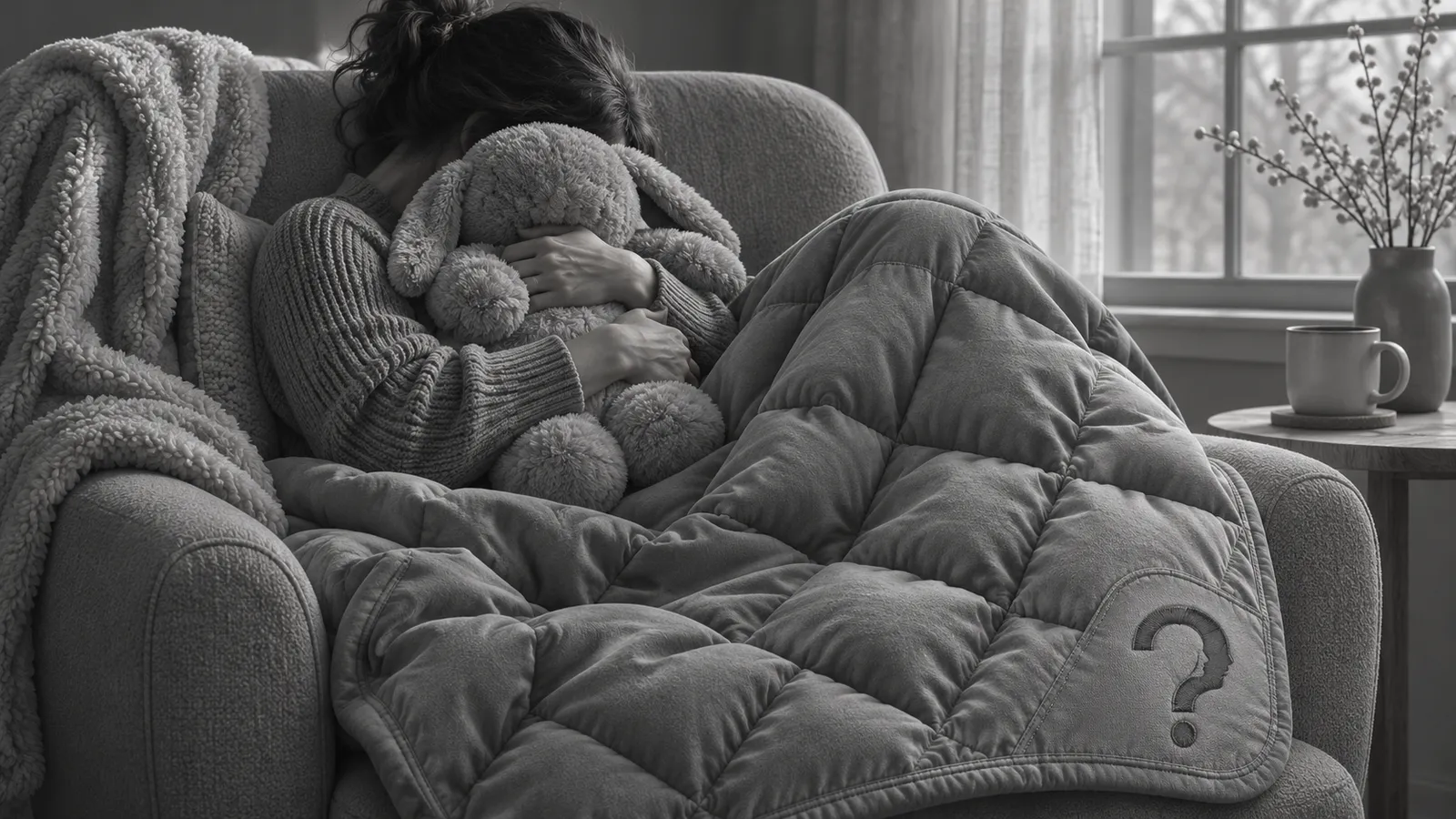
What research on pleasant touch, soft contact and the objects children keep says about why a comfort blanket or a weighted toy feels so right.
Answer to the question
Why do weighted toys and comfort blankets calm us?
A comfort blanket or weighted toy feels calming for three ordinary reasons. Slow, soft touch activates skin fibres tuned to pleasant contact, soft contact can outrank food for a frightened infant, and a particular object takes on a history that no copy shares. These describe comfort as an experience, not an effect on the body.
Key takeaways
- Line Löken and colleagues found that touch fibres in the skin called C-tactile afferents fire most at slow brushing, about 1 to 10 centimetres per second, the speeds volunteers rated most pleasant.
- In Harry Harlow's experiment, eight infant rhesus monkeys spent far more time on a cloth surrogate than a wire one, whichever supplied the milk.
- Susan Magsamen and Ivy Ross, in Your Brain on Art, describe rooms where the one people expected to settle them did not always match their wristband readings, so a felt sense of calm is not a measurement.
- In Bruce Hood and Paul Bloom's study of 43 children aged 3 to 6, children with a comfort object were far less willing than other children to take a copy in its place.
- Donald Winnicott introduced the transitional object in a paper presented in 1951 and published in 1953.
This article is general information about research on comfort blankets, weighted toys and how people respond to touch. It is not medical advice, and nothing in it is a reason to change any treatment or to stop seeking care. Speak to a GP or another clinician about your own health. Medical review: Reja Batool.
A toddler wakes in an unfamiliar room, finds a faded blanket with one frayed corner and holds it against her cheek. Across town an adult draws a heavy throw over his knees at the end of a long day and lets out a slow breath. Neither of them is solving a problem. Each is holding something soft or heavy and settling, which is why a comfort blanket, or a toy filled with weight, feels so right in the hands and sells so easily.
The research gives three ordinary reasons. Touch is processed as a social signal from the skin upward, soft contact can matter more to an infant than food, and one particular object can come to stand for safety in a way no copy can.
Why does soft touch feel good at all?
The skin carries a set of fibres that respond best to gentle, slow stroking. Line Löken and colleagues recorded from touch nerve fibres in people while a soft brush moved across the skin at different speeds. A class of unmyelinated fibres called C-tactile afferents fired most strongly at intermediate speeds, roughly 1 to 10 centimetres per second, and those were the speeds that volunteers rated as most pleasant. The other touch fibres did not show that pattern. The authors proposed that these fibres form a dedicated route for pleasant touch, likely tuned to affiliative contact between people.
That finding explains why a comfort blanket is usually drawn slowly across the skin and not tapped or pressed in quick bursts. A hand smoothing fabric, a thumb working along a seam and a stroked fur all fall inside the range the fibres prefer. It also explains why the material matters. Touch carries information about texture, temperature and weight, the qualities researchers group as haptic information, and a soft, warm, slightly heavy object supplies all three at once. A well-worn comfort blanket does this without effort, because years of use have made it supple and it takes on the warmth of the body that holds it.
Is it the softness or the food?
Harry Harlow put the question to infant rhesus monkeys in the 1950s. In his main experiment eight newborns were raised with two artificial mothers, one wrapped in soft cloth and one made of bare wire. Four infants were fed from the cloth mother and four from the wire mother, and then the roles were swapped between the groups. Whichever surrogate supplied the milk, the infants spent far more time clinging to the cloth one. When a frightening mechanical toy appeared, they ran to the cloth mother as well. Harlow concluded that contact comfort outweighs feeding as a source of an infant's affection, and he suggested that nursing matters mainly because it brings infant and mother into frequent close contact.
The study is about monkeys and surrogate shapes, and it does not translate straight into a claim about what a person gets from a comfort blanket. What it shows is narrower and more durable: softness with no food attached can be exactly what a frightened young animal seeks. It was an early challenge to the idea that feeding alone makes a bond, and the wider story of what infants seek from carers is told in What is attachment theory.
What does weight add to the feeling?
Weight is a form of touch too, and a heavy object held against the body gives steady, broad contact in place of the point contact of a light one. How far that adds to calm is a separate question from why soft touch pleases, and much of the research on weighted products asks clinical questions that sit outside the psychology of everyday comfort. What can be said here is about the feeling itself, and the qualities involved separate cleanly.
| Quality | What touch supplies | Everyday example |
|---|---|---|
| Softness | Gentle contact over a wide area | A comfort blanket drawn across the cheek |
| Weight | Steady pressure on the body | A weighted toy resting on the lap |
| Warmth | A temperature that suggests nearness | A blanket warmed by the body |
| History | A personal meaning no copy has | A comfort blanket kept for years |
Susan Magsamen and Ivy Ross, in Your Brain on Art, argue that the senses shape how a space or an object feels, and they describe a public installation of three rooms in which visitors wore wristbands that recorded body signals. Many visitors found that the room they expected to settle them did not always match what their readings showed.
That is a useful caution for anyone choosing a weighted toy. The sense of calm and a measured change are different things, so the honest claim for a weighted toy or a comfort blanket is that people often like how it feels, and the feeling is real as a feeling. Choosing one is a matter of liking the feel of it, much as choosing a favourite chair is, and the pleasure is worth having on those terms.
Why does one particular blanket matter?
Parents know that a child's comfort blanket cannot simply be swapped for an identical new one, and the experiment below puts that everyday knowledge to a test. Bruce Hood and Paul Bloom tested this with 43 children aged 3 to 6, 22 of whom had a comfort object they slept with and 21 of whom had an ordinary favourite toy.
A box described as a copying machine seemed to duplicate an object, and the children chose between original and copy. Among children with an ordinary toy, all agreed to the copying and about 62 percent chose the copy. Among children with a comfort object, four refused to let it be copied at all, and of the 18 who agreed, only 23 percent chose the copy.
A second experiment with 38 six-year-olds found that children valued an original linked to a particular person far above an identical copy, while an item whose value lay in its material, silver, gained no such premium. The comfort object works in the same way. It is valued as that object, with its own history, and not as a bundle of soft features. The sense that an object carries something of its owner is the same one behind Why Do Celebrity Objects Sell for More, and the pull of something personally made sits in Why You Love the Thing You Assembled.
Donald Winnicott gave the idea its best-known name, the transitional object, in a paper presented in 1951 and published in 1953. The attachment of young children to such objects is well documented and varies across cultures and sleeping arrangements, while Winnicott's broader claims about creativity remain theory. The finding that holds is the plain one. A weighted toy may borrow the feel of being held, but the blanket that matters most is the one with a history, which is why a duplicate does not do the same work.
Common questions
Why do weighted toys and comfort blankets calm us?
Soft, slow touch activates fibres in the skin that are tuned to pleasant contact, and an object with a history of safety adds meaning to the feeling. Studies of infants and of children show that contact and a particular object both matter. These are accounts of comfort as an experience, not claims about any effect on the body.
Is a comfort blanket the same as a weighted blanket?
No. A comfort blanket is valued as one specific object with a history. A weighted blanket adds steady pressure to softness, and its appeal rests on how it feels.
Do children choose softness over food?
In Harry Harlow's 1950s experiment, infant monkeys spent far more time on a cloth surrogate than a wire one, whichever supplied milk.
Can a duplicate comfort object work as well?
In Bruce Hood and Paul Bloom's study, children with a comfort object were far less willing than other children to accept a copy.
Sources
Magsamen, S., & Ross, I. Your Brain on Art. Seed book; vault hub Books/Your Brain on Art.
Löken, L. S., Wessberg, J., Morrison, I., McGlone, F., & Olausson, H. (2009). Coding of pleasant touch by unmyelinated afferents in humans. Nature Neuroscience, 12(5), 547-548. doi:10.1038/nn.2312 https://doi.org/10.1038/nn.2312
Harlow, H. F. (1958). The nature of love. American Psychologist, 13(12), 673-685. doi:10.1037/h0047884 https://doi.org/10.1037/h0047884
Hood, B. M., & Bloom, P. (2008). Children prefer certain individuals over perfect duplicates. Cognition, 106(1), 455-462. doi:10.1016/j.cognition.2007.01.012 https://doi.org/10.1016/j.cognition.2007.01.012