Why does Singles’ Day work?
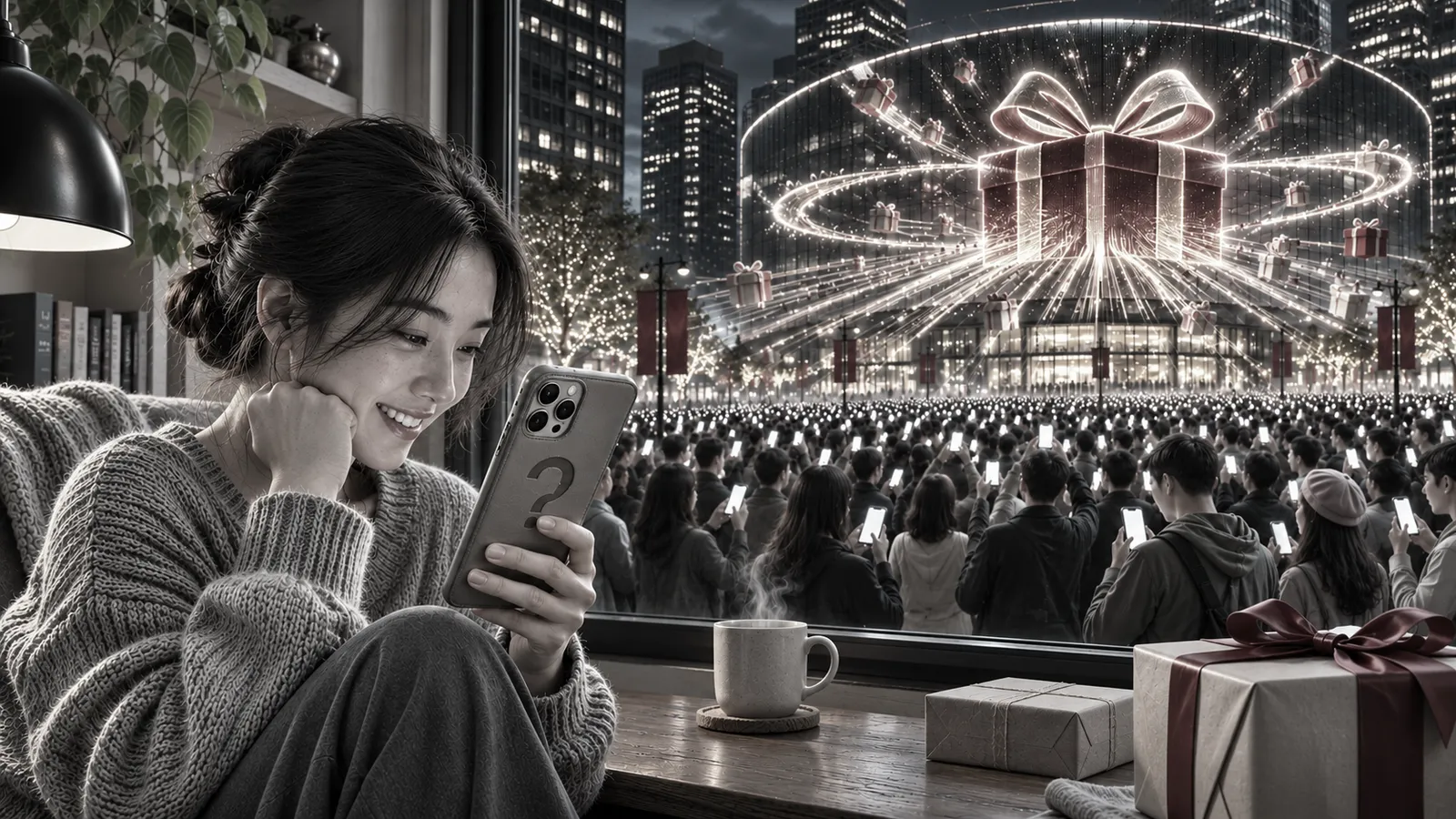
A shared date, an early logic of togetherness and the pull of the clock: what research says about why a shopping day on 11 November draws a crowd.
Answer to the question
Why does Singles’ Day work?
Singles’ Day works because it supplies a shared date, a sense of togetherness and a deadline at once. The date acts as a focal point that needs no announcement, the day began as a celebration among young people and kept that framing, and among 239 young consumers perceived time pressure strengthened the link between festival atmosphere and excitement.
Key takeaways
- Singles’ Day began as a way for young people in China to celebrate being single, and since 2009 an e-commerce company has built it into the largest online shopping day in the world (Sun and Creech, 2019).
- Research on focal points in coordination games explains why people choose the option that stands out when everyone wants to match; a repeated-digit date fits that description (Colman, 1997).
- Sun and Creech found that the day moved toward consumerism but that its meaning still rests on an early logic of celebrating togetherness through consumption.
- In Michael Morris’s Tribal, a custom can come to feel long established within a generation, as with Thanksgiving in the United States.
- Among 239 consumers in their 20s and 30s, festival atmosphere raised excitement and perceived time pressure strengthened the links for entertaining and social atmosphere (Xie, Yoon and Choo, 2023).
Four ones in a row is an unusual gift from a calendar. Singles’ Day falls on the eleventh of November.
The day began as a way for young people in China to celebrate being single, and few promotions can say that their start is already printed on every calendar. Since 2009 an e-commerce company has turned the day into the largest online shopping day in the world, according to Weimei Sun and Brian Creech, and what carries it is a date, a story and a deadline that millions of strangers share and nobody had to agree on in advance.
A shared date coordinates everyone
Most shopping events need an announcement. Singles’ Day needs almost none, because the date is a number nearly everyone can recall. Coordination problems, where each person wants to act on the same thing as everyone else, have a long research tradition. Andrew Colman’s 1997 review of salience and focusing in pure coordination games sets out why people choose the option that stands out when every player wants to match the others, and treats such focal choices as intuitive and effective. A date made of repeated digits stands out in just that way, since buyers, sellers and onlookers can each guess that the rest are watching it too.
Three things come with the date, and none of them has to be arranged:
- A moment everyone can name, so nobody has to ask when it is.
- A story about where it came from, which makes it feel like a custom and not a campaign.
- A deadline built into the calendar itself, because the day ends and the next one is an ordinary day.
None of the three is a price. Applying the idea to a calendar is our step, not a finding about shopping, and each item is a social fact. A discount on an unremarkable afternoon gives the shopper a lower number. A discount on Singles’ Day gives the shopper a lower number and the knowledge that a very large crowd is acting in the same hours. That is why the event is often described as a manufactured shopping holiday: the date was made into an occasion, and the occasion does work that a banner cannot.
Togetherness comes before the discount
Sun and Creech studied news coverage of Singles’ Day alongside posts on a social media platform, looking for the consumerist ideas that grew up around it. They found that the day moved toward consumerism over time, in step with demographic change, and that its meaning still rests on an early cultural logic that celebrated togetherness through consumption. A day that began with single people marking something side by side carried that framing into its commercial form.
A related line of work asks why people seek out shared experiences at all. Eshin Jolly, Diana Tamir, Bethany Burum and Jason Mitchell ran seven experiments in which people showed a strong motivation to take part in shared experiences, yet that motivation did not come with a matching rise in enjoyment. Participants reported being driven by a wish to connect with others. The authors conclude that the desire to share may come from a need for connection and not from immediate pleasure.
This helps explain why Singles’ Day is hard to copy with a price cut alone. The discount is the entry ticket and taking part is the product. A shopper who buys on a random Tuesday gets the goods. A shopper who buys on Singles’ Day gets the goods and the sense of having been in the same event as everyone else. Neither set of authors tested that claim directly, but it fits what both report: the pull is social first and financial second, an order that matters to anyone trying to copy the day.
New events can feel ancient
A tradition does not need centuries to feel settled. In Tribal, Michael Morris argues that customs can come to feel long established within a generation or two. His main example is Thanksgiving in the United States, which he traces to national proclamations in the 1860s. The stories of an earlier first thanksgiving, told and retold as families gathered each year, gave the day the feel of something that had always been there. The historian Eric Hobsbawm gave such customs the name invented traditions. Singles’ Day runs the same process on a shorter clock: a date, a yearly gathering and an origin story that people repeat, with the commercial layer added in 2009.
Morris calls the cues that tie a new custom to an older one precedent signals. In his account of Thanksgiving, the proclamations followed the naming and timing of earlier ones, so the new day read as the continuation of a series. A name that echoes earlier years and a date that returns every November do similar work for Singles’ Day. A custom that has come back every year since 2009 has built up a precedent of its own, and each repeat makes the next one feel more expected and less like an offer.
The clock lifts the mood
Once a day feels like a custom, the clock shapes how it feels. Jiali Xie, Namhee Yoon and Ho Jung Choo surveyed 239 consumers in their 20s and 30s about the atmosphere of the Double Eleven online shopping festival. They separated three kinds of atmosphere: promotional, entertaining and social interaction. All three raised excitement, and excitement in turn strengthened the intention to keep taking part. Perceived time pressure changed the strength of those links. The more pressure consumers felt, the stronger the tie between an entertaining or social atmosphere and excitement, with the largest effect for entertainment and the next largest for social interaction.
The deadline therefore does more than hurry people, because it makes the party feel livelier. The same pull sits behind the fear of missing out at the till, and a countdown timer on a sale page borrows a small version of it. On Singles’ Day everyone is working to the same date, which gives each participant a reason to feel the pressure and a crowd to feel it with. An event that is already a custom, already social and already on a fixed date gets more from the minutes that remain than a plain sale would. The clock is part of the gathering.
Common questions
Why does Singles’ Day work?
It supplies a shared date, a sense of togetherness and a deadline at the same time. The date acts as a focal point that needs no announcement, and the day began as a celebration among young people and kept that togetherness framing. Among 239 young consumers, perceived time pressure strengthened the link between festival atmosphere and excitement.
Where does Singles’ Day come from?
It began as a way for young people in China to celebrate being single on 11 November. Since 2009 an e-commerce company has built it into an online shopping festival, according to Weimei Sun and Brian Creech.
Is Singles’ Day only about discounts?
Research on the day finds that its meaning rests on an early logic of celebrating togetherness through consumption. Studies of shared experiences add that the wish to take part can come from a need for connection.
Does time pressure make shoppers more excited?
In a survey of 239 young consumers, higher perceived time pressure strengthened the link between an entertaining or social festival atmosphere and excitement.
Sources
Morris, M. Tribal. Seed book; vault hub Books/Tribal.
Sun, W., & Creech, B. (2019). Celebratory consumerism on China’s Singles’ Day: From grass-roots holiday to commercial festival. Global Media and Communication, 15(2), 233-248. doi:10.1177/1742766519848453 https://doi.org/10.1177/1742766519848453
Colman, A. M. (1997). Salience and focusing in pure coordination games. Journal of Economic Methodology, 4(1), 61-81. doi:10.1080/13501789700000004 https://doi.org/10.1080/13501789700000004
Jolly, E., Tamir, D. I., Burum, B., & Mitchell, J. P. (2019). Wanting without enjoying: The social value of sharing experiences. PLOS ONE, 14(4), e0215318. doi:10.1371/journal.pone.0215318 https://doi.org/10.1371/journal.pone.0215318
Xie, J., Yoon, N., & Choo, H. J. (2023). How online shopping festival atmosphere promotes consumer participation in China. Fashion and Textiles, 10(1), 5. doi:10.1186/s40691-022-00325-5 https://doi.org/10.1186/s40691-022-00325-5