Why Saving Feels Like Losing
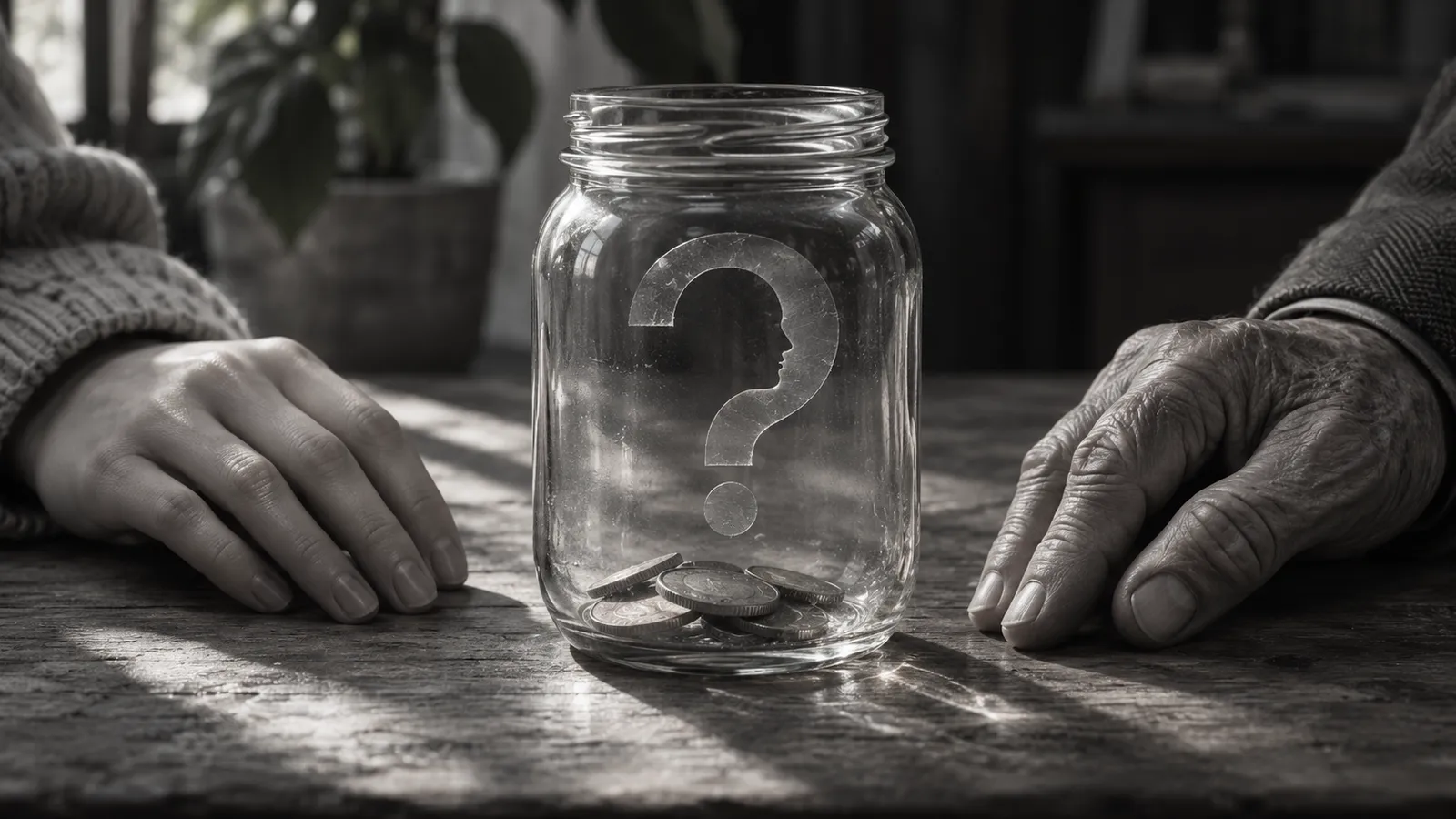
Money moved into savings is handed to a person who is not yet here. Present bias discounts the gift, and the research on the future self explains why the recipient can feel like a stranger.
Why is saving money so hard?
Saving is hard partly because of present bias: money that can be used now carries more weight than the same money later, so a transfer to savings feels like a loss in the moment. Studies also find that people treat their future selves partly like other people, and that making the future self feel familiar shifted choices toward later rewards.
Key takeaways
- In a brain-scanning study, choices that included money available now drew most strongly on reward regions tied to the dopamine system, while regions engaged by every choice tracked picking the later option (McClure and colleagues, 2004).
- Across four experiments, people's decisions for their future selves resembled their decisions for other people (Pronin and colleagues, 2008).
- People who felt less connected to the person they would become made more impatient choices, whether that connection was measured or lowered by the experimenters (Bartels and Urminsky, 2011).
- Meeting an age-progressed rendering of one's own face made people more inclined to choose later monetary rewards (Hershfield and colleagues, 2011).
- In the first company to use a plan where employees committed future pay rises to retirement saving, 78 per cent of those offered joined and average saving rates rose from 3.5 to 13.6 per cent over 40 months (Thaler and Benartzi, 2004).
Moving money into savings is a transaction with two parties, and one of them is absent. The person at the screen gives up something usable tonight; the person who benefits turns up years later. Economists call the resulting tilt present bias: a reward available now carries more weight than the same reward later. In the moment of choosing, saving is a loss to the only self present to feel it, though nothing about the money itself is lost. What goes is the use of it now, valued by present bias at more than the wait alone would justify, and the rest of the feeling comes from how the later person is imagined.
Where does present bias act?
A choice between some money now and more money later has been put to volunteers lying in a brain scanner. Samuel McClure, working with David Laibson, George Loewenstein and Jonathan Cohen, offered such pairs and watched two sets of regions. Areas in and around the limbic system, tied to the brain's dopamine circuits, responded most strongly when one option could be had immediately. Regions of the lateral prefrontal and posterior parietal cortex were engaged by every choice, whatever the delays. The balance between the two tracked the decision: more activity in the prefrontal and parietal regions went with picking the later, larger amount.
That pattern matches the shape of present bias set out in What is hyperbolic discounting, where a near reward gains a pull that a distant one lacks. Applied to saving, which the study did not test directly, it suggests that much of the difficulty sits in the moment of choice. A transfer to savings is a decision between an immediate option, keeping the money spendable, and a delayed one, and in the scanner it was options available now that most engaged the reward regions, while choosing the later amount went with more activity in the regions that every choice engaged.
This is why saving rarely feels like a neutral swap of one number for another. Only one of the two uses of the money is available today, and present bias treats that availability as a feature in its own right. The cost is felt in full at the point where the immediate option is given up, while the gain is spread across a future that nobody is yet living in. That asymmetry puts the hardest part of saving at the moment of transfer.
Who receives the money you save?
Present bias on its own treats the future as the same person at a later date, but that person may be imagined as somewhat less. In four experiments run by Emily Pronin, Christopher Olivola and Kathleen Kennedy, people decided how much of an unpleasant drink to consume for a study, how much time to give to tutoring during exam week, and whether to defer a lottery prize for a larger one. Choices made for their future selves resembled the choices they made for other people and differed from choices made for their present selves. The pattern appeared when the decisions were real and not when they were hypothetical, and it weakened when attention turned to how the experience would feel.
Hal Ersner-Hershfield, who now publishes as Hal Hershfield, scanned 18 young adults with colleagues including Brian Knutson as they rated personality traits for their current self, their future self and other people. A region near the front of the brain, the rostral anterior cingulate cortex, was more active for the current self than for the future self. People with the largest gap between the two discounted future money more steeply in a task about a week later.
These studies give the feeling of loss a recipient. Money set aside is in a real sense money handed over, to a person who shares a name and an account but is felt as a partial stranger. Future self continuity, the degree of overlap a person feels with who they will be, is the quantity this research tries to measure. Present bias explains why the gift is discounted at the moment it is made; weak future self continuity explains why the recipient seems to deserve less of it.
A future self that keeps changing
Morgan Housel, in The Psychology of Money, argues that long-range money plans fail less from poor arithmetic than from the fact that the person who made them will not stay the same. That argument has a measured counterpart. Jordi Quoidbach, Daniel Gilbert and Timothy Wilson asked people aged 18 to 68 how much their personality, values and preferences would change over the next ten years, and asked others how much they had changed over the past ten. At every age, people reported more past change than people ten years younger expected for the decade ahead. The authors called this the end-of-history illusion.
What a sense of change does to patience was tested directly by Daniel Bartels and Oleg Urminsky. When people felt less connected to the person they would become, whether measured or lowered by the experimenters, people more often took a smaller amount sooner, were less willing to wait in order to save money on a purchase, and wanted a larger premium before agreeing to delay a gift card.
Here the two findings meet awkwardly for saving, and present bias sharpens the problem. People underestimate how much they will change, yet when they do sense change they become less willing to provide for the self that results. Expecting change makes plans sturdier, in Housel's account, while feeling distant from the changed person makes them harder to fund. Change and connection can be separated. A person can expect different tastes at 60 and still feel firmly tied to the one who will hold them, and it is the tie, more than the sameness, that the patience studies tracked.
Two levers the studies tested
If the future self feels like a stranger, one line of research tried making the stranger familiar. Hershfield and colleagues let participants meet age-progressed digital renderings of their own faces, in immersive virtual reality in some studies and through interactive decision aids in others. Across four studies, people who met their aged selves were more inclined to choose later monetary rewards over immediate ones and to allocate more to the future. The renderings changed who the saving seemed to be for.
A second response moves the decision away from the feeling. In a plan designed by Richard Thaler and Shlomo Benartzi, employees agreed in advance to put part of their future pay rises into retirement saving. In the first company to use it, 78 per cent of those offered the plan joined, about 80 per cent stayed in through the fourth pay rise, and average saving rates went from 3.5 per cent to 13.6 per cent over 40 months. The design meets present bias on its own terms, since a cost in the future weighs less than a cost now, though it reaches only people willing to be locked in, a limit examined in Does Precommitment Really Work.
| Lever in the study | What changed | Link in the chain it touched |
|---|---|---|
| Meeting an age-progressed image of oneself | More choices of later rewards | How familiar the future self feels |
| Committing future pay rises in advance | Saving rates rose over 40 months | When the cost is felt |
| Lowering felt connection to the future self | More impatient choices | The tie to the future self |
| Attention on how an experience would feel | Choices for the future self became less like choices for others | How vivid the future feels |
Present bias sets the price of giving up money now; felt distance from the future self sets how much the recipient seems to deserve; and the tie to the person one will become sets how much patience feels worth spending. Each lever that moved behaviour touched one link of that chain while the money itself stayed exactly where it was.
Common questions
Why is saving money so hard?
Present bias gives money that can be used now more weight than the same money later, so moving it into savings registers as a loss in the moment. Studies also find that people treat their future selves partly like other people, which makes the later benefit feel as if it goes to someone else.
What is present bias?
Present bias is the tendency to give a reward available now more weight than the same reward later, by more than the delay alone would justify. In brain-imaging work, choices that included immediate money engaged reward-related regions more strongly than choices involving only delayed money.
What is future self continuity?
It is how connected a person feels to the person they will become. In studies, people with a weaker sense of that connection more often chose smaller, sooner rewards, and people shown age-progressed images of themselves chose later rewards more often than those who were not.
Sources
Housel, M. The Psychology of Money. Seed book.
McClure, S. M., Laibson, D. I., Loewenstein, G., & Cohen, J. D. (2004). Separate neural systems value immediate and delayed monetary rewards. Science, 306(5695), 503-507. doi:10.1126/science.1100907 https://doi.org/10.1126/science.1100907
Pronin, E., Olivola, C. Y., & Kennedy, K. A. (2008). Doing unto future selves as you would do unto others: Psychological distance and decision making. Personality and Social Psychology Bulletin, 34(2), 224-236. doi:10.1177/0146167207310023 https://doi.org/10.1177/0146167207310023
Ersner-Hershfield, H., Wimmer, G. E., & Knutson, B. (2009). Saving for the future self: Neural measures of future self-continuity predict temporal discounting. Social Cognitive and Affective Neuroscience, 4(1), 85-92. doi:10.1093/scan/nsn042 https://doi.org/10.1093/scan/nsn042
Quoidbach, J., Gilbert, D. T., & Wilson, T. D. (2013). The end of history illusion. Science, 339(6115), 96-98. doi:10.1126/science.1229294 https://doi.org/10.1126/science.1229294
Bartels, D. M., & Urminsky, O. (2011). On intertemporal selfishness: How the perceived instability of identity underlies impatient consumption. Journal of Consumer Research, 38(1), 182-198. doi:10.1086/658339 https://doi.org/10.1086/658339
Hershfield, H. E., Goldstein, D. G., Sharpe, W. F., Fox, J., Yeykelis, L., Carstensen, L. L., & Bailenson, J. N. (2011). Increasing saving behavior through age-progressed renderings of the future self. Journal of Marketing Research, 48(SPL), S23-S37. doi:10.1509/jmkr.48.SPL.S23 https://doi.org/10.1509/jmkr.48.SPL.S23
Thaler, R. H., & Benartzi, S. (2004). Save More Tomorrow: Using behavioral economics to increase employee saving. Journal of Political Economy, 112(S1), S164-S187. doi:10.1086/380085 https://doi.org/10.1086/380085
Related concepts
People
More articles
- Why Flavour Lives in the Nose
Smell reaches the nose two ways, and the one that runs up from the mouth carries most of what makes one food different from another. A cold blocks that route, and the tongue gets the blame.
- Why the Menu Description Changes the Taste
The words on a menu decide what reaches the table, and they also set the frame in which the first mouthful is judged. Both effects are largest when the words and the food agree.
- Why Joyful Objects Lift Us
Bright colour, a soft curve and a generous quantity each lift an object through a different mechanism, and all three depend on what the object already means to the person holding it.
- Why We Buy the Brands Our Parents Bought
A parent's shopping habit is a brand's first market. Children learn brands at home before they learn prices, and for everyday goods the family choice travels well into adult life.