Cliques Are a Stress Response
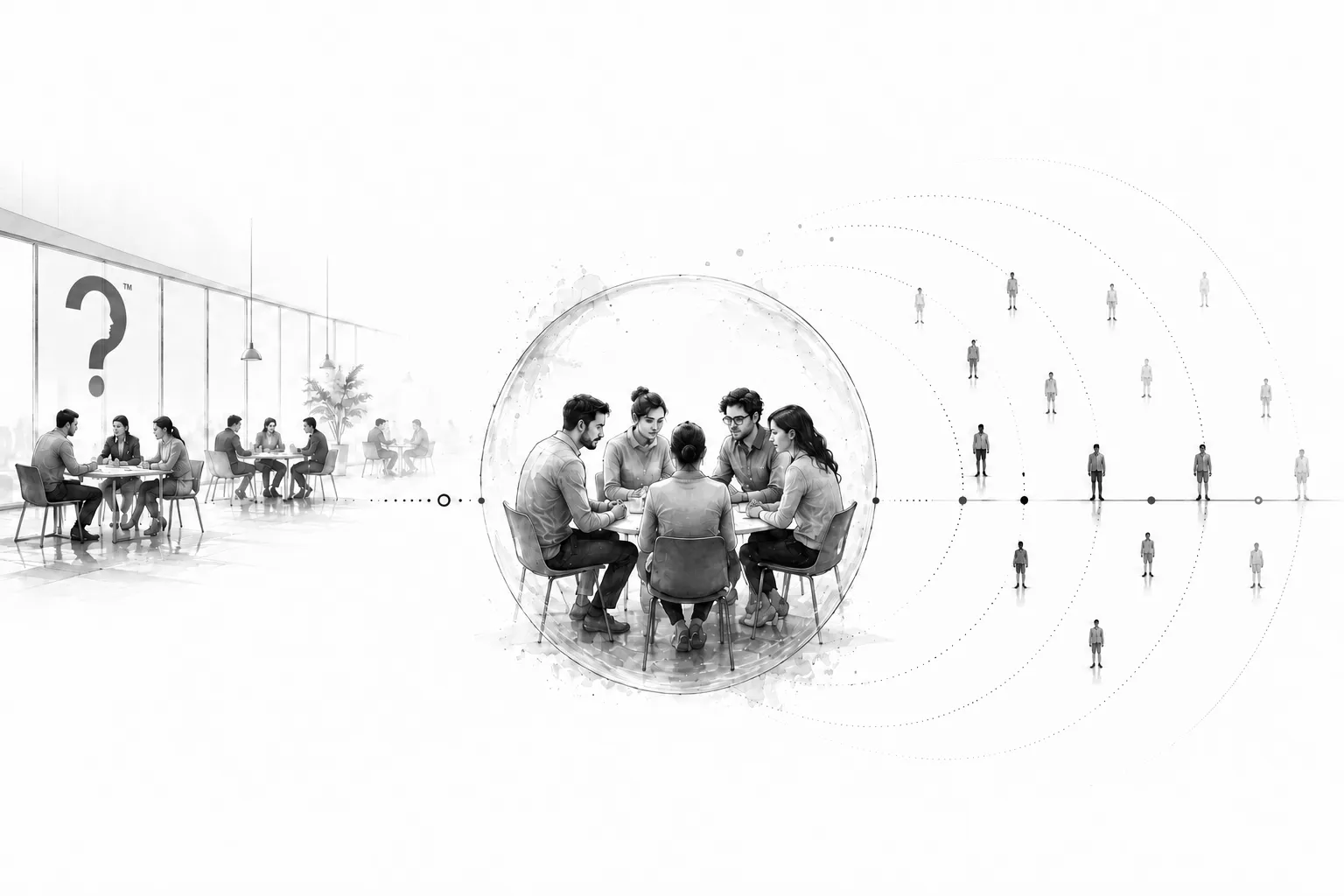
Why groups close ranks when the environment gets hard, and why the exclusion is the mechanism rather than the malfunction
Key takeaways
- The innermost layer of a person's social network is called the support clique. Robin Dunbar and Matt Spoors named it in 1995 and defined it by who you would turn to in severe distress, not by affection.
- Stress does not only trigger fight-or-flight. Shelley Taylor's tend-and-befriend account puts affiliation inside the stress response itself.
- Uncertainty makes people seek out sharply bounded groups specifically. In Michael Hogg's 2007 experiment, uncertain participants identified with tight groups at 6.98 on a nine-point scale against 4.61 for loose ones.
- A 2025 cortisol study found friends lower stress only when facing the same stressor. A friend who came purely to support, and was not being evaluated, raised cortisol instead.
- The exclusion is the mechanism rather than the fault, which is why enforced inclusion tends to make things worse rather than better.
Something happens to an office about three weeks after a reorganisation gets announced. Lunch rearranges itself. The same six people start eating together, invitations get quieter, and someone who used to drift between tables discovers they have been assigned to one. Leadership notices, calls it a culture problem, and books an offsite.
It is a stress response, and the exclusivity everyone objects to is the part doing the work.
Cliques get discussed almost entirely as a moral failure: petty, cruel, something we should have grown out of after school. That framing survives because it feels true from the outside. In the research a clique is a small, sharply bounded group doing a specific physiological job, and the boundary is not decoration on top of the friendship. It is the load-bearing wall.
The innermost five
The innermost layer of a person's social network is called the support clique, and it holds about five people. Robin Dunbar and Matt Spoors named it in 1995, in a study of British adults' social networks, and defined it by function rather than affection: the support clique is the set of people you would turn to in times of severe emotional, social or financial distress. The rest of the network sits in wider rings of roughly fifteen, fifty and a hundred and fifty, with emotional intensity dropping as the numbers climb.
Decades before anyone was writing think-pieces about mean girls and office [in-groups](https://thewhyweproject.com/articles/what-is-in-group-bias), the literature had already named the tightest circle of human relationships after what it does under pressure. The clique is the layer we reach for when things go wrong.
The standard account of the stress response, fight-or-flight, is incomplete, and Shelley Taylor's team said so in Psychological Review in 2000. Their alternative, tend-and-befriend, proposes that the behavioural response to stress runs through affiliation: tending, meaning nurturant activity that reduces distress, and befriending, the creation and maintenance of social networks. Under threat, one of the things the body does is go looking for people.
Two honest caveats. Taylor's paper argues this pattern is more characteristic of females than males, and it drew a published rebuttal from David Geary and Mark Flinn in the same journal in 2002. The core observation, that affiliation is a stress behaviour rather than merely a comfort, has held up better than the sharpest version of the sex difference. Treat it as a serious account of why the impulse exists, not as settled detail about who has it.
Edges, not company
Uncertainty makes people want a particular kind of group, one with visible edges.
Michael Hogg's uncertainty-identity theory holds that people identify with groups to reduce uncertainty about themselves, and that the effect depends on a property called [entitativity](https://thewhyweproject.com/articles/what-is-entitativity), how much a group reads as a real, bounded entity. Hogg's list of what makes a group entitative is almost a definition of a clique: clear boundaries, internal homogeneity, social interaction, clear internal structure, common goals, and common fate.
In 2007, Hogg and colleagues tested the interaction in the Journal of Experimental Social Psychology. In their second experiment, 89 undergraduates were primed to feel either certain or uncertain about themselves, and placed in groups presented as either tightly or loosely structured. Identification among uncertain participants in tight groups scored 6.98 on a nine-point scale. Uncertain participants in loose groups scored 4.61, barely above the participants who felt certain and were in loose groups, at 3.93.
Same uncertainty, same people. The only difference was whether the group had edges.
In the reorganised office the stressor is not the workload, it is not knowing where you stand, and the group that answers that question best is the one with a clear inside and outside.
Size follows from the same requirement. A group has to be small enough to feel distinct and large enough to feel like belonging. Marilynn Brewer called this optimal distinctiveness in 1991: people carry two competing needs, for inclusion and for differentiation, and satisfy both through groups that are neither too broad nor too narrow. Identification peaks in the middle of the range.
A company-wide culture is too inclusive to answer the question who am I here. A friendship of two is too fragile to buffer much. Five or six sits at the top of the curve, the same number as the support clique.
The building does it
A secondary school is the most efficient clique-generating environment we have built, and it produces cliques for structural reasons rather than developmental ones. They are associated with adolescence so strongly that most people file them as a phase.
Run the conditions against the research. Attendance is compulsory, so nobody can self-select away from the stressor. Evaluation is constant and public, the exact ingredient the Trier Social Stress Test isolates in a laboratory. Self-concept is in flux, which is Hogg's self-uncertainty in its purest form. And there is no legitimate way to shrink the group: you cannot choose your year, your class or your corridor.
A sharply bounded group of five or six is the correct answer to the problem the building poses. If you wanted to design an environment that manufactured entitative in-groups, you would design a school.
Most anti-clique programmes target the behaviour and leave every one of those conditions untouched. It is the same error as the offsite, run on people with less power to refuse it.
The adult versions are quieter but structurally identical. An open-plan office makes evaluation continuous. A start-up with no defined roles is uncertainty as a business model. In each case the tightening gets read as a personality problem belonging to whoever is doing it.
The supporter who makes it worse
Friends lower your stress hormones only when they are facing the same thing. A 2025 study in Psychoneuroendocrinology by Clarissa Filetti, Megan Gunnar and colleagues put 235 young people aged eleven to fifteen through an online version of the Trier Social Stress Test, the standard laboratory stressor, and randomly assigned them to face it alone, with an unfamiliar peer who was also tested, with a friend who came only to support them, or with a friend who was tested too.
The pre-registered prediction held. Friend support lowered cortisol reactivity when both friends underwent the stressor. When the friend was there purely as a supporter, and was not being evaluated themselves, cortisol went up.
A supportive friend who is not under the same pressure made the stress measurably worse.
What buffers stress is shared exposure rather than company or affection. The person who helps is the person in it with you; the person who is merely watching, however kindly, is another observer, and the body appears to score them as audience rather than ally.
Which is why the boundary exists. A group formed to metabolise a stressor cannot let in someone who is not carrying it, because that person changes what the group is for. Common fate is the sixth item on Hogg's entitativity list, and this is its physiological version. Exclusion is not the by-product of the clique. It is the specification.
What to do about the offsite
The intervention most organisations reach for is enforced inclusion: mix the tables, rotate the teams, run the exercise about openness. On this evidence that attacks the load-bearing wall. Adding a well-meaning outsider to a group that formed around a shared pressure does not dilute the clique; it adds a spectator, and the research suggests spectators raise the stress rather than lower it.
If cliques have appeared, something in the environment is generating uncertainty, and people have built the cheapest available machine for handling it. The clique is the symptom. Treat the stressor: say clearly who is safe, what is changing, and when people will know. The tables loosen without anyone being told to sit somewhere else.
We should be careful not to launder the cruelty here. Explaining a mechanism is not excusing what rides along with it, and plenty of exclusion has nothing to do with shared stress and everything to do with status. The research explains why the boundary is stubborn. It does not make being on the wrong side of one harmless.
The mechanism predicts where the damage lands. If a clique metabolises stress for the people inside it, the person outside carries the same environmental pressure with no group to process it, and per the Filetti result may be raising the stress of anyone they lean on who is not in the same position. The stress does not disappear when a group closes. It concentrates on whoever is left outside.
The healthiest-looking teams and the most exclusionary ones may be running identical machinery. The difference between them is whether the environment is calm enough that nobody needs the machine switched on.
Sources
Dunbar, R. I. M., & Spoors, M. (1995). “Social networks, support cliques, and kinship.” Human Nature, 6(3), 273–290.
Taylor, S. E., Klein, L. C., Lewis, B. P., Gruenewald, T. L., Gurung, R. A. R., & Updegraff, J. A. (2000). “Biobehavioral responses to stress in females: Tend-and-befriend, not fight-or-flight.” Psychological Review, 107(3), 411–429. doi:10.1037/0033-295X.107.3.411.
Geary, D. C., & Flinn, M. V. (2002). “Sex differences in behavioral and hormonal response to social threat: Commentary on Taylor et al. (2000).” Psychological Review, 109(4), 745–750.
Hogg, M. A., Sherman, D. K., Dierselhuis, J., Maitner, A. T., & Moffitt, G. (2007). “Uncertainty, entitativity, and group identification.” Journal of Experimental Social Psychology, 43(1), 135–142. doi:10.1016/j.jesp.2005.12.008.
Brewer, M. B. (1991). “The social self: On being the same and different at the same time.” Personality and Social Psychology Bulletin, 17(5), 475–482.
Filetti, C. R., Tsakonas, N. C., Donzella, B., Thomas, K. M., & Gunnar, M. R. (2025). “Share-the-load vs bring-your-own-judge: The effects of friends on social evaluative stress in early adolescence.” Psychoneuroendocrinology.