Why You Hear Your Name in a Crowd
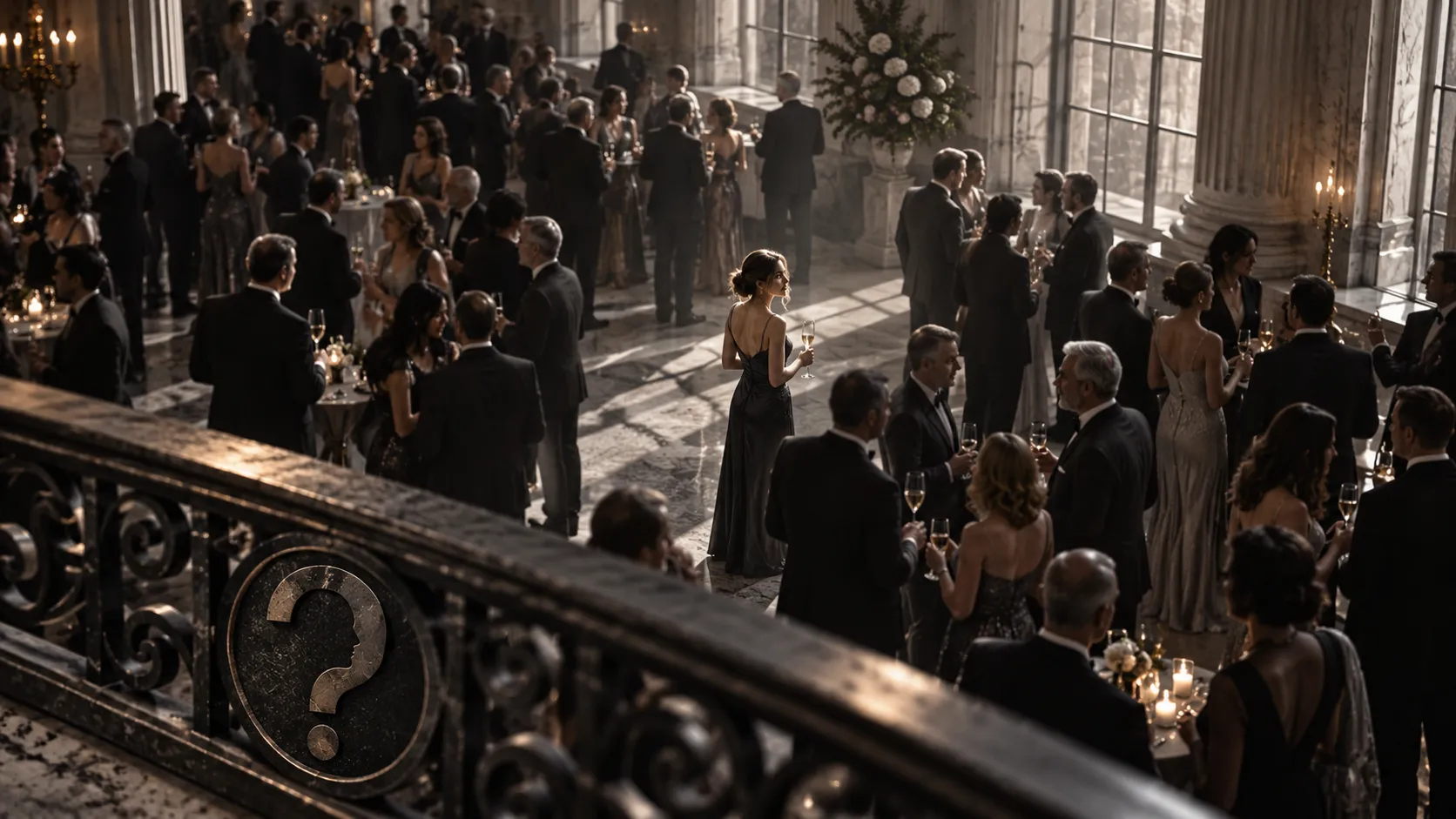
Your name breaks through a conversation you are ignoring for about a third of listeners in the laboratory. The people who notice are not simply the ones with the leakiest filter, and the group that suppresses distraction worst heard it least.
Answer to the question
Why do you hear your name across a crowded room?
On Anne Treisman's account the brain turns an ignored voice down without switching it off, and your own name keeps a permanently low threshold for recognition. About a third of people in listening experiments notice it. They tend to be people with attention to spare, and older adults, who had less to spare, noticed their names far less often.
Key takeaways
- Neville Moray (1959) found that listeners shadowing one ear mostly missed the other, with the exception of their own name, and replications put the share who notice at 34.6 per cent (Wood and Cowan, 1995) and 29 per cent (Röer and Cowan, 2021).
- In Conway and colleagues' 2001 study, 65 per cent of 20 low working memory span students noticed their name in the ignored message against 20 per cent of 20 high-span students.
- Gazzaley and Rosen's The Distracted Mind (2016) holds that ignoring is an active operation, and a 2005 study from Gazzaley's group found older adults less able to suppress irrelevant information, which predicts older adults would hear their name more.
- Naveh-Benjamin and colleagues (2014) found the reverse: 58 per cent of 50 young adults noticed their name in the unattended channel against 3 per cent of 29 older adults.
- The authors of the 2014 study propose an inhibition factor and an attentional capacity factor, so hearing your name needs spare attention as well as a filter that leaks.
You hear your name across a crowded room because the brain turns an ignored voice down without switching it off, and because some attention is left over to catch it. In laboratory listening tasks about a third of people notice their own name in a message they were told to ignore. Those who notice are more often people with capacity to spare than people with a leaky filter, and the group that suppresses distraction worst noticed it least.
A Filter That Turns Ignored Voices Down
The problem was set in 1953, when Colin Cherry gave it its name, the cocktail party problem. His listeners heard two spoken messages at once and repeated one of them aloud, a task called shadowing. They could tell when the voice in the rejected message changed from a man's to a woman's. They could not say what its words had been.
Donald Broadbent's filter theory, published in 1958, explained this by blocking the unattended message early, before its meaning was analysed. A blocked message cannot contain anything you recognise. Neville Moray ran the test in 1959 with the listener's own name placed in the ear being ignored. His abstract reports that almost nothing from the rejected message was retained, with one exception.
The only stimulus so far found that will break through this barrier is the subject's own name.
Anne Treisman proposed a softer filter. On her attenuation account the unattended message is turned down, and words that matter to the listener keep a permanently low threshold, so they can reach awareness even at low volume. Her 1960 experiments switched two passages between the ears partway through. Listeners occasionally repeated a word or two from the wrong ear at the switch but never followed it for longer, and did so more often when the passage was predictable. She suggested the filter raises thresholds for the rejected source instead of working as an all-or-none barrier. The account explains why you hear your name when you cannot repeat a word of the conversation around it.
The effect belongs to a minority of listeners. Noelle Wood and Nelson Cowan found in 1995 that 34.6 per cent of listeners recalled hearing their name, and the preregistered replication by Jan Philipp Röer and Cowan in 2021 found 29 per cent, so the figure has stayed near a third for decades and has never reached everyone. For the wider question of which psychology findings survive repetition, see The Psychology You Learned Didn't Replicate.
Why a Leaky Filter Seemed the Likely Answer
The obvious reading treats it as a lapse: if you hear your name in a message you were ignoring, the ignoring has failed. In 2001 Andrew Conway, Cowan and colleagues tested that reading by sorting 40 undergraduates by working memory span, a measure of how much a person can hold in mind while working on something else. Of the 20 with low spans, 65 per cent reported hearing their name in the message they were ignoring. Of the 20 with high spans, 20 per cent did. Low-span listeners also made more shadowing errors overall, and their errors rose after the name.
The authors argued that high-span listeners are better at inhibiting irrelevant information. They did not claim to know whether capacity drives inhibition or the reverse, and the study cannot say.
A mechanism for that reading sits in The Distracted Mind, by Adam Gazzaley and Larry Rosen (2016). The book holds that ignoring is an active operation, separate from focusing, and puts it in a line from page 85: focusing and ignoring are not two sides of the same coin.
Its evidence is Gazzaley's own laboratory work. Gazzaley and colleagues found in 2005 that older adults raised brain activity for relevant information about as well as younger adults did, and failed to push activity down for the irrelevant, a pattern called the suppression deficit. Poorer suppression went with worse working memory. The work comes largely from one laboratory, and the book adds that others have found mixed results for attention to spatial location. Its account of interruptions that come from within is the subject of Self-Interruption Is Half the Story.
The book says nothing about names or cocktail parties, so what follows is our inference and not its claim. If you hear your name because suppression is weak, older adults, who suppress poorly, should hear it more often than young adults do.
Older Adults Almost Never Heard Their Names
Five experiments published in 2014 by Moshe Naveh-Benjamin and colleagues, with Cowan as last author, ran that comparison, and the prediction failed. In the first, 58 per cent of 50 young adults noticed their name in the unattended channel. One of 29 older adults did, 3 per cent. Among the young, 69 per cent of low-span listeners noticed against 33 per cent of high-span listeners, so span did what Conway's group had found. Low-span young adults and older adults had similar spans, yet their rates sat at opposite ends of the table.
| Study | Listeners | Heard their own name |
|---|---|---|
| Moray, 1959 | Shadowing one ear | About a third |
| Wood and Cowan, 1995 | Undergraduates | 34.6 per cent |
| Conway and colleagues, 2001 | 20 low-span, 20 high-span | 65 per cent, 20 per cent |
| Naveh-Benjamin and colleagues, 2014 | 50 young, 29 older adults | 58 per cent, 3 per cent |
| Röer and Cowan, 2021 | Preregistered replication | 29 per cent |
The gap survived the obvious objections. With words presented more slowly, 48 per cent of young adults noticed their name and 7 per cent of older adults did. With the name controlled to the right ear, 15 per cent of older adults noticed it. Older adults also noticed their names less often when the name came in the attended channel, 45 per cent against 70 per cent in shadowing, so part of the gap is general. The difference remained significant after controlling for that, and after controlling for working memory span.
The authors offer two factors. An inhibition factor lets high-span young adults suppress the channel to be ignored. An attentional capacity factor leaves low-span young adults with unallocated capacity, which lets them notice their names much more often than older adults with comparably low spans.
What a Name Needs Before It Gets Through
Three things have to hold before you hear your name. The ignored message must be processed far enough for a name to be recognised, which is what Treisman's low threshold supplies, and the 2021 replication found that unexpected words did not capture attention the way the name did. The filter must leak, which is where the findings on suppression and Conway's low-span listeners meet. And attention must have room, which is where the older adults fall short. Take away any one and the name stays on the far side of the room.
A name heard across a room is weak evidence of a leaky filter taken alone, because the age group with poorer suppression in the 2014 experiments noticed its name least often in the 2014 experiments, and the authors added an attentional capacity factor to explain why.
What the evidence supports is narrower than the folk version of the effect. Every result above comes from headphones and a shadowing task, with noticing reported afterwards, so none of it says how often the effect occurs at a real party, with a familiar voice and a conversation going on. For the product side, see Why Your Name on a Product Works.
Common questions
Why do you hear your name across a crowded room?
On Anne Treisman's account the brain turns unattended speech down without switching it off, and your own name keeps a permanently low threshold for recognition, which is why you hear your name when little else gets through. About a third of people in listening experiments notice it. They tend to be people with attention to spare, and older adults, who had less of it to spare, noticed their names far less often.
Does everyone hear their name in a noisy room?
No. In shadowing experiments about a third of listeners noticed their name in the ignored message: 34.6 per cent in 1995 and 29 per cent in 2021. Rates differ by group. In the 2001 working memory study 65 per cent of low-span listeners noticed it against 20 per cent of high-span listeners.
What is the cocktail party effect?
Cherry's 1953 paper named the cocktail party problem, the question of how a listener follows one voice among several. The effect usually means the finding that you can hear your name in a message you are ignoring. That finding belongs to Moray, 1959, and Cherry is credited for the paradigm.
Sources
Gazzaley, A., & Rosen, L. D. (2016). The Distracted Mind: Ancient Brains in a High-Tech World. MIT Press. pp. 52-55, 84-86.
Cherry, E. C. (1953). “Some experiments on the recognition of speech, with one and with two ears.” Journal of the Acoustical Society of America, 25, 975-979. doi:10.1121/1.1907229.
Broadbent, D. E. (1958). Perception and Communication. Pergamon Press. doi:10.1037/10037-000
Moray, N. (1959). “Attention in dichotic listening: affective cues and the influence of instructions.” Quarterly Journal of Experimental Psychology, 11(1), 56-60. doi:10.1080/17470215908416289.
Treisman, A. M. (1960). “Contextual cues in selective listening.” Quarterly Journal of Experimental Psychology, 12(4), 242-248. doi:10.1080/17470216008416732
Wood, N., & Cowan, N. (1995). “The cocktail party phenomenon revisited: how frequent are attention shifts to one’s name in an irrelevant auditory channel?” Journal of Experimental Psychology: Learning, Memory, and Cognition, 21(1), 255-260. doi:10.1037/0278-7393.21.1.255.
Conway, A. R. A., Cowan, N., & Bunting, M. F. (2001). “The cocktail party phenomenon revisited: the importance of working memory capacity.” Psychonomic Bulletin & Review, 8(2), 331-335. doi:10.3758/BF03196169.
Gazzaley, A., Cooney, J. W., Rissman, J., & D’Esposito, M. (2005). “Top-down suppression deficit underlies working memory impairment in normal aging.” Nature Neuroscience, 8(10), 1298-1300. doi:10.1038/nn1543
Naveh-Benjamin, M., Kilb, A., Maddox, G., Thomas, J., Fine, H., Chen, T., & Cowan, N. (2014). “Older adults don’t notice their names: a new twist to a classic attention task.” Journal of Experimental Psychology: Learning, Memory, and Cognition, 40(6), 1540-1550. doi:10.1037/xlm0000020
Röer, J. P., & Cowan, N. (2021). “A preregistered replication and extension of the cocktail party phenomenon: one’s name captures attention, unexpected words do not.” Journal of Experimental Psychology: Learning, Memory, and Cognition, 47(2), 234-242. doi:10.1037/xlm0000874.