Emile Durkheim
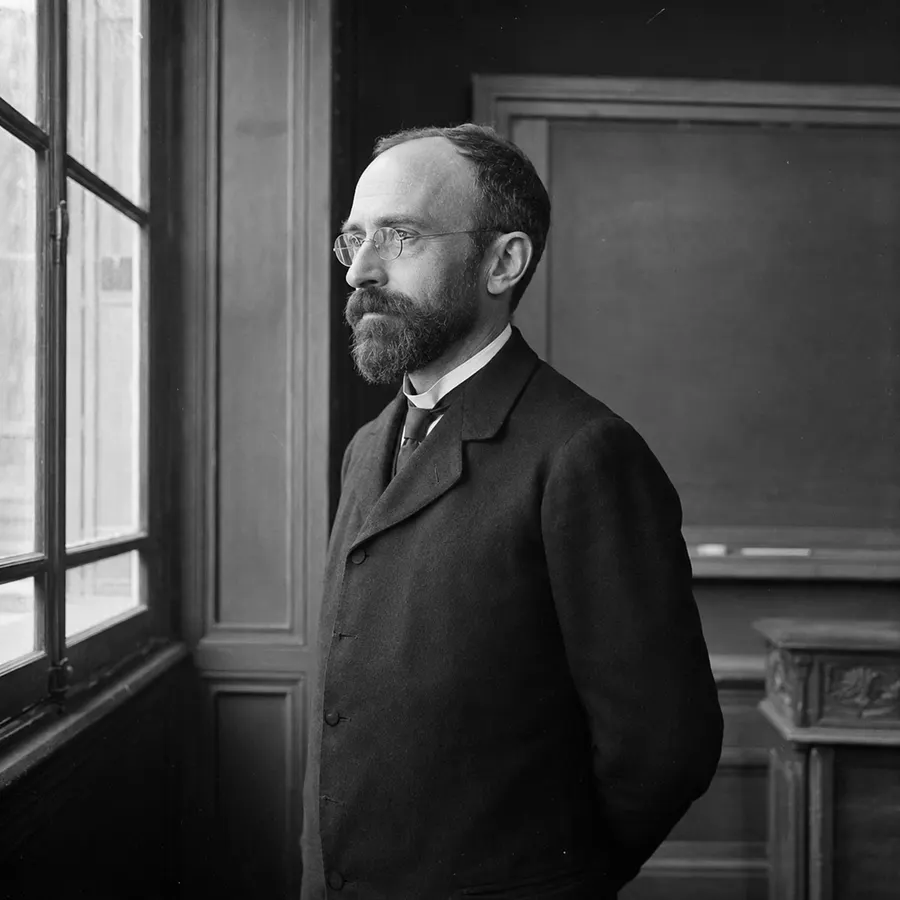
Emile Durkheim, 1858 to 1917, was one of the founders of sociology, and the person who named the thing the live-events industry now sells. In The Elementary Forms of Religious Life (1912) he argued that the sacred is not discovered but produced, by assembly: a group in physical proximity, attending to the same object, moving in shared rhythm, generates a heightened collective state he called collective effervescence, and religion is the account a society gives of that state afterwards. Strip the theology out and the description is of a stadium, a rally, a congregation or a full theatre. The mechanism he set out in 1912 is the one being priced today.
Who they are
Durkheim was a French sociologist who spent his career arguing that social facts are real things with causes of their own, not reducible to the individuals who make them up. He was appointed at the University of Bordeaux in 1887, where he taught what are generally described as the first sociology courses in France, and moved to the Sorbonne in 1902. His major works are The Division of Labour in Society (1893), The Rules of Sociological Method (1895), Suicide (1897) and The Elementary Forms of Religious Life (1912), and he built the discipline institutionally as well as intellectually, around a journal and a circle of students including Marcel Mauss and Maurice Halbwachs.
Elementary Forms is the one that matters here. Its argument is that religion's real object is the society doing the worshipping, and that the raw material of the sacred is a physical state generated by gathering. In assembly, with attention converging on one thing and bodies in rough synchrony, individuals experience a force that feels external to them and larger than they are. Durkheim's claim is that the force is real, that it is the group itself, and that the categories a society treats as sacred are the sediment left behind when the gathering disperses. Collective effervescence is his name for the state at its peak.
Two cautions belong on the page, and neither is a reason to drop him. The first concerns the evidence. Durkheim built the argument on second-hand ethnographic reports of Aboriginal Australian religious life, material he did not gather and later anthropology has criticised heavily, both for its accuracy and for the colonial apparatus that produced it. The mechanism is a theoretical claim supported by interpretation, not an experimental result, and it should be cited as one. The second concerns lineage. Joint attention as a psychological construct is not Durkheim's and not Tim Wu's. It comes from developmental psychology, from Scaife and Bruner's 1975 paper on infants following a caregiver's gaze. Durkheim supplies the felt, collective version of the idea, described a century ago from the outside; the laboratory version is much younger and, on objective measures, much weaker than the popular account of it suggests.
What survives all of that is the specification. Durkheim tells you which ingredients the effect is supposed to need: co-presence, a common object of attention, and shared rhythm. That is a testable list, and it is exactly the list a modern ticketed event assembles on purpose. When this site writes about the price of being in the room, the equipment being described is his.
Key works
Durkheim wrote books rather than papers in the modern sense, and the relevant one here is the last of the four major works.
Durkheim, E. (1893), The Division of Labour in Society.
Durkheim, E. (1895), The Rules of Sociological Method.
Durkheim, E. (1897), Suicide.
Durkheim, E. (1912), The Elementary Forms of Religious Life. The source of collective effervescence and of the claim that the sacred is produced by assembly.
Key papers
Durkheim, E. (1912), The Elementary Forms of Religious Life. The argument that the sacred is produced by assembly: a group focusing attention on the same object, in physical proximity, with shared rhythm, generates a heightened state he called collective effervescence, and religion is the story a society tells about that state afterwards. This is the work everything on this page rests on, and the vault's own reading of it is recorded as unresolved.
Internet Encyclopedia of Philosophy, entry on Émile Durkheim. The reference used for his dates, chosen because the Stanford Encyclopedia entry is not yet published.
Key ideas
Collective effervescence: a heightened state generated by a group in physical proximity attending to the same object in shared rhythm.
The sacred is produced rather than found. Religion is a society's account of a state its own gatherings create.
The mechanism has named preconditions, co-presence, common focus and rhythm, which is what makes it usable rather than merely evocative.
It is a theoretical and interpretive claim built on second-hand ethnography, not an experimental finding, and this site cites it on those terms.
Joint attention as a construct belongs to Scaife and Bruner (1975). Durkheim describes the collective, felt version and predates the laboratory one by six decades.
Concepts on this site
Find them elsewhere
Lifespan: 1858 to 1917. No social accounts, and none are claimed on their behalf.
Deceased, so no social accounts. Reference is the Internet Encyclopedia of Philosophy entry, used because the Stanford Encyclopedia entry is not yet published
Checked 2026-09-10. Handles and affiliations go out of date, so treat this block as a snapshot rather than a standing fact.
Sources
- Durkheim, E. (1912), The Elementary Forms of Religious Life.
- Internet Encyclopedia of Philosophy, entry on Emile Durkheim. Dates, the Bordeaux appointment in 1887, the move to the Sorbonne in 1902, and the circle around the journal.
- Scaife, M. & Bruner, J. S. (1975), "The capacity for joint visual attention in the infant," Nature, 253, 265-266.
- Mairon, N., Nahum, M., Stolk, A., Knight, R. T. & Perry, A. (2020), "Behavioral and EEG Measures Show no Amplifying Effects of Shared Attention on Attention or Memory," Scientific Reports, 10, 8458.