Marcus Raichle
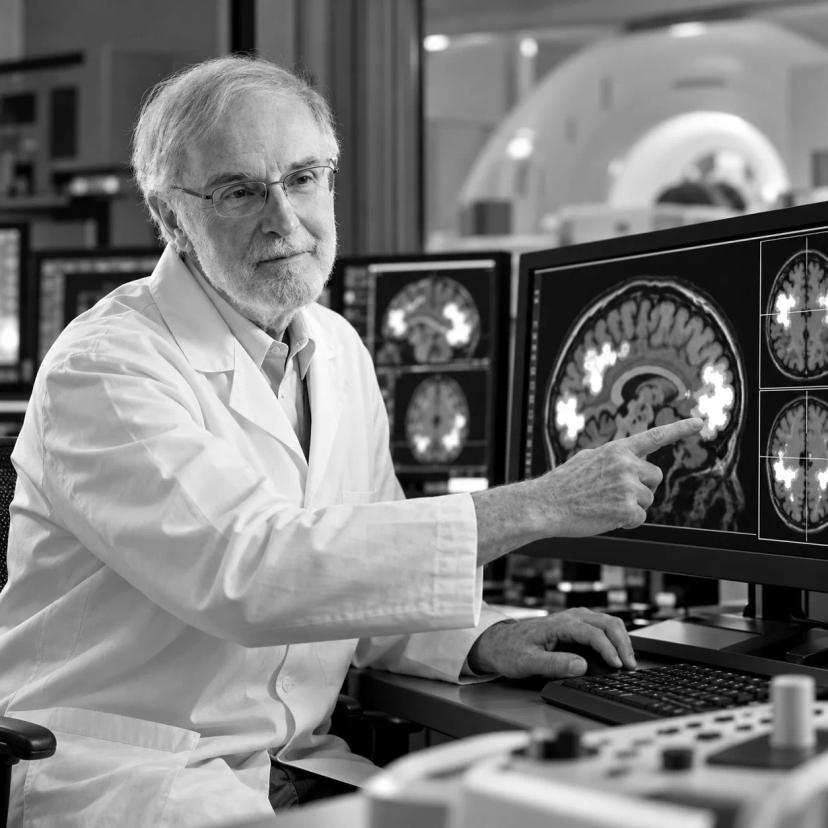
Marcus Raichle is the neuroscientist whose name is attached to the default mode network. He is first author of the 2001 paper in the Proceedings of the National Academy of Sciences that gave the pattern its name, and of the 2015 review that tells the story of its accidental discovery. With Debra Gusnard he also wrote the 2002 commentary that supplies the brain's energy figures.
Who they are
Raichle is a neuroscientist working with brain imaging. The authors of the 2002 energy commentary, Raichle and Gusnard, are listed at the Mallinckrodt Institute of Radiology, Washington University School of Medicine, St. Louis. Johann Hari, in Stolen Focus, interviewed him for a chapter on mind-wandering and reports that he is a winner of the Kavli Prize; that detail is Hari's, and this page has not checked it independently.
His work in this vault is used for three things: the energy budget of the brain, the oxygen-extraction baseline, and the history of the default mode network. In each, the page relies on what his own papers say, as read in their abstracts or full text.
Key papers
Raichle, M. E., MacLeod, A. M., Snyder, A. Z., Powers, W. J., Gusnard, D. A., & Shulman, G. L. (2001). A default mode of brain function. Proceedings of the National Academy of Sciences, 98(2), 676-682. The paper defines a baseline for the normal adult human brain using the oxygen extraction fraction, finds it remarkably uniform in people awake with their eyes closed, and reads the regions that consistently decrease from it during goal-directed tasks as an organised default mode of brain function.
Raichle, M. E., & Gusnard, D. A. (2002). Appraising the brain's energy budget. Proceedings of the National Academy of Sciences, 99(16), 10237-10239. A commentary on two companion papers. It notes that the brain is about 2 per cent of body weight and uses about 20 per cent of the body's oxygen and calories, and that local blood-flow changes measured with PET during most cognitive tasks are often 5 per cent or less.
Raichle, M. E. (2015). The brain's default mode network. Annual Review of Neuroscience, 38, 433-447. A review describing the network as matched, bilateral regions in the parietal, medial prefrontal and temporal cortices, discovered largely by accident in early PET studies that compared attention-demanding tasks with relaxed rest.
Key ideas
The first is that the brain has a large fixed energy cost and that tasks add little to it. If effort is a few per cent on top of a large fixed cost, the fixed cost is what needs explaining.
The second is that a baseline can be defined physiologically. Using the oxygen extraction fraction, the 2001 paper defined it without asking anyone to do or think anything in particular.
The third is that the regions falling in activity during goal-directed tasks form an organised pattern, a default mode that is suspended when behaviour is aimed at a goal.
Whether the network is the mind-wandering network is a separate claim that his papers, as read for this page, do not make, and which the field has not settled.
Sources
- Raichle et al. (2001), PNAS 98(2), 676-682. Abstract read. Raichle and Gusnard (2002), PNAS 99(16), 10237-10239. Read. Raichle (2015), Annual Review of Neuroscience 38, 433-447. Abstract read. Hari, J. (2022). Stolen Focus. Bloomsbury. Via the vault note.
Studies on this site by Raichle
- A default mode of brain function
Raichle (2001) · Proceedings of the National Academy of Sciences
- Appraising the brain's energy budget
Raichle (2002) · Proceedings of the National Academy of Sciences
- The brain's default mode network
Raichle (2015) · Annual Review of Neuroscience
Articles that cite Marcus Raichle
- What the Default Mode Network Does
The brain spends about a fifth of the body's energy whatever it is asked to do. The default mode network is the pattern found inside that expense, and the evidence supports it as an organised…
Concepts on this site
- Attention Restoration Theory
Attention restoration theory holds that directed attention is a resource spent down over the course of a day, and that natural environments replenish it in a way built environments do not. It was…
- Flow State
Flow is Mihaly Csikszentmihalyi's name for optimal experience: the total absorption that arrives when a task's difficulty sits just past your current skill, close enough that you might fail and near…
- Mind-Wandering
Mind-wandering is thinking about something other than what you are currently doing. Matthew Killingsworth and Daniel Gilbert measured it in 2010 by pinging 2,250 adults on their iPhones at random…
- Oxygen Extraction Fraction
The oxygen extraction fraction is the share of the oxygen delivered to the brain by blood that tissue actually takes up. Raichle and colleagues used it in 2001 to give the brain a physiological…
- Resting-State Functional Connectivity
Resting-state functional connectivity is the degree to which activity in separate brain regions rises and falls together when no task is set. It turns a map of regions that dropped during a task…
- Rumination
Rumination is Susan Nolen-Hoeksema's construct for what a person does when they meet a low mood by dwelling on it instead of acting. The situation gets turned over repeatedly against a standard that…
- Salience Network
The salience network is a brain network centred on the anterior insula and the dorsal anterior cingulate that triages incoming stimuli and decides which deserve attention. It was named by William…
- The Default Mode Network
The default mode network is the set of brain regions that become more active when a person appears to be doing nothing. The name and the finding are Marcus Raichle's, published in 2001, and the…