Robert Kurzban
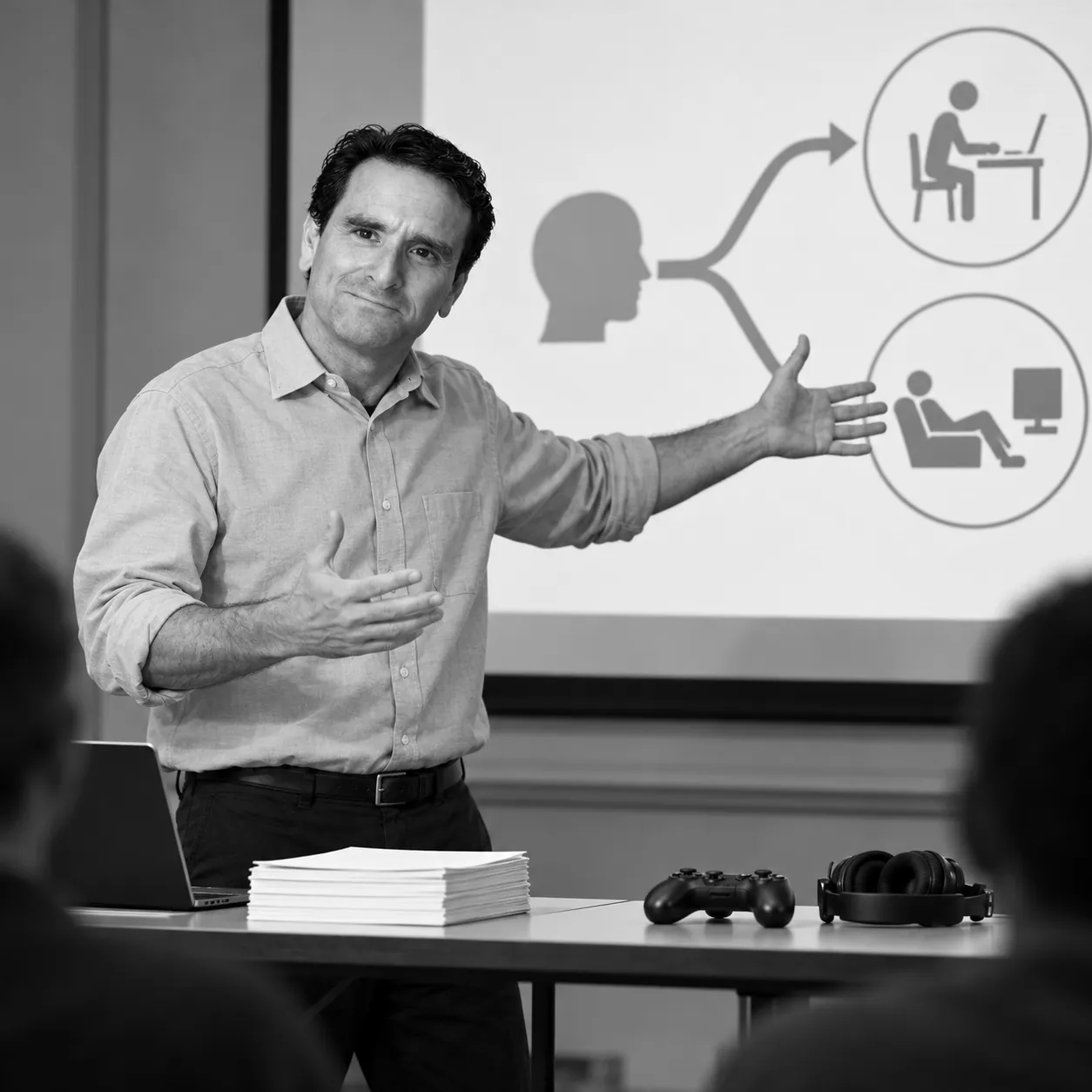
Robert Kurzban is an evolutionary psychologist and author of Why Everyone (Else) Is a Hypocrite (2010). With Angela Duckworth, Joseph Kable and Justus Myers he proposed in 2013 the opportunity cost model of effort, which treats the feeling of effort as the output of a cost-benefit calculation and offers a rival to the fuel tank account of ego depletion and decision fatigue.
Who they are
Kurzban is an evolutionary psychologist. He is best known for his 2010 book Why Everyone (Else) Is a Hypocrite, which argues that the mind is modular and that the part that produces speech is not the part that produces behaviour, so inconsistency is the normal condition and not a failure. The argument is a synthesis and an interpretive stance and not an experimental result, and it is judged on coherence.
The work relevant here is a different one. In 2013, with Angela Duckworth, Joseph Kable and Justus Myers, he published An opportunity cost model of subjective effort and task performance in Behavioral and Brain Sciences. The paper challenges the view that performance falls on demanding tasks because a physical resource is used up. It proposes that executive mechanisms can serve only a limited number of tasks at once, so using them carries an opportunity cost, and that the felt sense of effort is the output of a cost-benefit computation that lowers how much those mechanisms are deployed.
Wendy Wood's description of control as a cost-benefit decision, in Good Habits, Bad Habits, sits close to this account. Kurzban's model is a theoretical proposal supported by a review of evidence, and it has not been settled by a single decisive experiment.
What the record shows
The 2013 paper in Behavioral and Brain Sciences (volume 36, issue 6, 661-679), written with Duckworth, Kable and Myers, asks why some tasks cause the aversive experience of mental effort and a deterioration in performance. One explanation posits a physical resource that is depleted over time. The authors propose an alternative centred on mental representations of the costs and benefits of task performance.
Executive computational mechanisms can be deployed for only a limited number of simultaneous tasks, so deploying them carries an opportunity cost, the next-best use of those systems. The felt experience of effort is the output of these cost-benefit computations, and it motivates reduced deployment of the mechanisms for the present task. The paper reviews alternative explanations and empirical results across psychology and neuroscience and says how the models might be told apart empirically.
Key papers
Kurzban, R., Duckworth, A., Kable, J. W., & Myers, J. (2013). An opportunity cost model of subjective effort and task performance. Behavioral and Brain Sciences, 36(6), 661-679.
Book: Kurzban, R. (2010). Why Everyone (Else) Is a Hypocrite: Evolution and the Modular Mind. Princeton University Press. Not read by this vault.
Key ideas
The felt cost of mental effort reflects the opportunity cost of using limited executive mechanisms.
Control is rationed by cost and benefit, and not exhausted like fuel.
The mind is modular, and inconsistency between speech and behaviour is the normal state (the 2010 book).
Sources
- Kurzban, R., Duckworth, A., Kable, J. W., & Myers, J. (2013). An opportunity cost model of subjective effort and task performance. Behavioral and Brain Sciences, 36(6), 661-679.
- Kurzban, R. (2010). Why Everyone (Else) Is a Hypocrite: Evolution and the Modular Mind. Princeton University Press.
Studies on this site by Kurzban
- An opportunity cost model of subjective effort and task performance
Kurzban (2013) · Behavioral and Brain Sciences
Articles that cite Robert Kurzban
- Why Doing Harm Feels Worse Than Allowing It
Harm that follows an action is judged more harshly than the same harm that follows inaction. The research on omission bias shows where that comes from, why it can work as cover, and when it reverses.
- Does Decision Fatigue Spoil Our Choices
Decision fatigue says each choice drains a mental tank and later choices suffer. The tank has failed a 36-laboratory test, and the best-known real-world case, Israeli parole rulings, has a rival…
Concepts on this site
- Decision Fatigue
Decision fatigue is the claim that making many decisions uses up a limited mental resource, so that later decisions come out worse, lazier or more impulsive. It was proposed in 2008 and was given a…
- Opportunity Cost Model of Effort
The opportunity cost model of effort says that mental effort feels costly because using the mind's limited executive machinery on one task means giving up the value of the best alternative use…
- Self-Discretion
Self-discretion is the mechanism Kevin Simler and Robin Hanson prefer in The Elephant in the Brain (2018) to explain how a person can hold a motive without admitting it. There is no active lie…
- Self-Signalling
Self-signalling is choosing an action partly for what it will tell you about yourself. The idea has two roots. Daryl Bem's self-perception theory says people work out their own attitudes by watching…
- Strategic Self-Deception
Strategic self-deception is a proposal by Robert Trivers: that people deceive themselves in order to deceive others better. William von Hippel developed it with him. A speaker who believes the story…
- The Omission Strategy
The proposal that people favour harm by omission over harm by commission in order to avoid blame.
- The Unfalsifiable Frame
The unfalsifiable frame is the failure in which a theory is built so that almost nothing could refute it, because a denial is absorbed as further evidence for it. Agreement confirms the theory…