What is cognitive offloading, and is it making us forget?
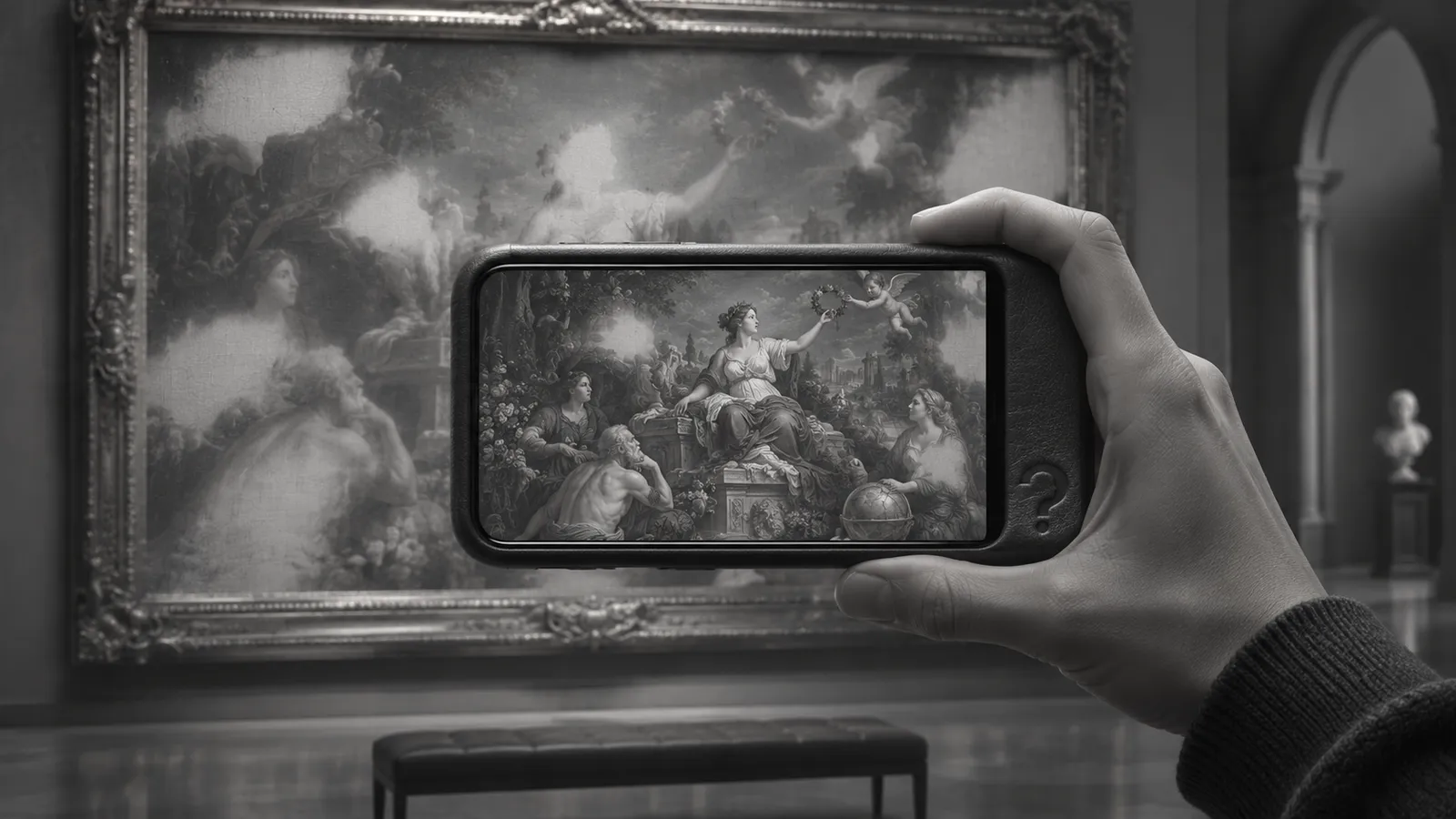
What a museum tour found about photographing objects, what people hand to tools and what they keep, and where the evidence stands on forgetting.
Answer to the question
What is cognitive offloading, and is it making us forget?
Cognitive offloading is using a tool or the surroundings, such as a camera, a note or a search, to hold information so the head does not have to. What is handed over is remembered less: museum visitors recalled less visual detail of objects they photographed. The freed effort has been linked to better performance on the next task.
Key takeaways
- In Linda Henkel's museum tour study, 27 students recalled visual detail with 55 per cent accuracy for objects they photographed and 64 per cent for objects they only looked at; free recall did not differ and zooming in removed the loss.
- In a pattern copy task, using a tool improved performance in the moment and left a weaker memory afterwards, even when participants knew a test was coming (Grinschgl and colleagues, 2021).
- Participants who saved a word list after study solved more modular arithmetic problems afterwards than those who could not save (Runge and colleagues, 2019).
- People tended to save the word pairs they found hardest, and their confidence in their own recall predicted what they saved (Hu and colleagues, 2019).
- Nicholas Carr's The Shallows supplies the consolidation account: a lasting memory is built over time as new connections grow, so information never processed is not built.
Visitors on a guided museum tour were asked to photograph some objects and only look at others. The next day, their accuracy on the visual details of the photographed objects was 55 per cent, against 64 per cent for the objects they had only looked at. The result comes from Linda Henkel's 2014 study of 27 students, and it is one of the cleanest demonstrations of cognitive offloading, the habit of letting something outside the head hold what the head would otherwise carry.
The same study holds results that rarely reach the headline. Free recall of the objects did not differ between the two conditions, at 47 per cent and 48 per cent. And when students zoomed in on one part of an object before photographing it, the loss in visual detail did not appear. Nicholas Carr cites the study in The Shallows and notes that the loss vanished with the zoom, which makes the way attention is spent the thing to watch in cognitive offloading, more than the camera.
Cognitive offloading hands the work to something outside the head
The label for that handing over was given a common frame in a 2016 review by Evan Risko and Sam Gilbert in Trends in Cognitive Sciences, and the examples are ordinary: a note on the fridge, a calendar alert, a photograph of a whiteboard, a search in place of a recollection. The same move sits behind the dinner photos taken up in Why We Photograph Our Food. It is also older than screens. In a story that Carr retells in The Shallows, a king doubts that writing will help memory, since a written record gives a reminder and not a remembering. Carr adds that the story reached us because someone wrote it down.
People do not offload at random. In four experiments by Xiao Hu and colleagues, published in Cognition in 2019, participants learned word pairs and could choose which pairs to save to a computer. They tended to save the pairs they found hardest, and their confidence in their own recall predicted what they saved.
A study led by Hauke Meyerhoff points the same way from another side. Participants did an intention-offloading task, a pattern-copy task and a short-term memory test, each on two consecutive days. Scores were reliable from day to day but did not correlate across the two offloading tasks, so no single trait explained both. Both offloading scores did relate to short-term memory capacity. Cognitive offloading is therefore a set of choices made task by task, guided by how sure a person is of their own memory, and not a fixed personal style.
What leaves the head is remembered less
A second clean demonstration comes from Sandra Grinschgl and colleagues, in the Quarterly Journal of Experimental Psychology in 2021. Their participants worked on a pattern copy task where a tool could hold the pattern for them. Cognitive offloading to the tool improved performance in the moment and left a weaker memory of the pattern afterwards. The weaker memory remained when participants knew a test was coming. When the tool became costlier to use, people used it less, performed less well in the moment, and remembered more.
Why would cognitive offloading cost memory? Carr's answer in The Shallows rests on consolidation. Drawing on Eric Kandel's work with a sea slug, he explains that a lasting memory is not a file saved but a physical change, the growth of new connections between neurons, and that building it takes time and attention. A fact that is never processed is a fact that is never built. That fits both studies: an object photographed and set aside, or a pattern held on a screen, receives less of the processing that consolidation draws on. The experiments measured the loss, and the consolidation account is the explanation that Carr's argument supplies.
| Study | Task | What was handed over | What followed |
|---|---|---|---|
| Henkel, 2014 | Guided museum tour, tested the next day | Attention to objects, passed to a camera | Visual detail 55 per cent against 64 per cent; free recall unchanged |
| Grinschgl and colleagues, 2021 | Pattern copy task | Holding the pattern, passed to a tool | Better performance in the moment, weaker memory afterwards |
| Runge and colleagues, 2019 | Study a word list, then solve arithmetic problems | The word list, saved after study | More arithmetic problems solved |
| Hu and colleagues, 2019 | Learn word pairs | Chosen pairs, saved to a computer | The hardest pairs were saved most |
Freed capacity shows up on the next task
The trade has a second side, and it explains why people keep using cognitive offloading. Yannick Runge and colleagues reported in Memory in 2019 that participants who saved a word list after studying it went on to solve more modular arithmetic problems than participants who had no chance to save. They suggest that saving frees resources for the demanding work that follows.
Dorothy Buchli and Benjamin Storm, in Memory in 2025, asked who gains most from saving. Across three experiments, the boost in later learning that follows saving was larger for people with higher working memory capacity. They read this as evidence that control processes shape how well a person uses cognitive offloading, so the benefit is not handed out evenly.
Working memory is the bottleneck on which What is cognitive load theory builds its account of instruction, and these experiments describe a way of easing that bottleneck from outside: a note, a saved file or a reminder takes a load that the head would otherwise carry. The cost shown by the museum tour and the pattern task and the gain shown by the arithmetic task come from the same act, seen at two moments.
The answer depends on the device and the habit
Is cognitive offloading making us forget? What is handed over is remembered less, which is the plain finding of the museum tour and the pattern task. What the head keeps free is spent on the next task, which is the finding of the saving studies. Choice sits between them, since in cognitive offloading people give away what they are least sure of and show no single style across tasks.
The zoom result gives the practical reading. When a detail matters, spending attention on it before reaching for the device keeps the memory that the device would otherwise take; when it does not matter, letting the device hold it costs little. Whether screens as a whole change memory is a wider argument, weighed in Both Sides of the Screen-Time Argument, and these experiments sit inside it without settling it.
A pooled review by Chen Gong and colleagues, in Frontiers in Public Health in 2024, gathered studies of the internet used as a place to keep facts, a large branch of the same practice. It reports that the pattern is associated with higher cognitive load, that it appears more often with phones than with computers, and that it is stronger among people with a history of heavy searching.
Common questions
What is cognitive offloading, and is it making us forget?
Cognitive offloading is using a tool or the surroundings to hold information so the head does not have to. What is handed over is remembered less, as in a museum study where photographed objects were recalled in less visual detail, and the freed effort has been linked to better performance on the next task.
Does taking photos make you forget what you saw?
In Linda Henkel's museum tour experiment, photographed objects were remembered with less visual detail the next day, 55 per cent against 64 per cent. Free recall did not differ, and zooming in on a part of the object removed the loss in detail.
Is cognitive offloading always bad for memory?
No. In one study, participants who saved a word list went on to solve more arithmetic problems, and in another, people chose to save the items they found hardest.
Who offloads the most?
A study that compared three tasks found that offloading scores did not correlate across two offloading tasks, so no single trait explained both. Both scores related to short-term memory capacity.
Sources
Carr, N. The Shallows. Seed book; vault hub Books/The Shallows.
Henkel, L. A. (2014). Point-and-shoot memories: The influence of taking photos on memory for a museum tour. Psychological Science, 25(2), 396-402. doi:10.1177/0956797613504438 https://doi.org/10.1177/0956797613504438
Risko, E. F., & Gilbert, S. J. (2016). Cognitive offloading. Trends in Cognitive Sciences, 20(9), 676-688. doi:10.1016/j.tics.2016.07.002 https://doi.org/10.1016/j.tics.2016.07.002
Hu, X., Luo, L., & Fleming, S. M. (2019). A role for metamemory in cognitive offloading. Cognition. doi:10.1016/j.cognition.2019.104012 https://doi.org/10.1016/j.cognition.2019.104012
Meyerhoff, H. S., Grinschgl, S., Papenmeier, F., & Gilbert, S. J. (2021). Individual differences in cognitive offloading: A comparison of intention offloading, pattern copy, and short-term memory capacity. Cognitive Research: Principles and Implications, 6, 34. doi:10.1186/s41235-021-00298-x https://doi.org/10.1186/s41235-021-00298-x
Grinschgl, S., Papenmeier, F., & Meyerhoff, H. S. (2021). Consequences of cognitive offloading: Boosting performance but diminishing memory. Quarterly Journal of Experimental Psychology, 74(9), 1477-1496. doi:10.1177/17470218211008060 https://doi.org/10.1177/17470218211008060
Runge, Y., Frings, C., & Tempel, T. (2019). Saving-enhanced performance: Saving items after study boosts performance in subsequent cognitively demanding tasks. Memory, 27(10), 1462-1467. doi:10.1080/09658211.2019.1654520 https://doi.org/10.1080/09658211.2019.1654520
Buchli, D. R., & Storm, B. C. (2025). Working memory capacity and the saving-enhanced memory effect. Memory, 33(8), 1015-1030. doi:10.1080/09658211.2025.2551230 https://doi.org/10.1080/09658211.2025.2551230
Gong, C., & Yang, Y. (2024). Google effects on memory: A meta-analytical review of the media effects of intensive Internet search behavior. Frontiers in Public Health, 12, 1332030. doi:10.3389/fpubh.2024.1332030 https://doi.org/10.3389/fpubh.2024.1332030