What is ecological valence theory?
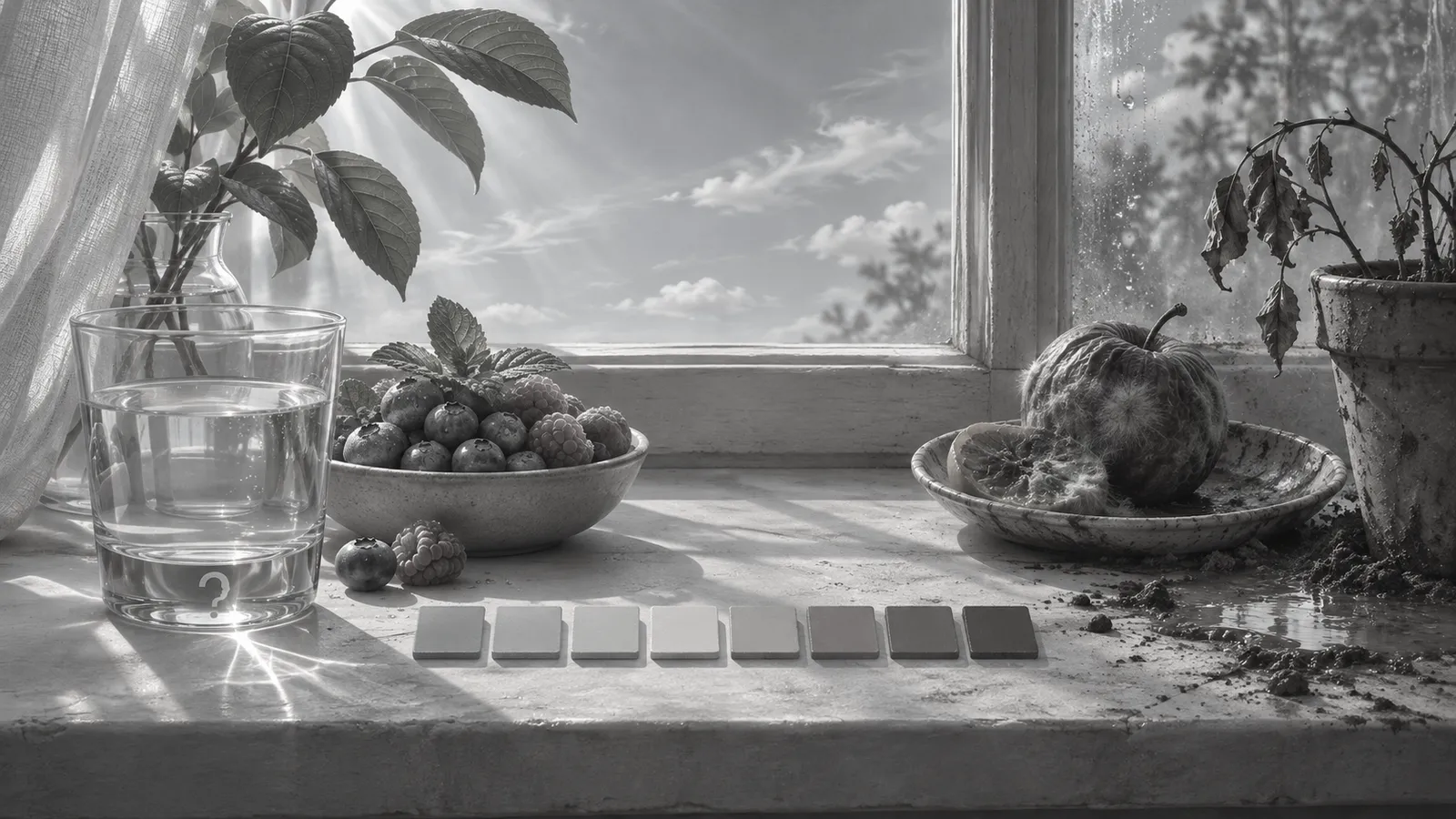
How feelings about clear skies, clean water and other objects shape colour liking, and what later studies found about where the idea explains less.
Answer to the question
What is ecological valence theory?
Ecological valence theory holds that people like a colour to the degree that they like the objects strongly associated with it, such as blues with clear skies and clean water. It fits average US ratings closely and explains less in some groups, where other influences also appear.
Key takeaways
- Ecological valence theory holds that colour preferences arise from people's average feelings about the objects linked with each colour (Palmer and Schloss, 2010).
- In an experiment, rating liked red objects and disliked green objects shifted colour ratings towards the liked objects, and the shift was gone after 24 hours (Strauss, Schloss and Palmer, 2013).
- The object-based score predicted men's colour preferences more strongly than women's (Taylor and Franklin, 2012).
- A test with adults in Saudi Arabia found the score accounted for no more than half of the variation in preference, and the authors point to other factors (Al-rasheed, Franklin and Maule, 2022).
- Michelle Baddeley's Copycats and Contrarians recounts monkeys whose colour preference followed the group, which shows how far surrounding choices can set a preference.
Two groups of wild vervet monkeys in South Africa were trained to prefer opposite colours of corn. Infants born afterwards took their mothers' colour, and males that moved between groups switched to their new group's, as Michelle Baddeley recounts in Copycats and Contrarians. Ecological valence theory makes a related claim about people: we like a colour for what it is attached to.
What does ecological valence theory claim?
Stephen Palmer and Karen Schloss proposed in 2010 that colour preferences arise from people's average feelings about the objects linked with each colour. People like colours strongly associated with objects they like, such as blues with clear skies and clean water, and dislike colours strongly associated with objects they dislike, such as browns with rotten food. The authors report that ecological valence theory fits their data better than accounts built on biological adaptation or colour-emotion links, even with fewer adjustable parts. A later cross-cultural test describes the score built on it, the weighted affective valence estimate, as accounting for up to 80 per cent of the variation in colour preference among adults in the United States.
Ecological valence theory also makes a claim about direction: the feeling about the object comes first and the liking for the colour follows. Preferences moved when the objects moved first, in an experiment by Eli Strauss, Karen Schloss and Stephen Palmer. Participants rated a set of colours, then saw photographs of objects, liked red ones and disliked green ones in one group and the reverse in the other, and rated the colours again. When they had judged how much they liked the objects, their colour ratings shifted towards the colours of the objects they liked. When they only looked at the photographs, nothing shifted. Imagining the objects was enough to move the ratings.
The change was gone after 24 hours.
Set beside the monkeys, the theory leaves a question open: whether the things a colour is attached to include what the people around us choose. Why Brands Reach for Blue sets out how the most widely liked colour fits ecological valence theory, and why being liked is a different matter from being persuasive. The concept note on Ecological Valence holds the theory's full statement.
Where the theory explains less
The same score does not predict every group equally. The score predicted men's colour preferences more strongly than women's, about three quarters of the variation in men's ratings and under half in women's, when Chloe Taylor and Anna Franklin repeated the approach. The number of objects tied to a colour mattered too: colours linked with few objects tended to be liked, and colours linked with many tended to be disliked. Their conclusion was that the findings show limits of ecological valence theory in its current form while still supporting a link between colour preference and colour-object associations.
How well does ecological valence theory travel? In a test with adults in Saudi Arabia, a different cultural setting from the original United States sample, the score accounted for no more than half of the variation in preference there, a result reported by Abdulrahman Al-rasheed, Anna Franklin and John Maule. Adding associations with abstract concepts did not explain more than object associations did overall, though the number of abstract associations did account for some of the variation among women and not among men. The authors conclude that the success of ecological valence theory varies across cultures and that other factors are likely at play. Colour Preferences of Men and Women follows the sex-difference question through other studies.
Neither set of results contradicts the other. One account asks what the average person feels about the objects that carry a colour, and the other asks how much of any one group's liking that average captures. We read ecological valence theory as a strong account of why colours carry the average liking they do and as an incomplete account of any single person, which is where the later studies point to additional influences.
How the four studies line up side by side
| Study | What was tested | What it found |
|---|---|---|
| Palmer and Schloss, 2010 | Whether colour liking tracks feelings about associated objects | Strong support among US adults, and a better fit than the alternative accounts compared |
| Strauss, Schloss and Palmer, 2013 | Whether liking objects of a colour shifts liking for the colour | Ratings shifted towards the colours of liked objects when participants judged the objects, and the shift was gone after a day |
| Taylor and Franklin, 2012 | Whether the score predicts men and women equally | Stronger for men than for women, and more objects tied to a colour went with lower liking |
| Al-rasheed, Franklin and Maule, 2022 | Whether ecological valence theory holds in a different cultural setting | The score accounted for no more than half of the variation, and other factors are likely involved |
The four studies also answer different kinds of question. The experiment with photographs changed what participants felt about objects and watched the colour ratings follow, which speaks to direction. The studies that compared the score with ratings across men, women and cultural settings measured how closely two sets of numbers move together, which speaks to how much of the picture the score covers. A strong link in the second kind of study does not show that objects cause the liking, and a weaker link does not show that they play no part. Both kinds of result leave the object account standing as one major influence on colour liking, with room beside it for others.
A colour tied to well-liked objects for one audience may be tied to different objects for another, so what matters for a room, a product or a page is what the colour is attached to for the people who will see it, not what it means in general. Liking a colour on a swatch does not show that the colour changes behaviour in a shop, and the evidence on that sits in Does Shop Colour Keep People Longer. The 24 hour fade fits a colour's standing resting on long experience, not one encounter.
Common questions
What is ecological valence theory?
It is the proposal that people like a colour to the degree that they like the objects strongly associated with it, such as blues with clear skies and clean water and browns with rotten food. It fits the average ratings of US adults closely and explains less in some other groups.
Why do so many people like blue?
Under ecological valence theory, blue is tied to objects most people like, including clear skies and clean water. The account explains why blue is liked. It does not show that blue persuades or moves people more than other colours.
Does ecological valence theory explain everyone's colour preferences?
No. Studies with men and women, and with adults in a different cultural setting, found the score explained about half of the variation or less in some groups, and the authors point to other factors.
Can experience change which colours we like?
In one experiment, yes for a short time. Judging liked and disliked objects of a colour shifted ratings of that colour towards the liked objects, and the shift was gone after 24 hours.
Sources
Baddeley, M. Copycats and Contrarians. Seed book; vault hub Books/Copycats and Contrarians.
Palmer, S. E., & Schloss, K. B. (2010). An ecological valence theory of human color preference. Proceedings of the National Academy of Sciences, 107(19), 8877-8882. doi:10.1073/pnas.0906172107 https://doi.org/10.1073/pnas.0906172107
Strauss, E. D., Schloss, K. B., & Palmer, S. E. (2013). Color preferences change after experience with liked/disliked colored objects. Psychonomic Bulletin & Review, 20(5), 935-943. doi:10.3758/s13423-013-0423-2 https://doi.org/10.3758/s13423-013-0423-2
Taylor, C., & Franklin, A. (2012). The relationship between color-object associations and color preference: Further investigation of ecological valence theory. Psychonomic Bulletin & Review, 19(2), 190-197. doi:10.3758/s13423-012-0222-1 https://doi.org/10.3758/s13423-012-0222-1
Al-rasheed, A. S., Franklin, A., & Maule, J. (2022). A test of the ecological valence theory of color preference, the case of Arabic. Frontiers in Psychology, 13, 1010108. doi:10.3389/fpsyg.2022.1010108 https://doi.org/10.3389/fpsyg.2022.1010108
van de Waal, E., Borgeaud, C., & Whiten, A. (2013). Potent social learning and conformity shape a wild primate's foraging decisions. Science. doi:10.1126/science.1232769 https://doi.org/10.1126/science.1232769