What is identity fusion?
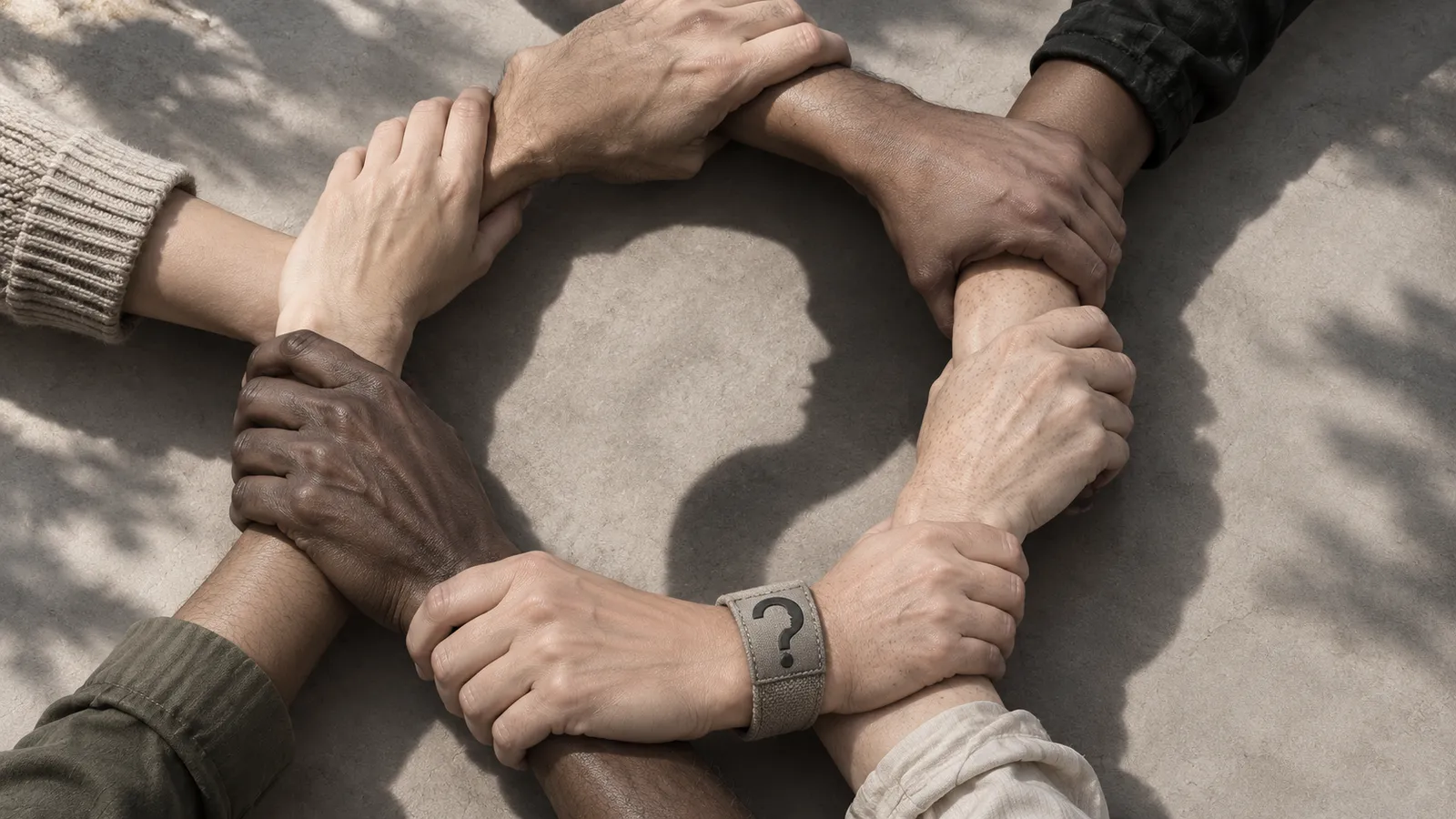
What research means by feeling one with a group, how that differs from identifying with it, and how shared experiences and moving together build the bond.
Identity fusion is a visceral sense of oneness with a group and its members, in which the personal self and the group self stay linked and feel like one. In studies led by William Swann, fused people were more willing than non-fused people to act on the group's behalf. Shared experiences and ritual are thought to build it.
Key takeaways
- Identity fusion is a visceral sense of oneness with a group and its members, with family-like ties to fellow members and feelings of invulnerability (Swann and Buhrmester, 2015).
- In eight studies reported in 2009, fused participants were more willing than non-fused participants to endorse extreme pro-group behaviour (Swann and colleagues).
- A verbal fusion measure predicted extreme pro-group behaviour better than an earlier pictorial measure across ten studies, with samples including immigrants from 22 countries (Gómez and colleagues, 2011).
- Among British football fans, lifelong loyalty was shaped by key emotional events that fans felt had shaped them, and less by time invested (Newson and colleagues, 2016).
- A developmental account places fusion based on shared biology in early childhood and fusion based on shared experiences in mid-adolescence (Reese and Whitehouse, 2021).
The usual picture of group loyalty is a trade. A person takes on a group's categories and, in doing so, lets the group self come forward while the personal self steps back. As What is social identity theory explains, a group becomes part of the self through shared categories, and What is in-group bias covers the related finding that being sorted into a group can be enough to tilt a choice towards it.
Identity fusion describes a bond that does not work as a trade. William Swann and Michael Buhrmester call it a visceral sense of oneness with a group and its members, in which the line between me and us has thinned until the group's fate feels like the self's own. Both selves stay switched on, and that is what makes fusion its own subject.
A bond in which both selves stay active
Two features set fusion apart. Fused people see themselves and the other members as sharing something essential, and they feel family-like ties to fellow members. Feelings of invulnerability also sit in the middle of the account, because a person who feels part of something larger feels stronger for it, and that feeling carries the willingness to act.
In identity fusion theory the personal self stays vivid, the group self joins it, and each can be summoned to support action for the group. Because the two stay linked, a reminder of who I am can raise willingness to act for the group just as a reminder of the group can.
That is also why fusion is not the same as identifying with a group, a distinction taken up in What is group identification. Identification asks how central a group is to how a person sees themselves. Fusion asks something closer to whether the member feels bound to the other individuals in it, one by one, as well as to the group as a whole. Both start from belonging, which is why they are easy to confuse, and the differences show in what each one asks about the member and the group.
| Feature | Group identification | Identity fusion |
|---|---|---|
| Core question | How central is the group to who I am? | Do I feel one with the group and each member? |
| Personal self | Group self gains weight | Stays active alongside the group self |
| Ties to members | Through shared category | Family-like, member by member |
| Link to committed action | Present | Stronger, in the later review |
How well does fusion predict action for the group?
Swann and colleagues tested the idea in a paper of five preliminary studies and three experiments. Fused participants were more willing than non-fused participants to endorse strong action on the group's behalf. Activating the personal identity raised that willingness, activating the social identity raised it, and activating both together raised it most. The authors read this as evidence that, in fused people, the two identities are functionally equivalent.
Measurement mattered to the case. Ángel Gómez and colleagues introduced a verbal measure of identity fusion and compared it with an earlier pictorial measure. Across ten studies, the verbal scale predicted willingness to act for the group better. The authors also found that feelings of agency and invulnerability carried part of the link from fusion to behaviour, and the scale held up in Spanish and English samples, including immigrants from twenty-two countries.
A theory paper by Swann, Jolanda Jetten, Gómez and colleagues collected these threads. It framed fusion as a relatively unexplored form of alignment with a group, blurring the boundary between personal and social identity, and it set out what drives fusion, from evolutionary and cultural influences far back to proximate features of a situation. The later review by Swann and Buhrmester argued that fusion predicts committed pro-group action more strongly than group identification does.
Wins, losses, rituals and moving in time
If identity fusion is a bond, something has to form it. Martha Newson, Buhrmester and Harvey Whitehouse studied lifelong loyalty among British football fans and found that loyalty was shaped by key emotional events, such as crucial wins and losses, that fans felt had shaped them, and less by the time they had invested in the club. The authors call these self-shaping group events. They fit the fusion picture, in which a person's story and a group's story run together.
Ritual is a second route. Whitehouse and Jonathan Lanman had earlier tied features of ritual, such as emotional arousal and causal opacity, to two forms of cohesion, identification and fusion, and they set out hypotheses for testing. A lighter version of the same idea appears in Do rituals make food taste better?, where shared ritual changes experience itself.
Age matters too. Elaine Reese and Whitehouse propose that fusion based on shared biology appears in early childhood, while fusion based on shared experiences emerges in mid-adolescence, alongside the development of autobiographical reasoning. Because that second kind develops around adolescence, they suggest the framework could help channel commitment towards peaceful group goals.
Michael Morris's Tribal makes the case for a route through moving together. It argues that synchronised movement raises felt closeness, and it describes the comparison with care: people who move in time with others against people who do the same physical activity out of time. The control matters, because it isolates timing from shared effort. Morris places the idea in a line that runs back to Durkheim's account of collective effervescence, which puts synchrony inside a long sociological tradition and not as a recent laboratory novelty.
Set side by side, the routes have something in common. A defining win, a shared ritual, a stage of growing up and a moment of moving in step each give a person an episode in which their own story and the group's story are the same story. Fusion, on this reading, is built from events more than from labels. Which way a bond then points depends on the group a person joins and on what that group asks of its members over time.
Common questions
What is identity fusion?
It is a visceral sense of oneness with a group and its members, in which personal and social identity feel like one. Swann and colleagues linked it to a greater willingness to act on the group's behalf.
How is identity fusion different from group identification?
Identification asks how central a group is to the self. Fusion adds family-like ties to individual members and keeps the personal self active, and a 2015 review argued it predicts committed pro-group action more strongly.
How does identity fusion form?
Research points to shared experiences that members feel shaped them, to ritual, and to moving in time together. A developmental account places experience-based fusion around mid-adolescence.
Can identity fusion be measured?
Yes. Gómez and colleagues validated a verbal scale in 2011 that predicted willingness to act for the group better than an earlier pictorial measure.
Sources
Morris, M. Tribal. Seed book; vault hub Books/Tribal.
Swann, W. B., Jr., Gómez, Á., Seyle, D. C., Morales, J. F., & Huici, C. (2009). Identity fusion: The interplay of personal and social identities in extreme group behavior. Journal of Personality and Social Psychology. doi:10.1037/a0013668 https://doi.org/10.1037/a0013668
Gómez, Á., Brooks, M. L., Buhrmester, M. D., Vázquez, A., Jetten, J., & Swann, W. B., Jr. (2011). On the nature of identity fusion: Insights into the construct and a new measure. Journal of Personality and Social Psychology. doi:10.1037/a0022642 https://doi.org/10.1037/a0022642
Swann, W. B., Jr., Jetten, J., Gómez, Á., Whitehouse, H., & Bastian, B. (2012). When group membership gets personal: A theory of identity fusion. Psychological Review. doi:10.1037/a0028589 https://doi.org/10.1037/a0028589
Swann, W. B., Jr., & Buhrmester, M. D. (2015). Identity fusion. Current Directions in Psychological Science. doi:10.1177/0963721414551363 https://doi.org/10.1177/0963721414551363
Newson, M., Buhrmester, M., & Whitehouse, H. (2016). Explaining lifelong loyalty: The role of identity fusion and self-shaping group events. PLoS ONE. doi:10.1371/journal.pone.0160427 https://doi.org/10.1371/journal.pone.0160427
Reese, E., & Whitehouse, H. (2021). The development of identity fusion. Perspectives on Psychological Science. doi:10.1177/1745691620968761 https://doi.org/10.1177/1745691620968761
Whitehouse, H., & Lanman, J. A. (2014). The ties that bind us: Ritual, fusion, and identification. Current Anthropology. doi:10.1086/678698 https://doi.org/10.1086/678698
Related concepts
People
More articles
- What is social facilitation?
What a pooled review of 241 studies shows, how arousal and dominant responses explain it, and what later experiments on audiences and virtual humans add.
- What is the just-world hypothesis?
What a 1965 experiment on a worker paid by chance showed, why the belief in a just world holds on, and where it shapes everyday judgement.
- What is the minimal group paradigm?
How a 1971 design built to find the least that makes people favour their own group travelled across fields, and what recent experiments ask of it.
- What is the inside view vs the outside view?
Two ways to forecast the same project, where each came from, what tests of the outside view found, and why organisations make it a routine step.
In these themes
- Belonging and Community
Why we need groups, and what we give up to stay in them.