What Recycling Was Asked to Do
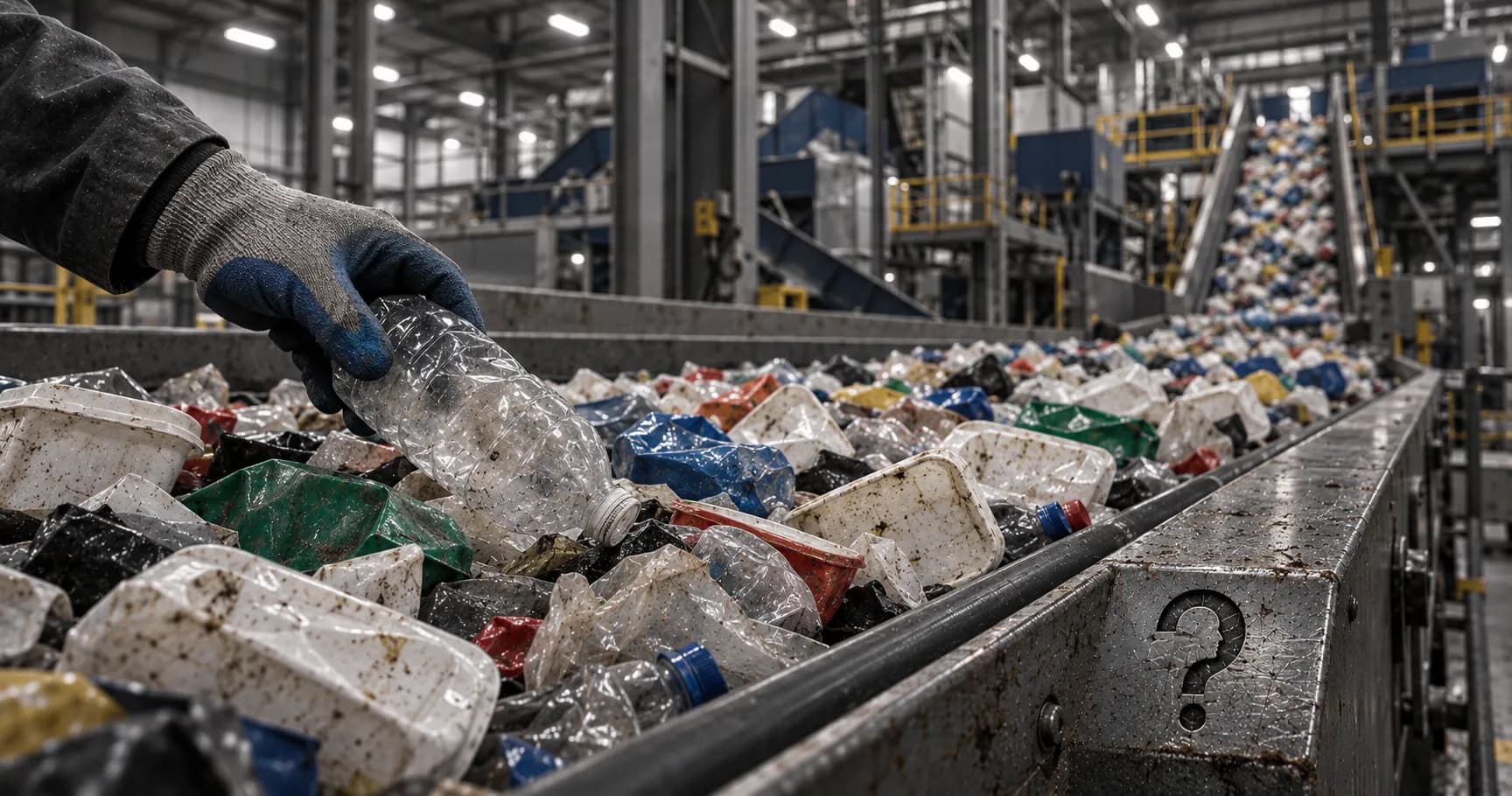
The nine per cent everybody quotes is cumulative since 1950 and the current rates are higher. The psychological finding the trade likes rests on forty-four undergraduates and one lavatory, and three searches found no direct replication of it. What moves the numbers is the collection system, and the psychology sits in the offer.
Answer to the question
What does greenwashing have to do with recycling?
It was offered as the answer to a problem shoppers could not solve. Nine per cent of all plastic waste generated between 1950 and 2015 had been recycled, on Roland Geyer and colleagues' model, and only a tenth of that more than once. The rates that move are set by collection systems, not by shoppers.
Key takeaways
- Of the 6,300 megatonnes of plastic waste generated between 1950 and 2015, Roland Geyer and colleagues put the recycled share at around nine per cent, and only a tenth of that had been recycled more than once.
- That nine per cent is cumulative since 1950. The same paper gives eighteen per cent for non-fibre plastic waste generated in 2014, thirty per cent in Europe and nine per cent in the United States.
- The finding that a recycling bin raises consumption comes from forty-four undergraduates in one laboratory and one men's lavatory measured fifteen days each side with no control site, and three searches found no direct replication in either direction.
- Across 28 stated-preference studies, James Murphy and colleagues found a median ratio of hypothetical to real willingness to pay of 1.35, against the factor of two or three usually quoted.
- The United States Environmental Protection Agency recorded a 9.1 per cent recycling rate for plastics overall in 2015 and 29.9 per cent for polyethylene terephthalate bottles and jars, in the same dataset and the same year.
In 1961 a psychologist was hired by the glass trade and, Saabira Chaudhuri reports, found that guilt was what stopped people throwing things away. In 1987 the Mobro barge and its cargo of New York rubbish became a national story, and a wave of copycat packaging ban bills followed. In 1988 seven chemical companies put up a million dollars each, and a sorting code began appearing on the bottom of plastic containers. In 2021 California legislated against that code on packaging nobody collects. Greenwashing is the modern word for the stretch in between, and recycling is its longest-running case.
A Psychologist Hired to Shift Guilt
The first piece of consumer psychology here arrived as a commission. Chaudhuri, a Wall Street Journal consumer goods reporter of about 12 years, opens Consumed with Ernest Dichter, the psychologist known as the father of motivational research. In 1961, she reports, he surveyed 800 bottlers, retailers and consumers for the Glass Container Manufacturers Institute, found that disposables read as clean and orderly, identified guilt as the obstacle to throwing things away, and proposed a stubby bottle.
Most of the industry history below comes from that one reporter's account, and the reader should have that before any of it is used. Her book rests on 82 interviews she conducted herself and on company and regulatory documents, which is the right apparatus for business history. It is still one account, and its central thesis, that recycling was a marketing campaign, is the claim in it our audit calls an overreach. Where a record exists outside the book, what follows uses the record and says so. Where it does not, it says the book.
The Dichter material is one of the places it does not. It rests on Chaudhuri citing his own 1961 reports, and the Hagley Museum and Library's catalogue record for his papers would not load when we went to check, so the sample of 800 and the guilt finding are her reporting and no more. The brief is what makes it worth the space. A psychologist was not asked how to sell a bottle, but which feeling stood between a customer and the bin.
That is the shape of everything that follows.
The Barge, Then the Million Dollars
Then the rubbish became visible. After the Mobro and the ban bills it inspired, Chaudhuri reports, seven chemical companies put in a million dollars each to fund a vaguely named lobbying body formed in 1988, the Council for Solid Waste Solutions: Amoco, Dow Chemical, DuPont, Exxon Chemical, Quantum, Cain and Mobil Chemical. They hired Don Shea, for 9 years the Beer Institute's head lobbyist. Asked why the body promoted recycling, Shea told her the industry needed bona fides.
Ron Liesemer, the DuPont product-development head seconded to prove plastics recyclable, judged the recycled lumber unsaleable and told a board member that 10 per cent would be a big achievement. Asked why they were bothering, he answered that the point was to prove it could be done.
The greenwashing charge against the industry is routine, and what anybody can document is narrower than what circulates. Of 595 endnotes in Consumed counted one by one, about 35 per cent are primary and 4.4 per cent peer-reviewed, the wrong yardstick for business history: a memo can settle what a company did in 1989 and a journal article cannot.
The documented version reaches us from better sources anyway. NPR and PBS Frontline, working from internal industry documents on 11 September 2020, report a 1973 report to executives saying there is no recovery from obsolete products and that sorting is infeasible, and a 1974 speech recording serious doubt that recycling plastic could ever be made economic.
A December 1989 memo by Larry Thomas, then president of the Society of the Plastics Industry, warned executives that the image of plastics was deteriorating at an alarming rate. Thomas, interviewed by NPR after he had left the industry, put the logic in his own voice: if the public thinks that recycling is working, they are not going to be as concerned about the environment.
> Promotion of recycling by the plastics industry from 1988 ran alongside internal industry documents, dating to at least 1973, recording doubt that plastics recycling could ever be economic, and served a stated purpose of relieving regulatory and public pressure.
The industry's answer travels with that. Steve Russell, then vice president of plastics at the American Chemistry Council, told NPR that the industry has never intentionally misled the public about recycling, and that the past failure was one of infrastructure and market signals and not of intent. The Plastics Industry Association's position is that the resin code was never an indicator of recyclability and was designed to help facilities sort.
A Code Built for Sorting Machines
The code came from inside the trade. Chaudhuri reports that Lewis Freeman, the Society of the Plastics Industry's head of government affairs, devised the resin identification code in 1988 and pushed it past internal opposition to forestall mandatory regulation, and that by the early 1990s 39 states had written it into law for rigid containers. Freeman says on the record in her book that there was no intent to confuse anyone, that the code was meant only to distinguish the numbers, and that recyclability is what people took it to mean.
The arrows around the number were older and had nothing to do with plastics. Gary Anderson designed them in 1970 as a 23-year-old architecture student, and tells Chaudhuri it was a marketing tool, that its association with greenwashing saddens him, and that he still thinks it useful.
If greenwashing has a founding artefact, this is probably it. "Please Recycle" was printed beside the arrows on packaging that was not recyclable, surveys showed a majority read it as meaning they could, and a 1993 report to senior Society of the Plastics Industry officials said the code was being misused as a green marketing tool.
California legislated against the arrows in 2021, on products not regularly collected and processed for recycling in the state. The prohibition was written to operate on the state regulator's characterisation of which materials are actually collected, so it takes effect after those findings rather than on enactment. Neither the bill text nor the regulator's page would load on this pass, so no commencement date is given here.
A mark for sorting machines had become a promise to shoppers.
A code built for sorting machines, lobbied onto packaging in almost forty states, had become a promise to shoppers.
The Number Everyone Rounds Off
Roland Geyer, with Jenna Jambeck and Kara Lavender Law, published the standard account in 2017, a material-flow model of every plastic ever made. Of the 6,300 megatonnes of plastic waste generated between 1950 and 2015, around 9 per cent had been recycled, 12 per cent incinerated and 79 per cent accumulated in landfills or the environment. Inside that recycled share sits the clause worth more than the headline: only 10 per cent of it had been recycled more than once.
That 9 per cent covers everything generated since 1950. Today's rates are higher, and the same paper gives them separately for non-fibre plastic: 18 per cent of what was generated in 2014, with the highest rates that year in Europe at 30 per cent and China at 25, while the United States held steady at 9 per cent from 2012. Treating the cumulative figure as today's rate is the commonest error in this field.
> Recycling delays, rather than avoids, final disposal. It reduces future plastic waste generation only if it displaces primary plastic production; however, because of its counterfactual nature, this displacement is extremely difficult to establish.
They are candid about the model, rounding cumulative results to the nearest hundred megatonnes and naming product lifetimes and the rates outside Europe and the United States as their largest uncertainties. What they state flatly is chemistry: none of the commonly used plastics are biodegradable.
Forty-Four Students and One Lavatory
The greenwashing story would be tidier if the psychology held. Jesse Catlin and Yitong Wang published "Recycling gone bad" in the Journal of Consumer Psychology, proposing that the ability to recycle may raise resource usage compared with no recycling option. The design detail below comes from Roberta Kwok's report of the study in Conservation Magazine of 13 September 2012, the full text having stayed out of reach.
Forty-four undergraduates cut shapes from paper to test pairs of scissors. Those given only a bin used 9.45 grams of paper on average; those given a recycling bin as well used 17.21 grams. In the field study the researchers weighed a men's lavatory's towels, counted users with an infrared beam for 15 days, then added a recycling bin and a sign promising the towels would be recycled. Per-person use rose from 6.12 grams to 7.13 grams.
Say plainly what that is. One room, and one lavatory measured 15 days each side with no control site, so nothing separates the bin from whatever else moved across those 30 days. The laboratory effect is close to a doubling and the field effect about a gram a head, the shape of a finding that has failed before, as [The Psychology You Learned Didn't Replicate](https://thewhyweproject.com/articles/the-psychology-you-learned-didnt-replicate) sets out.
Catlin told that reporter people may treat recycling as permission to consume more, and added, in the half the coverage drops, that this does not mean we should scrap recycling bins. We looked for a direct replication along three routes: the title, the authors with replication and preregistration terms, and the effect in plain language. Nothing came back either way.
Monic Sun and Remi Trudel built the strongest version in 2017, a model in which recycling reduces the negative emotion of wasting and adds a positive one to disposal, reporting that experiments with real disposal behaviour supported it. Only the publisher's abstract reached us, so no sample or effect is attached here and we cannot say what those experiments showed. Their mechanism, guilt removed and pride added, resembles what Dichter was hired to find.
Baolong Ma and three colleagues at the Beijing Institute of Technology are routinely cited as experimental confirmation and are no such thing. Theirs is a cross-sectional online survey of 356 participants in China, a design that cannot show recycling causing later consumption.
The Licence That Shrinks Under Inspection
The mechanism everyone reaches for is moral licensing, the idea that a good deed buys permission for a worse one. Irene Blanken, Niels van de Ven and Marcel Zeelenberg pooled 91 studies and 7,397 participants in 2015 and found it small to medium and significantly positive, with substantial variation between studies that none of their theorised moderators explained.
Their own paper is also the best case against it: a significantly asymmetric funnel plot, 21 studies estimated missing, and published studies running about four times the size of unpublished ones. Niclas Kuper and Antonia Bott re-modelled the larger dataset in 2019 and the adjusted estimates came out at a little over half the original or at nothing at all, cautioning that the first might understate and the second exaggerate.
The version that matters most here has been tested head on. Jan Urban, with Simon Bahnik and Marketa Braun Kohlova, ran two conceptual and one close replication of the green-consumption licensing study, 1,274 participants, with validated tasks in which people could take money by reporting inaccurately in their own favour. No effect on later dishonesty appeared, and their reading is that such policies trigger cross-domain licensing less often than was thought.
The best field evidence runs the other way. Verena Tiefenbeck and three colleagues ran a controlled experiment across 154 apartments. Residents given weekly feedback on their water use cut it by 6.0 per cent and raised their electricity use by 5.6 per cent against controls, income effects excluded. Their own hedge is that the findings are consistent with licensing without demonstrating it. A real effect, then, poorly bounded, and absent where this article needs it.
What the Labels Actually Sold
Eva Camacho-Cuena and three co-authors ran the one incentive-compatible test of what people will pay for recyclability itself. Participants answered a hypothetical question, then faced a real payment scenario. At population level there were no significant median differences between what they said and what they paid, while within subjects the low bidders understated their contributions and the high ones overstated. It is a laboratory study from 2004 and its abstract carries no sample size.
The general gap between a survey answer and a till receipt is also smaller than the folklore: James Murphy and three colleagues pooled 28 stated-preference studies in 2005 and found a median hypothetical-to-real ratio of 1.35, against a received wisdom of two or three.
Sebastian Feuss and four colleagues at RWTH Aachen ran the largest real-money test of green labelling available, 58,000 purchase decisions in an online fashion store. Eco-labels raised purchases, and higher price premiums reinforced the effect instead of weakening it, which has the shape of the cost condition in our piece on [going green where someone can see you](https://thewhyweproject.com/articles/going-green-where-someone-can-see-you). It is an eco-label on clothing rather than a recyclability claim on a packet, and only the abstract was available, so there is no effect size.
The commercial case at its strongest is the McKinsey and NielsenIQ analysis of 6 February 2023: five years of United States sales data to June 2022, 600,000 product lines, 44,000 brands. Products carrying environmental, social and governance claims grew 28 per cent cumulatively against 20 per cent for those carrying none, with a 4.7 per cent differential for sustainable-packaging claims. Its authors call this correlation, controlled for neither marketing spend nor promotion, and did not assess whether any claim was true.
The most-circulated figure in the field, that 66 per cent of consumers will pay more for sustainable brands, comes from a 2015 Nielsen panel survey whose own page returned an empty body for us, so it reaches us through secondary reports alone. These figures travel without their methods, which is the condition greenwashing needs.
One study is missing, and our searches for it, across several phrasings and source types, found nothing. Nobody appears to have run a randomised field experiment on real purchases testing a recyclability claim on packaging, a hole our piece on whether [brand purpose moves buyers](https://thewhyweproject.com/articles/does-brand-purpose-move-buyers) also meets.
Same Country, Same Year, Threefold Gap
The evidence that settles it has been sitting in a government table the whole time. The Environmental Protection Agency's 2015 figures record plastics generation of 34.5 million tons and 3.1 million tons recycled, which it states as a 9.1 per cent rate; the rounded tonnages themselves divide to 9.0. In the same dataset and year, polyethylene terephthalate bottles and jars ran at 29.9 per cent and high-density polyethylene natural bottles at 30.3 per cent.
Same consumers, same year, same bins, a threefold difference by material. No account of shopper psychology separates a person's attitude to a drinks bottle from their attitude to a yoghurt pot. Sorting, resale value and the existence of a buyer do.
Same consumers, same year, same bins, and a threefold difference by material. That is a fact about sorting and resale value.
Attach money to the container and the number moves again. Infinitum, which operates Norway's deposit return system, publishes a return rate of 92 per cent for aluminium and 95 per cent for plastic bottles, and says on its own site that it has run that system since 1999. Those are the operator's figures, unaudited by anyone we could find.
When psychologists ask what actually raises household recycling, the answers come back about situations. Alessandra Varotto and Anna Spagnolli pooled 36 studies reporting 70 field interventions in 2017 and found social modelling and environmental alterations most effective, ahead of information, feedback, incentives and commitment. No pooled effect size was in the abstract we read. Environmental alteration means moving the bin.
Set the two cases side by side. The psychological one: the offer plausibly changes how disposal feels, one laboratory study of 44 students plus a lavatory found a recycling bin raising use of a free resource, a second team reports experimental support for an affective version of it in a paper we read only in abstract, and licensing pools positive across 91 studies. The infrastructural one: rates that move threefold with the collection system while the consumers stay put.
We go with the second, on the quality of the designs. On one side sit one laboratory, one lavatory, one survey, one abstract and no reproduction. On the other sit agency material-specific series, national return rates and 70 field interventions. When a 44-person study and a statistical series disagree, the series wins.
That does not retire the psychology. It relocates it. What is documented is a psychologist paid to find the emotional obstacle to disposal, a code built for sorting machines and lobbied onto packaging in almost 40 states, a symbol its designer calls a marketing tool, and a memo warning executives that plastic's image was collapsing. None of that is a finding about shoppers. All of it records what shoppers were asked to believe.
Chaudhuri's own book ends where the evidence does, arguing for polluter-pays producer responsibility, recycled-content mandates, penalties and simpler materials, and listing a few consumer actions before calling them, in her words, small potatoes, with the real power in regulation.
That is not the same as nothing for a reader to do. Three things here are worth carrying out of the piece.
- Know what in your own bin is actually recycled. On the agency's 2015 figures bottles ran at about 30 per cent against 9.1 per cent for plastics overall, because bottles have a buyer. A yoghurt pot in the same bin is being hoped at.
- Know where the large numbers come from. With a deposit on the container, Norway's operator reports 92 and 95 per cent coming back, on its own unaudited figures. That lever is pulled in legislatures rather than at the bin.
- Read a label as a claim somebody has to be paid to make true. The answerable question is who collects this material and who buys it back.
A promise is cheap to print and expensive to honour, and for most of this story the printing was the whole of the policy.
Common questions
What does greenwashing have to do with recycling?
The recycling promise is the longest-running case of it. A sorting code devised in 1988 was legislated into 39 states and read by shoppers as a recyclability claim, while internal industry documents dating to 1973 recorded doubt that plastics recycling could ever be economic. McKinsey and NielsenIQ define greenwashing as empty or misleading claims about a product's environmental merits, and say they did not check any.
Does a recycling bin make people consume more?
The evidence is thin. Jesse Catlin and Yitong Wang reported it from 44 undergraduates in one laboratory and one men's lavatory monitored for 15 days each side with no control site, and three separate searches turned up no direct replication in either direction. Later work extends the idea with an affective model and a correlational survey. Treat it as suggestive and under-powered.
Is nine per cent the current plastic recycling rate?
No. It is the cumulative share of all plastic waste generated between 1950 and 2015 that had been recycled, from Roland Geyer and colleagues' material-flow model. The same paper gives current figures separately: 18 per cent of non-fibre plastic waste generated in 2014, 30 per cent in Europe, 25 in China and 9 in the United States.
Sources
Geyer, R., Jambeck, J. R., & Law, K. L. (2017). 'Production, use, and fate of all plastics ever made.' Science Advances, 3(7), e1700782. doi:10.1126/sciadv.1700782
Catlin, J. R., & Wang, Y. (2013). 'Recycling gone bad: When the option to recycle increases resource consumption.' Journal of Consumer Psychology, 23(1), 122-127. doi:10.1016/j.jcps.2012.04.001
Kwok, R. (2012). 'Wasteful Thinking.' Conservation Magazine, 13 September 2012.
Sun, M., & Trudel, R. (2017). 'The Effect of Recycling versus Trashing on Consumption: Theory and Experimental Evidence.' Journal of Marketing Research, 54(2), 293-305. doi:10.1509/jmr.15.0574
Ma, B., Li, X., Jiang, Z., & Jiang, J. (2019). 'Recycle more, waste more? When recycling efforts increase resource consumption.' Journal of Cleaner Production, 206, 870-877. doi:10.1016/j.jclepro.2018.09.063
Blanken, I., van de Ven, N., & Zeelenberg, M. (2015). 'A Meta-Analytic Review of Moral Licensing.' Personality and Social Psychology Bulletin, 41(4), 540-558. doi:10.1177/0146167215572134
Kuper, N., & Bott, A. (2019). 'Has the evidence for moral licensing been inflated by publication bias?' Meta-Psychology, 3. doi:10.15626/MP.2018.878
Urban, J., Bahnik, S., & Braun Kohlova, M. (2019). 'Green consumption does not make people cheat: Three attempts to replicate moral licensing effect due to pro-environmental behavior.' Journal of Environmental Psychology, 63, 139-147. doi:10.1016/j.jenvp.2019.01.011
Tiefenbeck, V., Staake, T., Roth, K., & Sachs, O. (2013). 'For better or for worse? Empirical evidence of moral licensing in a behavioral energy conservation campaign.' Energy Policy, 57, 160-171. doi:10.1016/j.enpol.2013.01.021
Feuss, S., Fischer-Kreer, D., Majer, J., Kemper, J., & Brettel, M. (2022). 'The interplay of eco-labels and price cues: Empirical evidence from a large-scale field experiment in an online fashion store.' Journal of Cleaner Production, 373, 133707. doi:10.1016/j.jclepro.2022.133707
Camacho-Cuena, E., Garcia-Gallego, A., Georgantzis, N., & Sabater-Grande, G. (2004). 'An Experimental Validation of Hypothetical WTP for a Recyclable Product.' Environmental and Resource Economics, 27(3), 313-335. doi:10.1023/B:EARE.0000017657.08513.74
Murphy, J. J., Allen, P. G., Stevens, T. H., & Weatherhead, D. (2005). 'A Meta-analysis of Hypothetical Bias in Stated Preference Valuation.' Environmental and Resource Economics, 30(3), 313-325. doi:10.1007/s10640-004-3332-z
Varotto, A., & Spagnolli, A. (2017). 'Psychological strategies to promote household recycling. A systematic review with meta-analysis of validated field interventions.' Journal of Environmental Psychology, 51, 168-188. doi:10.1016/j.jenvp.2017.03.011
McKinsey & Company and NielsenIQ (2023). 'Consumers care about sustainability and back it up with their wallets.' McKinsey, 6 February 2023.
Nielsen (2015). 'The Sustainability Imperative.' Nielsen, October 2015.
United States Environmental Protection Agency (2015). 'Plastics: Material-Specific Data.' Facts and Figures about Materials, Waste and Recycling.
Infinitum (2024). 'Facts and figures.' infinitum.no.
NPR and PBS Frontline (2020). 'How Big Oil Misled The Public Into Believing Plastic Would Be Recycled.' 11 September 2020.
Chaudhuri, S. (2025). Consumed: How Big Brands Got Us Hooked on Plastic. London: Blink Publishing.