Why We Skip Ugly Fruit
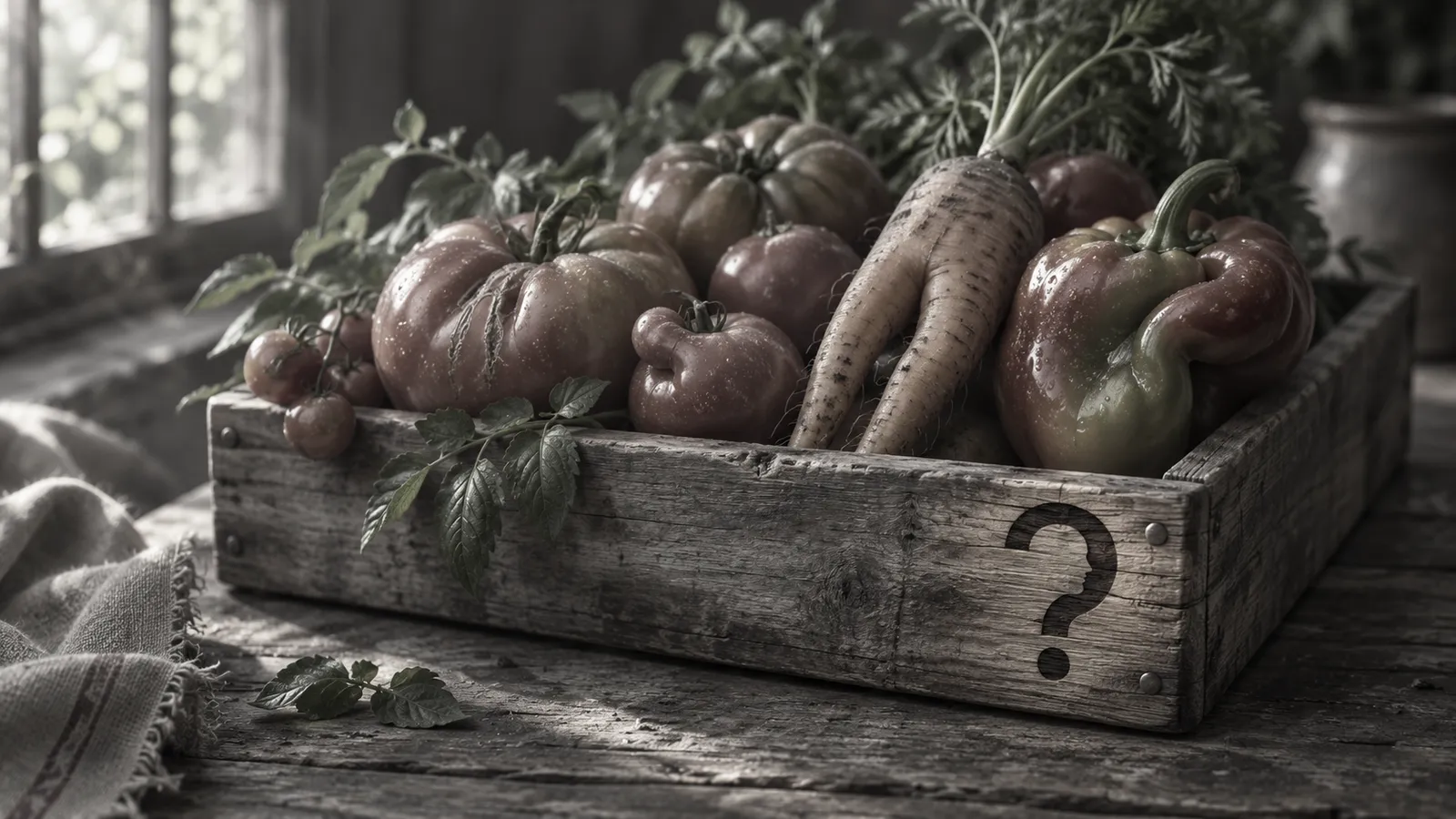
What experiments and surveys show about shape, taste, framing and place of sale in the choice to leave odd-looking produce on the shelf.
Answer to the question
Why do people avoid ugly fruit and vegetables?
Because shape is read as a sign of quality before anything is tasted. In one experiment an abnormally shaped vegetable was judged less favourably than a normal one, and in a survey of 3,504 US consumers shape imperfections were generally not accepted. The same studies show tasting, message wording and place of sale can shift the verdict.
Key takeaways
- In a 2024 experiment with tomatoes and sweet peppers, an abnormally shaped vegetable was judged less favourably than a normal one, while a small vegetable was judged more favourably than a regular one.
- In a survey of 3,504 US consumers, colour-related imperfections were accepted but shape imperfections generally were not, and price discounts were the second most important factor in acceptance.
- Across three studies, people with direct experience of growing produce saw low-beauty items as more prototypical, less disgusting and more desirable.
- Tasting a slice raised willingness to buy in one experiment, and both gain-framed and loss-framed messages about food waste raised acceptance in a survey of 3,504 consumers.
- In two online surveys of 1,021 Romanian and British consumers, misshapen tomatoes were seen as least misshapen and most likely to be bought in particular places of sale.
In one recent experiment, an abnormally shaped vegetable was judged less favourably than a normal one, and a small vegetable was judged more favourably than a regular one. That split sits at the centre of why ugly fruit stays on the shelf. Saabira Chaudhuri's Consumed follows the move to self-service shops, where selling passed from the clerk behind a counter to the item and its pack on a shelf, so that how a thing looked did the persuading. Fruit and vegetables inherited that arrangement, which left the odd-looking ones with no clerk to explain them, and the research on ugly fruit since shows two sides to it: appearance lowers the verdict, and several things raise it again.
Shape lowers the verdict on ugly fruit
Tomatoes and sweet peppers that were small or abnormally shaped were rated for perceived quality and willingness to buy, under three information conditions, in an experiment by Efrat Elimelech, Eyal Ert, Yael Parag and Guy Hochman. The abnormal shape lost ground against the normal one, while the small size gained against the regular one, which runs against the size rules that retailers apply. The authors read the pattern as a consumer bias toward aesthetic qualities. The size result is the useful detail, because it shows that the dislike is aimed at one kind of departure from the expected look rather than at difference as such.
A survey of 3,504 consumers in the United States points the same way. In the choice experiment run by C. J. Lagerkvist and colleagues, respondents weighed imperfections against price, production type and origin. Respondents accepted produce with colour-related imperfections but generally did not accept imperfections of shape or other physical aspects. Price discounts came second in importance among the factors, so selling ugly fruit and vegetables with colour flaws may call for a substantial discount, and the authors found that this applied only to colour.
Under self-service selling there is no clerk to speak for an odd shape. The look of the item is the whole of its case, and a shape that departs from the picture in the shopper's head makes a weak case. That is the first side, and it holds across both studies: appearance is read as quality before anything else is known.
Experience sets what counts as normal
Where does the picture in the shopper's head come from? Sean Hingston and Theodore Noseworthy, drawing on prototype theory, predicted that personal experience decides how far a person's mental prototype of a fruit or vegetable leans toward beauty, and so how that person responds to a misshapen item. Across three studies, people with direct experience of growing produce saw items of low aesthetic beauty as more prototypical, less disgusting and more desirable.
The finding places the aversion to ugly fruit in a learned standard rather than in the food. A prototype tilted toward beauty behaves like the halo described in What is the halo effect, where one good feature lifts judgement of everything else about a thing, and experience of growing food appears to pull the tilt back. What a person counts as normal, and so as ugly fruit, is a matter of what that person has seen, handled and grown, and the same item reads differently against a different standard.
Chaudhuri's account of packaging as a selling device gives the finding a commercial setting. Where the pack and the look of the item carry the sale, the standard a shopper holds for that look decides the result. A standard formed by cooking and gardening differs from one formed only by shelves, which is why the same crooked carrot can read as ordinary in one kitchen and as a defect in another.
Tasting, framing and venue shift it
The same experiment that found the shape penalty also tested tasting. Participants who tasted a slice after seeing the picture of ugly fruit were more willing to buy, though tasting did not change their quality ratings of the sized or shaped products. The authors suggest that direct taste experience can shift perceptions and encourage acceptance of visually imperfect produce. These are ratings and stated willingness to buy, so they show a change of intention in the laboratory rather than a change in shop sales.
Message content moved acceptance as well. In the survey of 3,504 consumers, respondents were randomly given no message, a gain-framed message or a loss-framed message about the nutritional and environmental impacts of food waste. Both versions increased acceptance, the gain and loss pairing at the heart of What is the framing effect, and the size of the effect depended on personal values. People who prioritised self-transcendence and openness to change were more open to imperfect food and especially responsive to the messages.
Place of sale mattered too. Two online surveys of 1,021 Romanian and British consumers, run by Iris Vermeir, Dacinia Crina Petrescu and Ruxandra Malina Petrescu-Mag, asked about misshapen tomatoes. Shoppers saw the least abnormality, and were most likely to buy, in fresh markets in Romania, and in organic stands and supermarkets in the UK. A setting that tells the shopper to expect variety changes how far ugly fruit reads as ugly.
Where the two sides meet
Both sides stand, and they do not cancel. Appearance lowers the verdict on ugly fruit and vegetables in every study above that measured it, and in the same studies the verdict moves with tasting, message wording, venue and experience. We agree with the side that treats the rejection of ugly fruit as learned and movable, because the studies that document the penalty are also the ones that document ways of reducing it. The look of food sets an expectation that taste then has to meet, a pattern traced in Food Branding Psychology: Taste Starts With the Eye, and an odd shape sets a low expectation that a taste can overturn.
For a seller or a household, the findings point to three moves:
- Offer a taste alongside the sight of the item.
- Say plainly why the item is sold, using a gain or a loss version of the message.
- Place it where variety is expected.
The start of the effect may lie in the kitchen. Eleven focus groups with 97 New Zealand children aged 5 to 11, run by Annesha Makhal, Kirsten Robertson, Maree Thyne and Miranda Mirosa, found that families who use imperfect produce, teach about waste and rely on knowledge when shopping helped their children accept it, while other children absorbed rejection by watching parents' choices, following explicit instructions or adopting shared norms.
Common questions
Why do people avoid ugly fruit and vegetables?
Ugly fruit loses because shape is read as a sign of quality before anything is tasted. In one experiment an abnormally shaped vegetable was judged less favourably than a normal one, and in a survey of 3,504 US consumers shape imperfections were generally not accepted, while colour imperfections were.
Do people accept ugly produce if it costs less?
Partly. For ugly fruit and vegetables, in a survey of 3,504 US consumers, price discounts were the second most important factor in acceptance, and the authors found that a substantial discount mattered only for colour-related imperfections.
Does tasting change the verdict on ugly produce?
In one experiment, tasting a slice raised willingness to buy but did not change the quality ratings of the sized or shaped products.
What is an idealized prototype?
It is the mental picture of a typical fruit or vegetable, which tends to lean toward beauty. Hingston and Noseworthy found that people with direct experience of growing produce saw low-beauty items as more prototypical.
Sources
Chaudhuri, S. Consumed: How Big Brands Got Us Hooked on Plastic. Seed book; vault hub Books/Consumed.
Elimelech, E., Ert, E., Parag, Y., & Hochman, G. (2024). Exploring the impact of visual perception and taste experience on consumers' acceptance of suboptimal fresh produce. Sustainability, 16(7), 2698. doi:10.3390/su16072698 https://doi.org/10.3390/su16072698
Lagerkvist, C. J., Edenbrandt, A. K., Bolos, L. A., & Nayga, R. M. (2022). Consumer acceptance of aesthetically imperfect vegetables: The role of information framing and personal values. Evidence from the United States. Food Quality and Preference, 104, 104737. doi:10.1016/j.foodqual.2022.104737 https://doi.org/10.1016/j.foodqual.2022.104737
Hingston, S. T., & Noseworthy, T. J. (2020). On the epidemic of food waste: Idealized prototypes and the aversion to misshapen fruits and vegetables. Food Quality and Preference, 86, 103999. doi:10.1016/j.foodqual.2020.103999 https://doi.org/10.1016/j.foodqual.2020.103999
Vermeir, I., Petrescu, D. C., & Petrescu-Mag, R. M. (2023). What are the shape friendly locations to sell misshapen tomatoes? The effect of point of purchase on consumers' abnormality perception and probability to buy. Food Quality and Preference, 106, 104809. doi:10.1016/j.foodqual.2023.104809 https://doi.org/10.1016/j.foodqual.2023.104809
Makhal, A., Robertson, K., Thyne, M. A., & Mirosa, M. (2020). Normalising the ugly to reduce food waste: Exploring the socialisations that form appearance preferences for fresh fruits and vegetables. Journal of Consumer Behaviour, 20(5), 1025-1039. doi:10.1002/cb.1908 https://doi.org/10.1002/cb.1908