Why We Call The Lord of the Rings the Best Book Ever Written
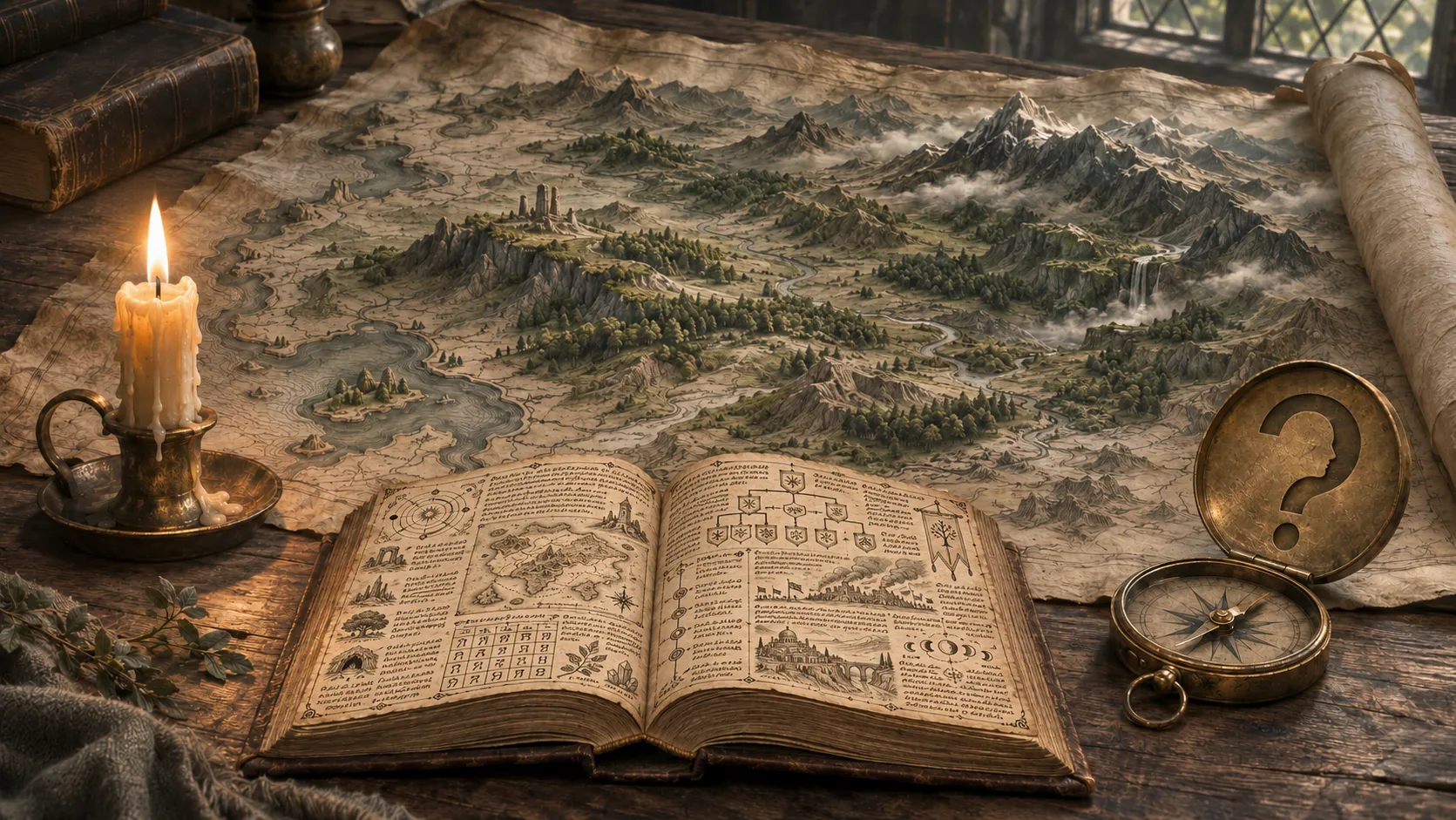
A built world of languages, maps and histories, what research says about being absorbed in a story, and why readers return to Middle-earth.
Why is The Lord of the Rings called the best book?
Polls record how much readers love a book, and The Lord of the Rings gives them a world built with languages, maps and histories. Research on narrative transportation and perceived realism suggests such a consistent world can hold readers inside a story, and the book's ending and rereadability add to its pull.
Key takeaways
- In the BBC's Big Read of 2003, The Lord of the Rings came first in a final round of about 750,000 votes, and Britannica reports sales of over 50 million copies by about 2000.
- Tolkien wrote the book over about seventeen years and planned its appendices in 1942, with maps, invented languages and historical annals behind the main story.
- Rick Busselle and Helena Bilandzic argued in 2008 that what breaks absorption in a story is inconsistency with the real world or with the story's own rules, not the fact that it is invented.
- Melanie Green and Timothy Brock found in 2000 that more transported readers held more beliefs consistent with the story and rated its protagonists more favourably.
- A 2022 survey of 671 US adults linked a tendency to reread with trait narrative transportation, while Tolkien's word eucatastrophe names the sudden upward turn that ends such a story.
J. R. R. Tolkien worked on The Lord of the Rings for about seventeen years, and he conceived its appendices when the main text was only about half written. In the BBC's Big Read, a national vote held in the first years of this century, hundreds of thousands of people took part in the final round and The Lord of the Rings came first. A strong candidate for what readers respond to when they call The Lord of the Rings the best book ever written is the depth of the world behind it. Charan Ranganath argues in Why We Remember that memory ties events to their context, and this book supplies a great deal of it.
What Readers Mean by Best Book Ever Written
A vote for the best book ever written reports the voter's experience. The polls ask which book people love most, and a book can be admired by a small circle of specialists while a poll of hundreds of thousands records a reaction that many different readers share. That shared reaction is what needs explaining, and research on stories points to two places to look: how far a reader is carried into the narrative world, and what the world gives back once the reader is there.
The Big Read began in April 2003 with nearly 1.4 million votes to choose a top 100 of the nation's fiction, then put five finalists to a public vote. The Lord of the Rings won that final round with 174,000 votes among about 750,000 cast, according to the report of the result published on 14 December 2003. Britannica adds that by about 2000 the book had sold over 50 million copies in roughly 30 languages, and that several polls since 1996 have named it the best book of the twentieth century. Numbers on that scale describe a large and varied audience for The Lord of the Rings.
A World Built Before the Story
The world of the book was built on purpose and over a long time. The Tolkien Estate records that Tolkien had been inventing languages, Elvish above all, since his youth, and that he built the novel's world on them.
He redrafted his maps over the years so that they matched the sequence of the story, and he drew six separate maps of the Shire alone. The appendices he planned in 1942 were meant to hold what would slow the main plot but mattered to him: historical annals, alphabets and languages, and family trees. The publisher kept the maps and appendices when it cut costs after the war. The labour behind all this raises a separate question, whether visible effort in itself raises how much people value a work, taken up in Does Effort Justification Hold Up.
This is more reference material than most novels carry, and Ranganath's account of memory suggests why it may matter to a reader. Events are remembered with the setting around them, and a person who already holds an organised picture of a place can attach new events to it with less effort. A reader meets a landscape with a past, a calendar and a set of tongues, so each scene arrives with somewhere to be filed. How surroundings shape what is remembered is explored in Why the Odd One Out Gets Remembered.
The better-tested part of the argument comes from a 2008 theoretical synthesis in Communication Theory, which draws on earlier studies and reports no experiment of its own. Its authors, Rick Busselle and Helena Bilandzic, hold that audiences build mental representations of a story's events, characters and setting, and that when the building runs smoothly people become absorbed and lose awareness of their surroundings.
What breaks absorption, they argue, is not that a story is invented, since knowing a story is fiction does not disrupt the processing. Disruption comes from material that clashes with the real world, which they call a failure of external realism, or that breaks the rules the story has set for itself, a failure of narrative realism. In The Lord of the Rings, a world with fixed languages, maps that agree with the plot and histories that account for its customs offers fewer such breaks.
What Absorption Does to a Reader
The state of being carried into a story is called narrative transportation, a term Melanie Green and Timothy Brock introduced in 2000 for imagery, feeling and attention working together on the narrative. A published research summary of their paper reports four experiments with an imagery-rich story and several variants, in which readers who were more transported held more beliefs that agreed with the story and evaluated its protagonists more favourably. The finding concerns what readers carry away from a story they have entered fully. What the transportation research does and does not show about stories and money is set out in What a Story Adds to a Price.
Enjoyment was the next question. In a 2004 account by Green, Brock and Geoff Kaufman, enjoyment can come from the immersion itself and from what follows it, including bonds with characters and personal change. A long narrative such as The Lord of the Rings, set in a consistent world, is a place where both can build, because months of reading give a reader time to form those bonds.
Why Readers Return to Middle-earth
A book this long invites a second reading. In an online survey of 671 adults in the United States, Lauren Ministero and colleagues included a short scale for the tendency to reread. That tendency was distinct from the general tendency to read, and it was positively associated with trait narrative transportation even after general reading was taken into account. The survey was correlational and did not concern any one title, so it supports only the broad point that absorption in fictional worlds and a habit of going back to familiar books tend to go together.
For a world like Middle-earth the return has a further reward, and The Lord of the Rings is built to give it. The appendices, the languages and the maps give a reader more to find on each visit, so a second reading is not a copy of the first.
| Term | Plain meaning | Source |
|---|---|---|
| Narrative transportation | Being absorbed in a story through imagery, feeling and attention | Green and Brock, 2000 |
| External realism | How closely a story matches the real world | Busselle and Bilandzic, 2008 |
| Narrative realism | Whether events and characters stay consistent with the story's own rules | Busselle and Bilandzic, 2008 |
| Eucatastrophe | A sudden upward turn that changes a falling plot into joy | Tolkien, On Fairy-stories |
Tolkien coined the word eucatastrophe in his essay On Fairy-stories, which grew from a lecture he gave in 1939 and was published in 1947. It names a sudden upward turn in a plot, a reversal of what looked like a falling course, so that sorrow becomes joy. He saw it as the mark of the fairy story, as tragedy is the mark of drama. The turn works only if disaster has seemed a real possibility beforehand. After hundreds of pages in which a reader has come to know the land and what is at stake in it, the reversal reaches someone who is fully inside the story, and that fits the 2004 description of enjoyment that follows immersion.
Common questions
Why is The Lord of the Rings called the best book?
Polls record how much readers love a book, and The Lord of the Rings has a built world of languages, maps and histories that research on narrative transportation suggests can hold readers inside a story. The BBC's Big Read of 2003 placed it first in a final round of about 750,000 votes.
How long did Tolkien take to write The Lord of the Rings?
The Tolkien Estate dates the writing from December 1937 to 1949, about seventeen years. The three volumes were published in 1954 and 1955.
What is narrative transportation?
It is the state of being absorbed in a story, with imagery, feeling and attention all engaged. Melanie Green and Timothy Brock introduced the term in 2000.
What does eucatastrophe mean?
It is Tolkien's word for a sudden upward turn in a plot that changes an apparent defeat into joy. He used it in his essay On Fairy-stories, published in 1947.
Sources
Ranganath, C. Why We Remember. Seed book; vault hub Books/Why We Remember.
Green, M. C., & Brock, T. C. (2000). “The role of transportation in the persuasiveness of public narratives.” Journal of Personality and Social Psychology, 79(5), 701-721. doi:10.1037/0022-3514.79.5.701 https://doi.org/10.1037/0022-3514.79.5.701
Green, M. C., Brock, T. C., & Kaufman, G. F. (2004). “Understanding media enjoyment: The role of transportation into narrative worlds.” Communication Theory, 14(4), 311-327. doi:10.1111/j.1468-2885.2004.tb00317.x https://doi.org/10.1111/j.1468-2885.2004.tb00317.x
Busselle, R. W., & Bilandzic, H. (2008). “Fictionality and perceived realism in experiencing stories: A model of narrative comprehension and engagement.” Communication Theory, 18(2), 255-280. doi:10.1111/j.1468-2885.2008.00322.x https://doi.org/10.1111/j.1468-2885.2008.00322.x
Ministero, L. M., Green, M. C., Gabriel, S., & Valenti, J. (2022). “Back where I belong: Rereading as a risk-free pathway to social connection.” Psychology of Aesthetics, Creativity, and the Arts, 16(1), 97-109. doi:10.1037/aca0000375 https://doi.org/10.1037/aca0000375
Tolkien Estate. The Lord of the Rings, writing, maps, languages and appendices. https://www.tolkienestate.com/writing/the-lord-of-the-rings/
Tolkien Estate. Eucatastrophe and On Fairy-stories. https://www.tolkienestate.com/?p=35367
Al Jazeera (14 December 2003). Lord of the Rings novel tops UK poll. https://www.aljazeera.com/news/2003/12/14/lord-of-the-rings-novel-tops-uk-poll
Encyclopaedia Britannica. The Lord of the Rings. https://www.britannica.com/topic/The-Lord-of-the-Rings
Related concepts
People
More articles
- Is phone addiction real?
Seventy-eight scales measure excessive smartphone use, and researchers disagree about what to call it. Four papers show where the argument stands.
- What is the Ovsiankina effect?
The Ovsiankina effect is the tendency to go back to a task that was interrupted. A 1941 puzzle study, a 1944 review and a 2025 meta-analysis show what it covers and what it does not.
- Does gamification work?
Gamification moves some outcomes and leaves others alone. A 2014 review, a 2020 meta-analysis and three experiments show which, and what each one measured.
- What Does a Brand Strategy Consultant Do?
The role runs from diagnosis and research to decisions on audience and position, leadership alignment and measurement. Four studies and one book on judgment show why an outside view helps.
In these themes
- Advertising and Storytelling
How messages win attention, stay in memory, and why stories hold us.