Why We Photograph Our Food
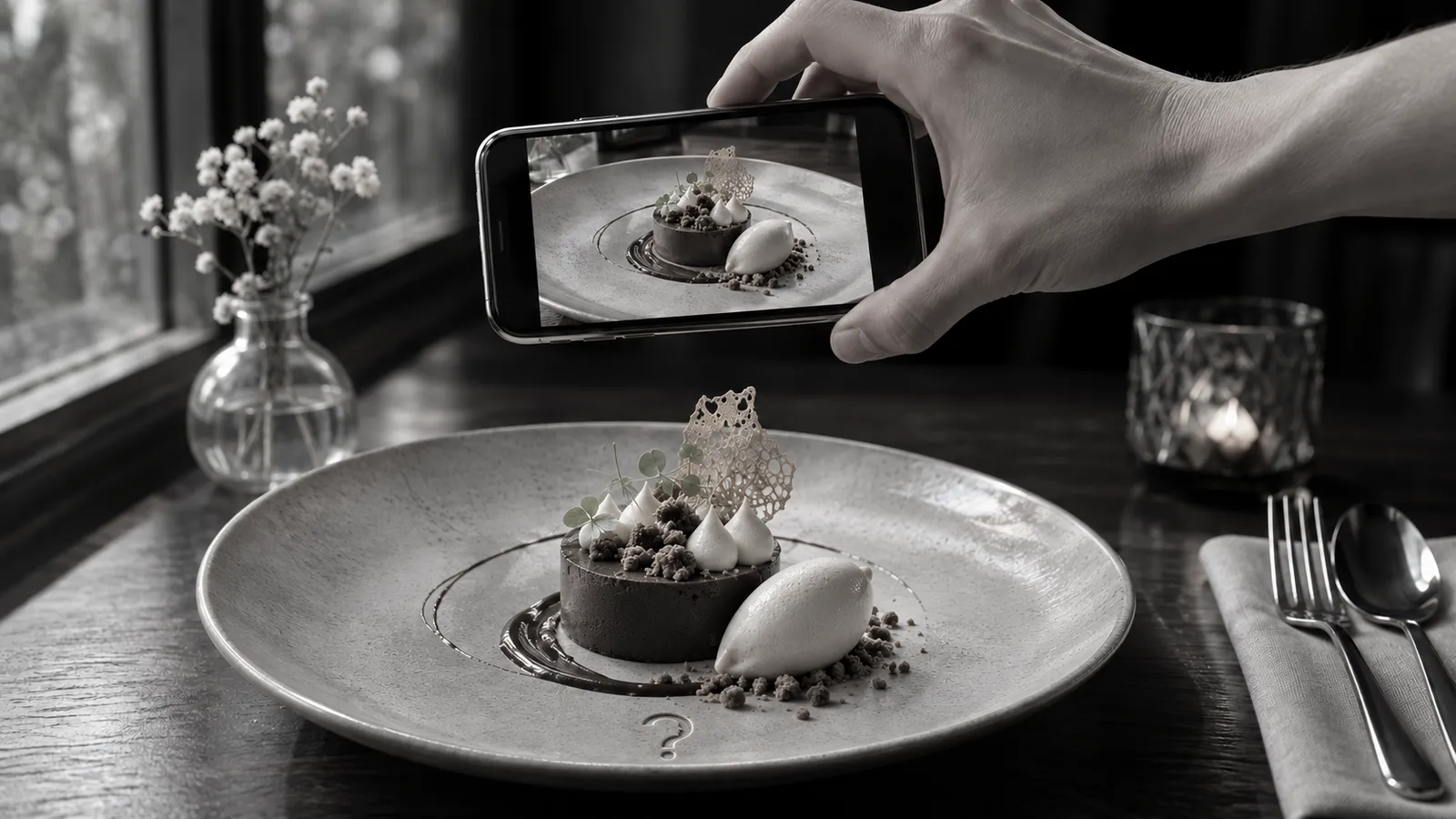
A pause, a closer look, a changed memory and an audience: what four studies say about the habit of photographing a plate.
Answer to the question
Why do we photograph our food?
Making the picture adds a short pause before eating and directs attention to the dish, and in studies both were linked to more enjoyment. Many food photographs are also made to be shared, and taking photos with that goal reduced enjoyment compared with taking them for oneself.
Key takeaways
- Across three studies, making a picture of indulgent food before eating produced a brief delay that heightened savouring and improved taste ratings.
- Across three field studies and six laboratory experiments, taking photos increased enjoyment of positive experiences in many contexts, less so when the experience was already highly engaging.
- In a museum study, photographing a whole object impaired memory for it, while zooming in on one part did not.
- Across five studies, taking photos with the intention to share them reduced enjoyment compared with taking photos for oneself.
- The studies on enjoyment and memory used experiences and museum objects as well as food, so the link to a plate of food is a reading, not a direct test.
Making a picture of a dessert before eating it put a short pause between the plate and the first mouthful, and in three studies that pause changed the rating. That pause is the first answer to why we photograph our food.
Does a Pause Change Taste?
A dessert that had been photographed was judged more favourably than one that had simply been eaten, in three studies by Sean Coary and Morgan Poor on what they call consumer-generated images, meaning pictures that people make and control themselves. The studies varied the kind of food and whether participants photographed it before eating. Making the picture produced a brief, active delay before the first bite, and for indulgent foods that delay heightened savouring and improved attitudes and taste ratings.
The delay is the useful part of that result. A picture takes a few seconds to compose, and in those seconds the person has to look at the food, choose an angle and wait. Waiting is a known source of pleasure in its own right, which is the subject of What Anticipation Actually Adds, and the photograph turns an unplanned pause into a small routine. A related experiment on short routines before eating, covered in Do rituals make food taste better?, found that fixed steps before a first bite raised enjoyment, though those steps were set by the researchers and were not photographs.
What sits on the plate matters as well. In the salad study described in Food Branding Psychology: Taste Starts With the Eye, a painting-style arrangement was rated tastier than a tossed one, so a person framing a dish is looking at something that already changes how it tastes.
The authors also point out a practical reading: sellers of food could encourage customers to photograph what they order. That is their suggestion about marketing, and the studies themselves measured ratings given by the people who made the pictures, not later purchases.
What Does a Camera Do?
Taking photos increased enjoyment of positive experiences in many contexts, across three field studies and six laboratory experiments by Kristin Diehl, Gal Zauberman and Alixandra Barasch, and the authors propose that the reason is engagement. Holding a camera directs more visual attention to the features of whatever is in front of you, and the extra attention makes the experience richer.
The same account says when the effect should shrink, and the studies found it where predicted. When an experience was already highly engaging, a photo added little. When taking the photo got in the way of the experience, the benefit weakened. A meal with good company and a plate that holds the eye is already engaging, while a photo session that keeps a diner from eating the food while it is warm interferes with the thing being enjoyed.
Charan Ranganath's Why We Remember supplies the memory-science view behind this. He argues that distinctive memories come from attention directed on purpose, and that photographing without attending works against them. The camera, on that view, is neutral: it helps when it makes a person look more closely and hurts when it replaces looking. The studies above test the first part of that claim for enjoyment, and the next study tests the second part for memory.
A guided tour of an art museum gave Linda Henkel a clean test of what a camera does to memory: students photographed some objects and only observed others. Photographing a whole object led to a photo-taking-impairment effect: participants remembered less about the objects they had photographed than about those they had only looked at. The result has a twist that matters for anyone with a plate in front of them. When participants zoomed in to photograph one part of an object, the impairment did not appear, and their memory for features they had not zoomed in on was as strong as their memory for the features they had.
Henkel's reading is that the memory of a person and the memory of a camera differ, and that the extra attention and thought needed to frame a specific detail can remove the effect. The study used museum objects and not food, so it does not say what happens to the memory of a dinner. It does say that how a photo is taken matters as much as whether one is taken, and that a picture of a single detail asks for more attention than a quick shot of the whole.
The result fits a plain picture of attention. Framing a whole object takes little thought and can hand the remembering to the camera, while framing a detail takes choices about what matters, and those choices keep the person's own attention on the object. For a diner, that suggests a difference between a quick snap of the table and a deliberate shot of one dish.
Does Sharing Change It?
Most food photographs are made to be posted. Taking photos with the intention to share them reduced enjoyment compared with taking photos for oneself in a later set of studies, two in the field and three in the laboratory, by Alixandra Barasch, Gal Zauberman and Kristin Diehl. The authors attribute this to self-presentational concern, which lowers enjoyment directly and also through reduced engagement.
The same studies identified who is affected most. Differences between people mattered, in how much they care about how others see them, and so did the audience: how close the intended viewers were changed the result. A photo for oneself keeps the gains the earlier studies found, a pause and a closer look, while a photo made for an audience brings in a second task of managing how the result will be seen.
Of the two motives, the pause and the look raised enjoyment in the studies above, while the audience side was the one linked to lower enjoyment across the five studies on photo-taking goals, through concern about how the picture would be seen.
Each of the four studies answers a different question about the camera.
| Question | What the study found | Study |
|---|---|---|
| Does a photo before eating change the rating? | A brief pause heightened savouring and improved taste ratings for indulgent food | Coary and Poor |
| Does taking photos add enjoyment? | Yes in many contexts, less when the experience is already engaging or the photo interferes | Diehl, Zauberman and Barasch |
| Does taking photos affect memory? | Photographing a whole object impaired memory, zooming in on a detail did not | Henkel |
| Does sharing change it? | Taking photos to share them reduced enjoyment compared with photos for oneself | Barasch, Zauberman and Diehl |
Common questions
Why do we photograph our food?
Making the picture adds a short pause and directs attention to the dish, and in studies both were linked to more enjoyment. Many food photographs are also made to be shared, and sharing as a goal reduced enjoyment compared with photos for oneself.
Does photographing food make it taste better?
In three studies on indulgent foods, making a picture before eating produced a brief delay that heightened savouring and improved attitudes and taste ratings.
Does taking photos hurt memory?
In a museum study, photographing a whole object impaired memory for it, while zooming in on a detail did not. The study used objects in a museum, not meals.
Does photographing for social media reduce enjoyment?
In five studies, taking photos with the intention to share reduced enjoyment compared with taking photos for oneself, through self-presentational concern and lower engagement.
Sources
Ranganath, C. Why We Remember. Seed book; vault hub Books/Why We Remember.
Coary, S., & Poor, M. (2016). “How consumer-generated images shape important consumption outcomes in the food domain.” Journal of Consumer Marketing, 33(1), 1-8. doi:10.1108/jcm-02-2015-1337 https://doi.org/10.1108/jcm-02-2015-1337
Diehl, K., Zauberman, G., & Barasch, A. (2016). “How taking photos increases enjoyment of experiences.” Journal of Personality and Social Psychology, 111(2), 119-140. doi:10.1037/pspa0000055 https://doi.org/10.1037/pspa0000055
Henkel, L. A. (2014). “Point-and-shoot memories: The influence of taking photos on memory for a museum tour.” Psychological Science, 25(2), 396-402. doi:10.1177/0956797613504438 https://doi.org/10.1177/0956797613504438
Barasch, A., Zauberman, G., & Diehl, K. (2018). “How the intention to share can undermine enjoyment: Photo-taking goals and evaluation of experiences.” Journal of Consumer Research, 44(6), 1220-1237. doi:10.1093/jcr/ucx112 https://doi.org/10.1093/jcr/ucx112