What a Screen Replaces
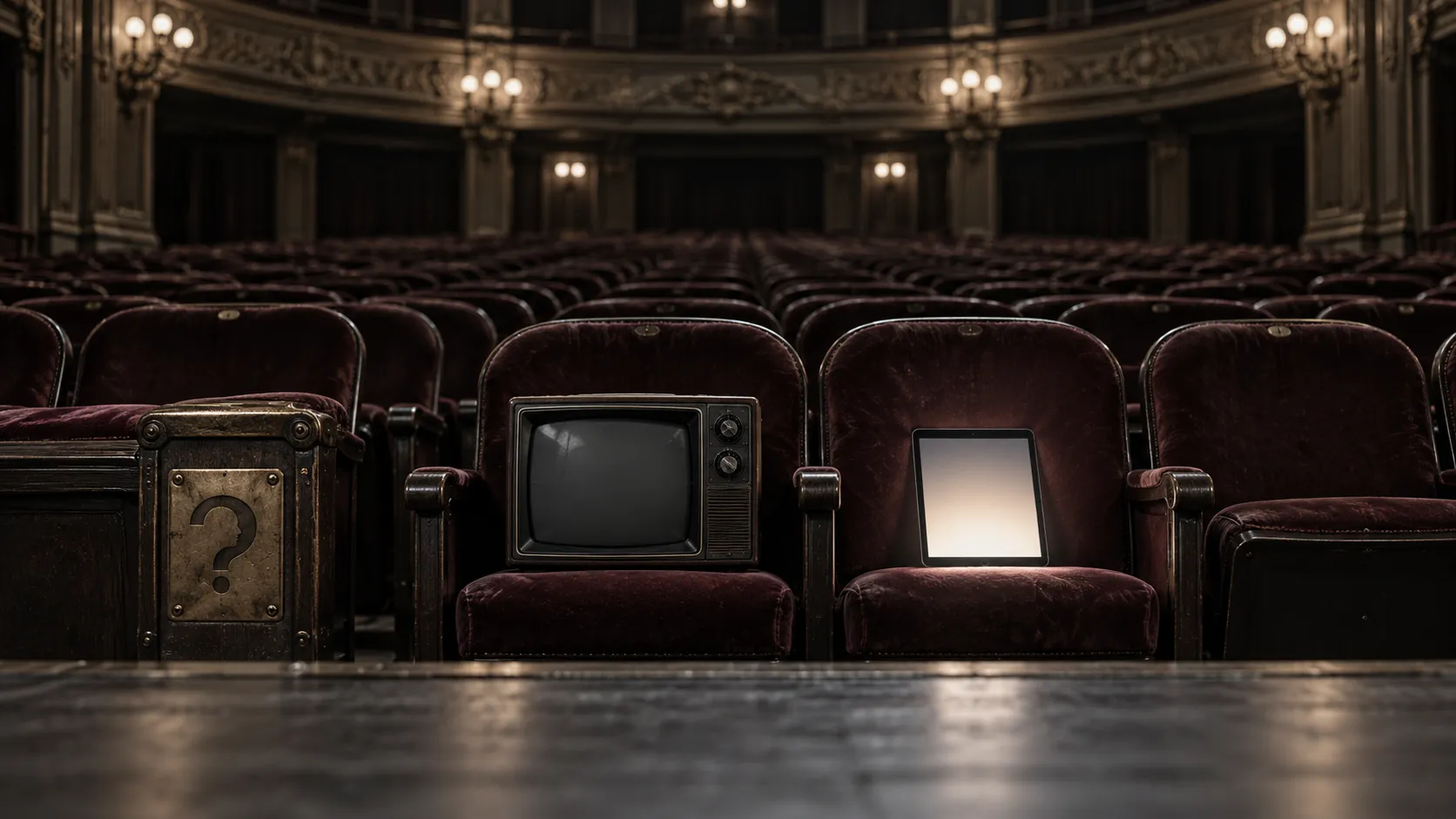
The argument about attention asks what a screen does to you while you are looking at it. This piece asks what you were doing instead, and the one paper that estimates the trade in minutes says that mediated experience mostly displaces other mediated experience. The photography evidence is genuinely split, the retreat indoors is real and unattributed, and the measured case for what screens add is better than the sceptics expect.
Answer to the question
What does mediated experience actually replace?
Mostly other mediated experience. The best time-use estimate puts each extra minute of online leisure alongside 0.29 fewer minutes of all other leisure, about half of that from television and video and about 0.05 minutes from face-to-face socialising. The author reports these as correlations, and the nineteen-year rise in time spent at home is left unattributed by the researcher who measured it.
Key takeaways
- The largest single thing an extra minute of online leisure displaces is another screen, with television and film taking about 0.12 of the 0.29 minutes lost from all other leisure.
- Face-to-face socialising is displaced at about a twentieth of a minute per minute online, which is a real figure in the predicted direction and a small one.
- American adults spent one hour and thirty-nine minutes more per day at home in 2022 than in 2003, and the researcher who measured it says the survey cannot see a smartphone.
- The photo-taking impairment effect replicates, including under preregistration, while the paper that let people choose what to photograph found the reverse on the visual channel.
- The measured case for what screens add is stronger than expected: no cannibalisation of English theatre attendance, and conference audiences roughly 40 to 120 per cent larger online.
A screen takes a slot in the day that something else used to hold, and mediated experience is the name for what fills it. What the screen does to you while you look at it is a different question, and the two are confused constantly: the argument about attention asks what a screen does to you while you are looking at it, and this piece asks what you were doing instead. The book behind the question is Christine Rosen's The Extinction of Experience, and the first thing to settle is what kind of book it is, because the answer sets the standard.
The standard for an essayist
It is cultural criticism in the tradition of the New Atlantis and the Hedgehog Review, and not a popular-science synthesis. The apparatus says so. Around 497 endnotes, with no bibliography, no index of sources and no tables. About 60 are peer-reviewed journal articles, roughly twelve per cent. About 110 are books. About 200, roughly forty per cent, are journalism and magazine items.
The books are where the intellectual sourcing sits.
That sets the standard. Did she label her claims honestly? She does. At page ninety-nine she writes that to be fallow is not the same thing as to be useless, a claim no study could refute. She states her value claims as value claims, and almost nobody arguing her side does.
The mismatch is where the auditing attention belongs. When she reaches for an empirical claim about effects instead of practices, she reaches for the layer of journalism she uses for texture, and that layer carries no effect sizes and no replication status. The book has the citation profile of an essayist and, in two dozen sentences, the claim profile of a social scientist. Failed popular science is the wrong audit here.
The hypothesis in one sentence
Her mechanism sits at page seventeen: "we relate to our world through information about it rather than direct experience with it." The phrase in her title is not hers and she says so, crediting the naturalist Robert Michael Pyle, who coined it in 1993 for conservation.
If mediated experience is taking the place of the direct kind, the hours have to come from somewhere, and time-use diaries record where. Her displacement assertions, at pages forty-five to forty-six, 126, 190, 195 and 212, are readings of correlations, and she is clear about how thin the ground is:
> "large-scale studies of the long-term effects of mediated relationships on children are not yet available"
She writes that at page forty-five, and calls her supporting studies "a few intriguing new studies". [What Technology Does to Who We Are](https://thewhyweproject.com/articles/what-technology-does-to-who-we-are) already settled that a general claim in either direction goes further than the evidence. This piece asks what the hours went to.
What a minute online displaces
Scott Wallsten, writing alone for the National Bureau of Economic Research in 2013, built American Time Use Survey diaries from 2003 to 2011 into a dataset of about 124,000 person-level observations. A diary records what somebody did on a specified day, minute by minute. Asking people to estimate their own screen time is a different instrument, and the gap between estimates and logged device data is why that matters.
His abstract:
> "each minute of online leisure time is correlated with 0.29 fewer minutes on all other types of leisure, with about half of that coming from time spent watching TV and video, 0.05 minutes from (offline) socializing, 0.04 minutes from relaxing and thinking, and the balance from time spent at parties, attending cultural events, and listening to the radio."
Beyond leisure, each minute online sits alongside 0.27 fewer minutes working, 0.12 fewer sleeping and 0.06 fewer on education. The 0.29 comes from one regression on all other leisure taken together. The figures below come from separate regressions, one per activity, on the largest components of leisure, so they are not a breakdown of that 0.29 and do not sum to it. They total about 0.24, and the remainder sits in leisure categories whose own coefficients did not reach significance. Television at 0.12 is about two fifths of the total rather than the half the abstract rounds it to. These are the 2013 working paper's numbers, and they are unchanged in the 2015 book chapter.
| What an extra minute online goes with, by separate regression | Minutes given up |
|---|---|
| Television and film, non-religious | 0.12 |
| Socialising and communicating | 0.054 |
| Relaxing and thinking | 0.037 |
| Parties | 0.016 |
| Cultural events | 0.010 |
| Radio | 0.0044 |
| Hobbies | gains 0.0036 |
The largest single thing an extra minute online displaces is another screen. Rosen's thesis is about embodied experience giving way to mediated experience, and the best estimate says the main transaction is one mediated experience giving way to another.
The largest single thing an extra minute online displaces is another screen.
Face-to-face contact does move in the predicted direction, and it moves a little, at about 0.054 minutes per minute. Wallsten reaches his summary of the social side by pointing at socialising, parties and cultural events together: a cost of online activity, he writes, is less time spent with other people.
He also says, repeatedly, that this is correlation.
> "this paper does not evaluate which online activities substitute or complement offline activities. Instead, it estimates the opportunity cost of online leisure time."
Online leisure was roughly thirteen minutes a day by the end of his window, against about five hours of daily leisure, so these are marginal rates and multiplying them by a modern screen-time figure would be a fabrication. Reading, which he codes separately, does not appear among his subcategory results.
Nineteen years of staying indoors
Patrick Sharkey, also writing alone, took the same survey through 2022. Time spent at home among American adults rose by one hour and thirty-nine minutes in a typical day between 2003 and 2022, roughly ten per cent, and it rose for every subset of the population and for virtually all activities. Steadily upward to 2019, a jump in 2020, a slight decline since.
The pandemic accelerated a trend already nineteen years old.
> "One major limitation of the ATUS is that the survey does not have precise questions that track the amount of time on smartphones or social media ... More research using alternative data sources is needed to assess the relationship between smartphone use, social media use, and time spent at home."
He argues against the simple reading in his own voice too, noting that activities with little to do with new technology also moved indoors. Among the alternatives he names are fear or discomfort in public space, including the rise of mass shootings, and larger homes. The retreat indoors is large and general, and the person who documented it says his instrument cannot see a screen.
The photograph and its split record
The photography literature sits in this piece because it is the only place Rosen's displacement claim has been run as an experiment: a camera is a screen put between a person and a room, and these studies measure what it takes and what it gives.
The most testable version of her claim is about cameras, and she uses it at page 157. Linda Henkel, sole author, took undergraduates round the Bellarmine Museum of Art and had them photograph half the objects and merely look at the rest. Photographed objects were remembered in less visual detail, .55 against .64 on her accuracy measure. Free recall showed no difference, and she says so and drops it. Her samples were 27 and 46, undergraduate, at one museum.
Her second experiment is what makes the paper good. Every object got twenty-five uninterrupted seconds with photographing time added on top, so photographing bought more exposure. Photographing the whole object still cost visual detail. Zooming in on a specified part did not. And the result nobody quotes: memory for which room an object was in ran .74 for observed objects and .45 under zoom. The condition that protected detail lost the room.
She then named her own untested boundary:
> "Future research should examine whether similar effects are seen when people are free to choose what objects to photograph. After all, people are likely to take photos of objects that they value, find important, or want to remember."
Alixandra Barasch, Kristin Diehl, Jackie Silverman and Gal Zauberman tested exactly that in 2017, in the same journal, the four recording equal contribution. On a self-guided tour of an Etruscan exhibit with an audio guide, visual recognition ran about 66.5 per cent correct with a camera against 59.8 without, with no difference on the audio material. Three laboratory studies and two bus-tour studies followed. Pooled across all six, photo-taking had a positive effect on visual memory of about 0.54 standardised units and a smaller negative one on auditory memory of 0.26.
Holding a camera improved memory for things it was never pointed at. Their limits: a short delay, no revisiting of the photographs, and visual information unusually salient.
Julia Soares and Benjamin Storm replicated the impairment in 2018, at around 0.58 and 0.70, with the viewing timer starting only after the photograph was taken. Sending it via Snapchat, which does not save it, made the impairment larger; deleting it changed nothing.
> "photo-taking prospectively impairs how an experience is encoded even after the camera is put down"
Their results, they write, are inconsistent with the offloading account Henkel had proposed, and they resolve the apparent contradiction themselves, in print: photographing may impair memory by disrupting attentional engagement, but only when participants do not control what is photographed. And [Both Sides of the Screen-Time Argument](https://thewhyweproject.com/articles/screen-time-both-sides) carries the Google effect's replication failure.
Baike Li and colleagues, in press at the same journal, ran three preregistered experiments with roughly 60 to 68 participants each. The impairment replicated, and survived when the photograph required only a Bluetooth button press, which challenges the attentional account. It appeared in the group told the photographs would be available afterwards and vanished in the group told otherwise.
The mechanism literature therefore points two ways on one manipulation. Soares and Storm removed future access and the impairment survived at full size. Li and colleagues removed it and the impairment disappeared.
After their experiment, 52 per cent of participants said photographs help them remember and nineteen per cent correctly said they impair it; of those who said they help, 62.5 per cent had just remembered less about what they photographed.
Rosen reports the museum result and then volunteers that it "has been replicated twice by other researchers, most recently in 2021". That checks out, and it undercounts: the impairment also replicated in Li's three experiments, in a 2022 paper on multiple photographs, and conditionally in a 2017 study of manual against wearable cameras reaching us through Soares and Storm. The date fits Rebecca Lurie and Deanne Westerman's 2021 paper, which we have at bibliographic record only.
Volunteering a replication status is rare in this genre, and she does it unprompted in a book that nowhere else discusses replication. What she does not mention is the paper that found the reverse on the channel the camera captures. The book has no bibliography and discusses effect sizes nowhere.
Rooms, screens and what moves
Put the photography results side by side and they stop looking like a verdict on cameras. The zoom condition protected detail and lost the room. Camera-holders remembered unphotographed things better than people with no camera. The same team, with Kristin Diehl first, reports across nine experiments that photo-taking raises enjoyment of positive experiences through engagement, and that the engagement went with worse evaluations of negative ones; we have that at publisher-record level.
Mediation does not subtract. It moves attention from the room to the frame, and both of those are things people came for. [Why You Remember the End of a Holiday and Not the Middle](https://thewhyweproject.com/articles/why-you-remember-the-end-of-a-holiday) works the same mechanism from the recall side.
Mediation does not subtract. It moves attention from the room to the frame, and both of those are things people came for.
The best test of the room against the screen is a randomised one. David Figlio, Mark Rush and Lu Yin assigned students in a large introductory microeconomics course to live lectures or the same lectures online, with problem sets, support, office hours and examinations identical.
> "While the overall effect of live instruction relative to internet delivery is very modest and positive (though not statistically distinguishable from zero), these mean effects may mask substantial differences."
The subgroups are the finding. Hispanic students scored about 11.3 points higher on a hundred-point scale with live instruction, male students about 3.5 and low achievers about 4.1, each statistically significant; White and Asian students showed no reliable difference. Those, the authors write, are precisely the students more likely to populate the less selective universities.
On the comparison Rosen's museum chapter is really about, whether standing in front of the thing beats looking at it, what exists compares screens with screens, or carries a confound, like the 2025 study of 24 people who all visited the museum first; two searches turned up no randomised trial of a physical museum visit against a virtual one, and no systematic review of such trials.
Nature is the cleanest substitution anybody has measured head to head. Matthew Browning and colleagues put 82 students in the same chair for six minutes: outdoors in nature, indoors in a headset watching a 360-degree video shot at that same spot, or indoors facing a blank wall. Against the wall, virtual nature raised positive affect by 0.53 and the outdoors by 0.79. The outdoor group's mood rose, the wall group's fell, the virtual group's did not move.
The two nature conditions were rated equally restorative and their skin-conductance trajectories did not differ. Their limitations are candid: a healthy, mostly White and Asian student sample with ready access to the outdoors, and no condition showing a complex non-natural video, which they say would have separated nature from novelty. They ran no cognitive task and say so.
Nature reliably improves mood. It does not reliably improve thinking.
The measured case for mediated experience
The strongest measured case for what mediated experience adds is British, and it asks this question. Hasan Bakhshi and Andrew Whitby took about 16 million transaction records for 54 English performing arts organisations, representing 44 million tickets, from the launch of National Theatre Live in 2009 to late 2013, coding treatment as distance from a cinema that had shown a broadcast in the previous year.
Theatre visits ran about ten per cent higher within a kilometre of such a cinema, seven per cent at one to two kilometres, three per cent at two to three, and nothing beyond.
> "We find no evidence of cannibalisation on theatre attendance at a broad spread of English venues since the National Theatre Live programme was instituted in 2009 ... Caution is, however, required in interpreting these results."
The caution is theirs. Their own hypothesis predicted a stronger effect on theatre than on other art forms, and non-theatre visits showed a similar pattern, so they offer two readings: that broadcasts promote arts attendance generally, or that an omitted variable correlated with the treatment is doing the work, cinemas self-selecting into the programme among the candidates they name.
The reach figures are the plainest statement of what mediation adds. The National Theatre's first broadcast, Racine's Phèdre, in June 2009 doubled in one night the audience the play drew across its three-month run.
Matthew Skiles and colleagues measured access where the change was forced, comparing science and engineering conferences that moved online in 2020 with their own in-person editions from 2015 to 2019. Audiences were roughly 40 to 120 per cent larger. Cost is their proposed mechanism: researchers from outside the United States paid between 90 and 210 per cent more to attend in person, at up to 250 per cent of their country's annual output per head against about three per cent for Americans.
One 2020 virtual meeting ran its live talks on a United States clock, European attendance rose 102 per cent and Middle Eastern 76 per cent, and attendance from Asia, where sessions fell past midnight locally, did not rise. Several co-authors organised the conferences analysed and the manuscript declares it, and the figures above come from its abstract, results and figure legends. The gain is a design choice.
Two figures and the open question
At page 212 Rosen reports Americans spending about four hours a week with friends by 2019, down 37 per cent on five years earlier, citing a newspaper column. It traces to Bryce Ward, an economist, in the Washington Post opinion pages on 23 November 2022:
> "By 2019, the average American was spending only four hours per week with friends (a sharp, 37 percent decline from five years before.)"
Ward is a real economist analysing a real federal survey, and he publishes no method, no table, no code and no peer review. The figure can be checked only against the column. It is not fabricated and it is not verified. The distinction is checkable against uncheckable.
The disreputable end of the same problem is the claim that the attention span has fallen to eight seconds, one less than a goldfish. The chain, shown because it may only ever appear this way: a Microsoft Canada marketing report produced to sell attention to advertisers; the report credits a statistics website, which could not substantiate the figure; the goldfish comparison has no identifiable origin; a news outlet published the marketing document under a headline beginning "Science:"; and books then cited the news article while calling it a Microsoft study. We read none of those documents, nor the 2017 investigation that found nothing behind the citation.
The premise fails before the provenance does. Attention duration is task-dependent, so a population average across tasks measures nothing.
So the measured displacement question is partly open. Mediated experience displaces other mediated experience first, and face-to-face contact at a small rate in the predicted direction.
Notice what the open parts share.
Sharkey says the survey cannot see a screen. Browning and colleagues ran no cognitive task. Nobody has randomised a museum. Rosen's ecological metaphor predicts precisely that: a loss of this kind would be invisible to the field's instruments, which is both the most interesting thing about her thesis and the reason it resists testing. Nobody has yet built the instrument that would settle it.
Common questions
What does mediated experience actually replace?
Mostly other mediated experience. The best time-use estimate, from American diaries for 2003 to 2011, puts each extra minute of online leisure alongside 0.29 fewer minutes of all other leisure. Television and video is the largest single component, at 0.12 minutes, with face-to-face socialising at about 0.05. The author calls these correlations.
Does taking photographs make you remember less?
It depends on the channel and on who chose the subject. Told what to photograph, museum visitors remembered less visual detail than people who only looked. Choosing for themselves, participants remembered the visual side better and the audio commentary worse. The impairment replicates, and its cause is contested: two studies removed access to the photographs afterwards and got opposite results.
What does a screen add that a room cannot?
Mediated experience adds reach and access. English theatre visits ran about ten per cent higher within a kilometre of a cinema showing National Theatre Live broadcasts, with no sign of cannibalisation across 44 million tickets, though the authors flag a similar effect on other art forms. Conferences that moved online drew audiences roughly 40 to 120 per cent larger.
Sources
Wallsten, S. (2013). 'What Are We Not Doing When We're Online?' NBER Working Paper No. 19549
Sharkey, P. (2024). 'Homebound: The Long-Term Rise in Time Spent at Home Among U.S. Adults.' Sociological Science, 11, 553-578. doi:10.15195/v11.a20
Henkel, L. A. (2014). 'Point-and-Shoot Memories: The Influence of Taking Photos on Memory for a Museum Tour.' Psychological Science, 25(2), 396-402. doi:10.1177/0956797613504438
Barasch, A., Diehl, K., Silverman, J., & Zauberman, G. (2017). 'Photographic Memory: The Effects of Volitional Photo Taking on Memory for Visual and Auditory Aspects of an Experience.' Psychological Science, 28(8), 1056-1066. doi:10.1177/0956797617694868
Soares, J. S., & Storm, B. C. (2018). 'Forget in a Flash: A Further Investigation of the Photo-Taking-Impairment Effect.' Journal of Applied Research in Memory and Cognition, 7, 154-160
Li, B., Gilbert, S. J., Yu, Y., Ju, Y., Tang, B., Yang, C., & Liu, M. (in press). 'Photo-Taking Impairment in Recognition Memory: Comparing Attentional Disengagement and Cognitive Offloading Accounts.' Journal of Applied Research in Memory and Cognition. doi:10.1037/mac0000287
Lurie, R. E., & Westerman, D. L. (2021). 'Photo-taking impairs memory on perceptual and conceptual memory tests.' Journal of Applied Research in Memory and Cognition, 10(2), 289-297. doi:10.1016/j.jarmac.2020.11.002
Diehl, K., Zauberman, G., & Barasch, A. (2016). 'How taking photos increases enjoyment of experiences.' Journal of Personality and Social Psychology, 111(2), 119-140. doi:10.1037/pspa0000055
Figlio, D. N., Rush, M., & Yin, L. (2010). 'Is It Live or Is It Internet? Experimental Estimates of the Effects of Online Instruction on Student Learning.' NBER Working Paper No. 16089
Browning, M. H. E. M., Mimnaugh, K. J., van Riper, C. J., Laurent, H. K., & LaValle, S. M. (2020). 'Can Simulated Nature Support Mental Health? Comparing Short, Single-Doses of 360-Degree Nature Videos in Virtual Reality With the Outdoors.' Frontiers in Psychology, 10, 2667. doi:10.3389/fpsyg.2019.02667
Bakhshi, H., & Whitby, A. (2014). 'Estimating the Impact of Live Simulcast on Theatre Attendance: An Application to London's National Theatre.' Nesta Working Paper No. 14/04
Skiles, M., Yang, E., Reshef, O., Robalino Munoz, D., Cintron, D., Lind, M. L., Rush, A., Perez Calleja, P., Nerenberg, R., Armani, A., Faust, K., & Kumar, M. (2022). 'Conference demographics and footprint changed by virtual platforms.' Nature Sustainability, 5, 149-156. doi:10.1038/s41893-021-00823-2
Ward, B. (2022). 'Americans are choosing to be alone. Here's why we should reverse that.' The Washington Post, 23 November 2022
'Contrasting Physical and Virtual Museum Experiences: A Study of Audience Behavior in Replica-Based Environments' (2025). Sensors, 25, 4046. doi:10.3390/s25134046