Why an Almost-Human Face Feels Wrong
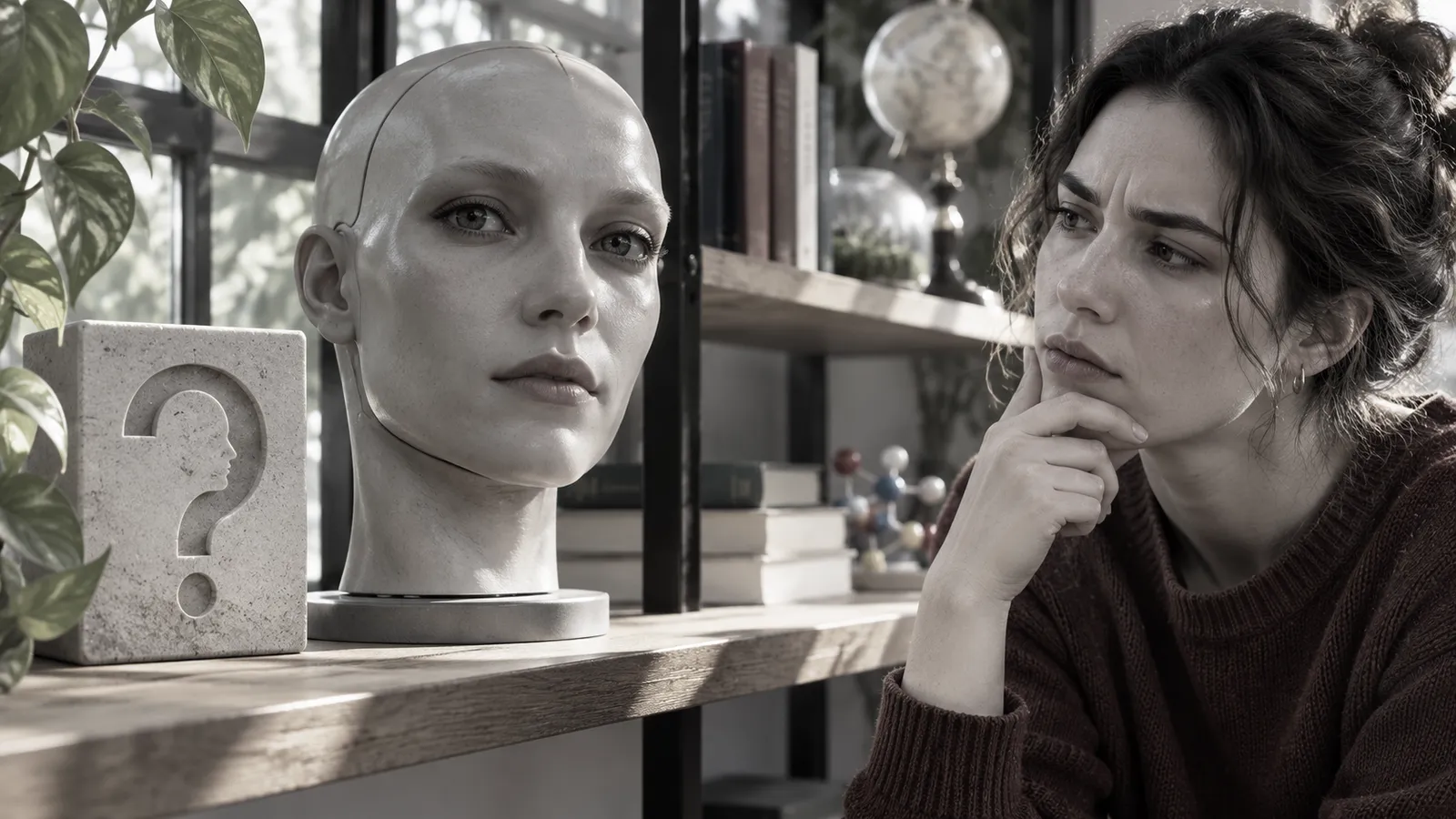
A robot or digital face that is nearly human can please less than one that is clearly artificial. The experiments point to a single feature out of step with the rest of the face.
What is the uncanny valley?
The uncanny valley is a proposed dip in comfort with faces that look almost, but not quite, human. Masahiro Mori described it in 1970, and later experiments find it most clearly when one feature, such as the eyes, is out of step with the rest of the face. Evidence on very high likeness is still thin.
Key takeaways
- The uncanny valley began as a 1970 prediction by a robotics professor that feeling toward a robot would fall into unease when it looked almost but not fully lifelike (Mori, 1970; English translation by Mori, MacDorman and Kageki, 2012).
- In morphed faces the most unpleasant impressions came at highly realistic faces, but only when the faces carried abnormal features such as bizarre eyes (Seyama and Nagayama, 2007).
- Mismatched eyes or skin within a human image made it seem eerier and colder across three experiments with 548 participants, while the most category-ambiguous images were neither the eeriest nor the coldest (MacDorman and Chattopadhyay, 2016).
- With 80 real-world robot faces, the dip showed in likability ratings and in an investment game that measured trust (Mathur and Reichling, 2016).
- A meta-analysis of 72 studies found face distortion produced the largest effect (Diel, Weigelt and MacDorman, 2021), and a 49-study meta-analysis found too few tests of highly humanlike robots to draw conclusions at that end (Mara, Appel and Gnambs, 2022).
Show people a face that is nearly, but not quite, human and many report a small jolt of wrongness before they can say why. The jolt is the uncanny valley, and it turns up wherever screens now carry faces: a digital presenter reading the news, a game character delivering a line, a robot greeting guests at a hotel desk. Asked to explain, viewers tend to point to a single part, such as eyes that do not quite follow or skin that is too smooth beside a mouth that moves too little. In experiments the jolt depends less on how human a face looks overall than on whether one part, usually the eyes, is out of step with the rest.
What do robot faces show?
Maya Mathur and David Reichling gathered eighty real-world robot faces and mapped how liking changed with human likeness. The map had the uncanny valley in it, a dip found in explicit likability ratings, and the dip reached behaviour too: in an investment game the effect also shaped how far people trusted each face, so a face alone moved a decision about whom to rely on. Confusion between the human and robot categories did not account for the dip.
Products already borrow human cues, a name being the lightest, as Why We Give Chatbots a Name sets out, and a face is the heaviest. Whether people trust a machine's judgement is a separate question, taken up in Do people trust algorithms more than humans.
A face is the natural place to look for the uncanny valley. Dean Burnett, in The Idiot Brain, describes a brain with regions dedicated to faces, so tuned that a face-like pattern tends to be seen as a face, and the same system registers whether a face is familiar. A system that finds faces in almost nothing and keeps track of whose face it is looking at gives a plausible setting for noticing when a face is nearly right. The pull is strong enough that people read faces into objects, a pattern followed up in Why We See Faces in Products.
Testing the uncanny valley needs faces that differ in small steps along a scale of human likeness, and morphing software, which blends two images in graded proportions, supplied them. Jun'ichiro Seyama and Ruth Nagayama morphed artificial faces toward real ones and asked observers for their impressions. The most unpleasant impressions came at highly realistic faces, but only when those faces carried an abnormal feature. The dip appeared for morphs with oddities such as bizarre eyes and not for those without, and the authors concluded that near-perfect realism is necessary for the effect but not sufficient for it.
Which feature carries the effect?
Eyes recur across the uncanny valley studies. Christine Looser and Thalia Wheatley blended human and mannequin faces into continuous series and found that observers saw life in a face at a fixed point near the human end, a boundary between categories, with pairs of images straddling that point easier to tell apart. Impressions of life came mostly from the eyes. The work concerned animacy and not eeriness, but it locates where a face tips from object to person and shows which part of the face carries the judgement.
A competing account says that a face that cannot be filed as human or non-human unsettles the viewer. Karl MacDorman and Debaleena Chattopadhyay tested that across three experiments with more than five hundred participants. Reducing the consistency of human realism within an image, for example by pairing mismatched eyes or skin, made human faces seem eerier and colder, while the same manipulation did not do so for objects. The images that were hardest to categorise were neither the eeriest nor the coldest. The pattern fits perceptual mismatch between features better than uncertainty about category and agrees with the finding that a single odd feature can carry the uncanny valley.
| Cue the studies varied | What the work found |
|---|---|
| Distorted features | The largest effect in a seventy-two-study analysis |
| The eye region | Odd eyes drove the dip in morphed faces, and eyes carried impressions of life |
| Consistency across features | Mismatched eyes or skin made human faces eerier and colder |
| Movement | Moving robots were rated as more human-like than static ones |
Does the uncanny valley hold?
Across many studies the picture is broader than any one face. A meta-analysis of seventy-two studies by Alexander Diel, Sarah Weigelt and Karl MacDorman found that face distortion produced the largest effect, and a review led by Jari Kätsyri found little consistent support for the claim that near-human appearance alone causes eeriness, with more support for perceptual mismatch.
Martina Mara, Markus Appel and Timo Gnambs pooled forty-nine studies of the uncanny valley and more than three and a half thousand participants: robots rated higher in anthropomorphism were more likable at low and medium levels, and moving robots were rated as more human-like than static ones. Too few studies had tested highly humanlike robots to say anything firm about a dip at the top of the scale.
The uncanny valley itself began as a prediction, not an experiment. Masahiro Mori, a Japanese robotics professor, wrote in 1970 that feeling toward a robot would shift sharply from empathy to unease as it grew more realistic without yet being fully lifelike. The first complete English translation, authorised and reviewed by Mori, came decades later from Karl MacDorman and Norri Kageki, by which time the idea had spread through robotics, computer animation and popular culture. A curve with one smooth dip was easy to carry across fields, and the experiments above describe something closer to a rule about parts.
Movement offers the clearest open question. A still face has to keep its features in agreement once, while a moving face has to keep them in agreement from frame to frame, through blinks, glances and mouth shapes, so every added channel is another place for a part to fall out of step. Digital humans now sit in the high-likeness range that the larger analyses call thinly studied, which is where that question will be settled. A team building one can ask whether every feature agrees.
Common questions
What is the uncanny valley?
The uncanny valley is a proposed dip in comfort with faces and figures that look almost, but not quite, human. Masahiro Mori described it in 1970 for robots, and later studies find it most clearly when one feature, such as the eyes, is out of step with the rest of a face.
Is the uncanny valley real?
Experiments find dips in liking, trust and eeriness for real robot faces and morphed images, and a meta-analysis of 72 studies found face distortion the largest effect. A review found more support for mismatched features than for near-human appearance alone.
Why do almost-human faces feel wrong?
Studies point to mismatch. When eyes or skin were out of step with the rest of an image, human faces seemed eerier and colder, and a single odd feature was enough in morphed faces. Confusion over whether a face is human or robot did not explain the effect in two sets of experiments.
Sources
Burnett, D. The Idiot Brain. Seed book.
Mori, M., MacDorman, K. F., & Kageki, N. (2012). The uncanny valley [From the Field]. IEEE Robotics & Automation Magazine, 19(2), 98-100. doi:10.1109/MRA.2012.2192811 https://doi.org/10.1109/MRA.2012.2192811
Seyama, J., & Nagayama, R. S. (2007). The uncanny valley: Effect of realism on the impression of artificial human faces. Presence: Teleoperators and Virtual Environments, 16(4), 337-351. doi:10.1162/pres.16.4.337 https://doi.org/10.1162/pres.16.4.337
Looser, C. E., & Wheatley, T. (2010). The tipping point of animacy: How, when, and where we perceive life in a face. Psychological Science, 21(12), 1854-1862. doi:10.1177/0956797610388044 https://doi.org/10.1177/0956797610388044
MacDorman, K. F., & Chattopadhyay, D. (2016). Reducing consistency in human realism increases the uncanny valley effect; increasing category uncertainty does not. Cognition, 146, 190-205. doi:10.1016/j.cognition.2015.09.019 https://doi.org/10.1016/j.cognition.2015.09.019
Mathur, M. B., & Reichling, D. B. (2016). Navigating a social world with robot partners: A quantitative cartography of the Uncanny Valley. Cognition, 146, 22-32. doi:10.1016/j.cognition.2015.09.008 https://doi.org/10.1016/j.cognition.2015.09.008
Diel, A., Weigelt, S., & MacDorman, K. F. (2021). A meta-analysis of the uncanny valley's independent and dependent variables. ACM Transactions on Human-Robot Interaction, 11(1), 1-33. doi:10.1145/3470742 https://doi.org/10.1145/3470742
Kätsyri, J., Förger, K., Mäkäräinen, M., & Takala, T. (2015). A review of empirical evidence on different uncanny valley hypotheses: Support for perceptual mismatch as one road to the valley of eeriness. Frontiers in Psychology, 6, 390. doi:10.3389/fpsyg.2015.00390 https://doi.org/10.3389/fpsyg.2015.00390
Mara, M., Appel, M., & Gnambs, T. (2022). Human-like robots and the uncanny valley: A meta-analysis of user responses based on the Godspeed scales. Zeitschrift für Psychologie, 230(1), 33-46. doi:10.1027/2151-2604/a000486 https://doi.org/10.1027/2151-2604/a000486
Related concepts
People
More articles
- Why We Enjoy a Rival's Stumble
A rival's near miss draws a laugh from one set of stands and a shrug from another. The research on schadenfreude ties the pleasure to group identity, to the pain of feeling behind, and to envy of a…
- Why Doing Harm Feels Worse Than Allowing It
Harm that follows an action is judged more harshly than the same harm that follows inaction. The research on omission bias shows where that comes from, why it can work as cover, and when it reverses.
- Why a Cliffhanger Keeps Us Watching
A cliffhanger ends a story at its most unresolved point. Research on suspense and curiosity shows why viewers want the next instalment, and what the ending does not change.
- Why an Unexpected Extra Delights More Than a Promised One
A promised extra is counted into the stay before it arrives. An unannounced one is measured against nothing, and experiments on reward, mood and gifts suggest that gap is where the extra delight…