Why We Pay to Skip the Queue
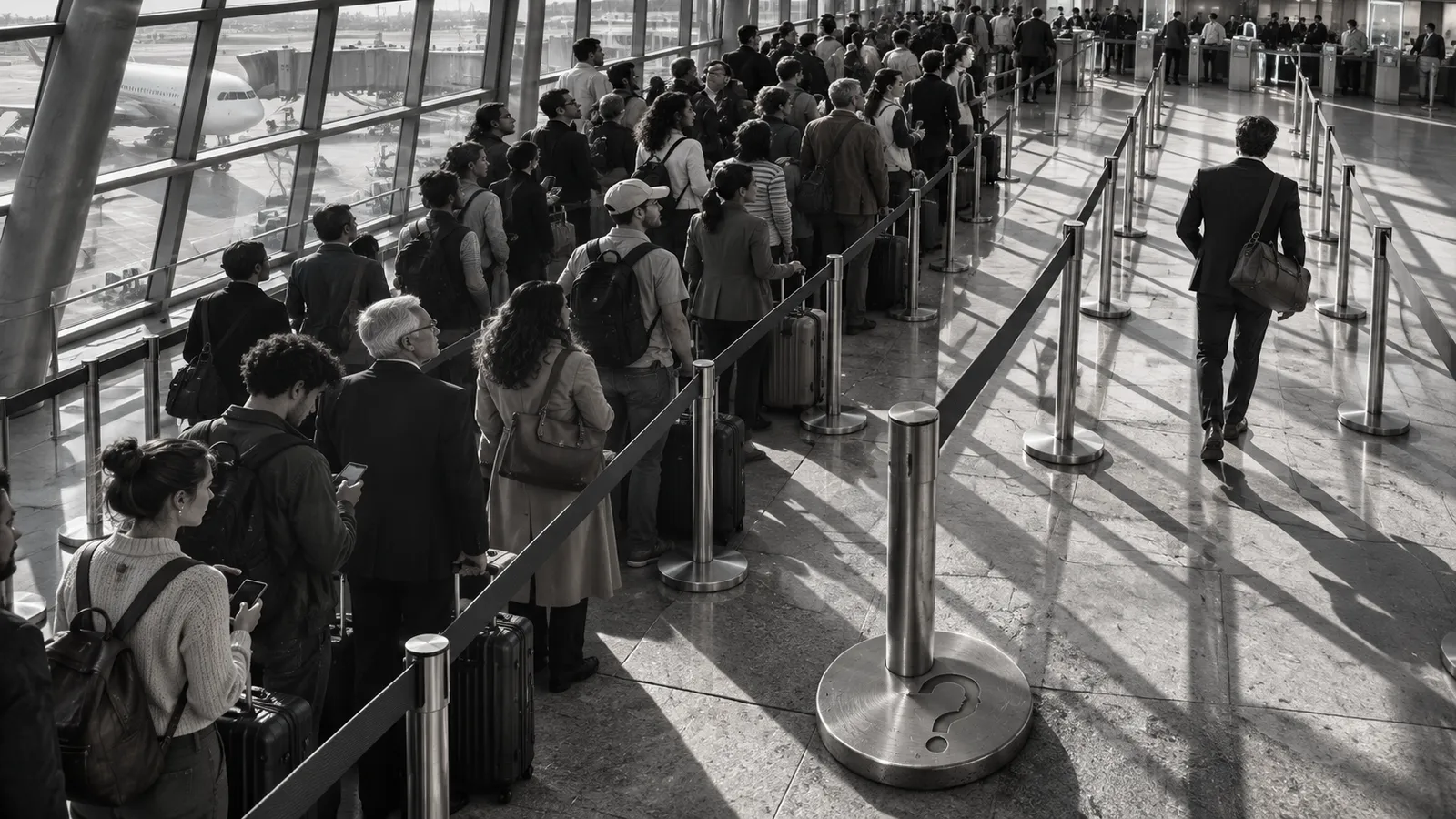
A fast-track lane sells time, but also certainty, standing and a break from the queue's oldest rule. The people left behind judge it by one test: whether it pushes them back.
Why do people pay for fast track?
People pay for fast track to buy back time and certainty about how long a wait will last. Research on paid priority adds two forces: a separate lane carries visible status, and the people still queueing judge it by whether it pushes them back, which is why express lanes were judged less fair than one-for-one line-sitting.
Key takeaways
- When bottled water ran short in a survey scenario, 76 per cent of the public judged first come, first served fair, against 27 per cent for raising the price (Frey and colleagues, 1993).
- People were cautious about gambling with their time even where they would take a chance with money, so a paid lane may sell a predictable wait as well as a short one (Leclerc and colleagues, 1995).
- Offered up to ten dollars to let a stranger cut in, many people let the stranger in, but only a small minority took the cash (Oberholzer-Gee, 2006).
- Express lanes were judged less fair than hired line-sitters, because a line-sitter swaps one for one while the lane adds people ahead of those waiting (Althenayyan and colleagues, 2025).
- Perks received in front of other customers brought social discomfort along with the benefit (Jiang and colleagues, 2013).
A fast-track lane sells a place in a line that money was never meant to decide. Paid priority, the arrangement in which a fee moves a customer ahead of people who arrived earlier, now runs through airports, theme parks and ticket counters.
Its appeal looks simple: minutes are scarce and a fee buys some back. People in a queue, though, treat their place as something earned by turning up, and they judge paid priority by a different rule from the one they use for a paid seat or an upgraded room.
Two rules for one wait
| The queue | The paid lane | |
|---|---|---|
| What decides your place | Arrival order | Arrival order, or a fee |
| What you give up | Time | Money, and less time |
| What the people behind see | One rule for everyone | A rule some can buy their way out of |
| Judged fair when bottled water ran short | 76 per cent, for first come, first served | 27 per cent, for raising the price |
| What it says about the person | Patience | Means, and a measure of standing |
A queue and a paid lane answer to different codes, and Dan Ariely describes both in Predictably Irrational. He argues that people move between two sets of rules, social norms built on goodwill and shared obligation, and market norms built on prices and payment, and that bringing money into a social setting switches the rules rather than adding to them. A queue is a small social contract: strangers agree to stand in order and police it together. Paid priority inserts a market rule into that contract, which is why a fee that would pass unnoticed at a shop till can feel like a breach at a boarding gate.
The queue and the lane ration the same scarce thing, the attention of a counter or a gate, by different means. The queue uses arrival order, which charges everyone in the same currency, time. Paid priority adds money, a second currency that people hold in very unequal amounts. When Bruno Frey and colleagues asked members of the public how a well should share out bottled water among hikers on a hot day with too few bottles, 76 per cent judged first come, first served a fair method, against 27 per cent for raising the price. Economics students rated the price rise more kindly; the general public sided with the queue.
What does waiting really cost?
Standing in line costs more than the minutes it takes, because time behaves differently from money in the mind. France Leclerc, Bernd Schmitt and Laurette Dubé tested whether people treat waiting time the way they treat money, and found they do in some respects and not in others. With certain outcomes, losses of time were judged much as losses of money are. With risky outcomes the two parted: people were cautious about gambling with their time, where with money losses they tend to take a chance. The authors traced the gap to time not being interchangeable with money.
That caution fits the shape of paid priority. Part of the cost of a queue may be its uncertainty, since nobody standing in it knows whether the line ahead will take ten minutes or forty. Paid priority sells a short and predictable wait, and a person who dislikes gambling with time may be buying the removal of that gamble as much as the minutes themselves. Empty minutes carry a cost of their own as well: the people in Why Ten Quiet Minutes Feel So Long found a short spell with nothing to do far harder than they expected, and a queue is often exactly that.
People in a queue still do not treat their place as something to sell. Felix Oberholzer-Gee ran a field experiment in which strangers approached people waiting in line and offered up to ten dollars to cut in ahead of them. Bigger offers made people more willing to let the stranger in, and most were prepared to wait longer. Only a small minority took the money. The author traced the reluctance to social concerns, including a sense of obligation not to profit from a crowded line. A place in the queue, on this evidence, is easier to give away than to sell, which is the social norm Ariely describes holding firm against a cash offer.
Is paid priority fair to others?
The people left in the ordinary line judge a paid lane by what it does to them, and the structure of the lane counts for more than the fee. That sharpens the water survey. One reading, ours rather than the authors', is that paid priority meets the same test people apply to prices in general, whether the seller seems to be taking something from someone, and a shopper's mood may shift that verdict less than expected, since the closest test in Does a Good Mood Make Prices Look Fair found anger, not happiness, moving fairness judgements.
Abdullah Althenayyan and colleagues compared two ways of jumping a queue across three experiments: hiring a line-sitter, someone paid to hold a place and hand it over, and buying entry to an express lane. With waiting times held equal, people were more satisfied when they met a line-sitter than an express-lane customer, and they judged the express lane less fair. That fairness gap carried through to how satisfied they felt with the wait.
The authors locate the difference in arithmetic. A line-sitter is a one-for-one swap: the hired person has done the waiting, and nobody else in the queue ends up further back than before. An express lane adds people at the front with no one taken out, so every paid entry lengthens the wait of those behind. When one line-sitter held places for several clients at once, and so added people to the line, the arrangement was judged as unfair as the express lane. Fairness in this research tracked whether anyone else lost ground. On that arithmetic, a lane served by its own staff might leave the main line untouched and give the people in it less to object to.
Status at the front
Walking past a long line is also a public act, and that brings status into the purchase. Paid priority shares its structure with the tiers of a loyalty scheme: a small group set apart from a larger one, in full view. Xavier Drèze and Joseph Nunes studied how such tiers shape the status members feel. Adding more people to the top tier weakened its status, while adding a lower tier beneath raised the standing of those above it. By the same logic, a fast-track lane draws its standing from the length of the queue beside it, and gives some of that standing up as the lane itself fills.
The crowd supplies the other half of the signal. Does a Long Queue Make People Want In shows a line outside a door working as a sign that the place is worth getting into, and the paid lane lets the buyer hold that sign from the front. The cue need not be loud, any more than the small marks of rank in Why We Read Quiet Logos as Status are. A different coloured boarding card or a separate rope is enough for the people still waiting to read who paid.
Status received in public has an awkward side. Lan Jiang, JoAndrea Hoegg and Darren Dahl studied customers who received perks they had not earned, such as a surprise upgrade, while other customers looked on. Across four experiments the perk was welcome, yet being seen to receive it brought a social discomfort about how onlookers would judge the recipient, and that discomfort lowered satisfaction with the visit. A paid lane is bought rather than handed out, a difference these studies did not test. The walk past the waiting line is still the same public moment they describe.
Common questions
Why do people pay for fast track?
To buy back time and, often, certainty about how long the wait will last. Research on paid priority suggests more is involved: people are cautious about gambling with their time, a separate lane carries visible status, and the people still queueing judge the fee by whether it costs them anything. Express lanes were judged less fair than one-for-one line-sitting.
Is paying to skip the queue seen as fair?
Often less so than waiting. In one survey of the public, 76 per cent judged first come, first served a fair way to share out scarce bottled water, against 27 per cent for raising the price. In experiments, express lanes were judged less fair than hired line-sitters, because the lane adds people ahead of those already waiting.
Why do people refuse money to give up their place in line?
In a field experiment, people offered up to ten dollars to let a stranger cut in were often willing to let the stranger in, yet only a small minority took the cash. The researcher linked this to social concerns, including a sense of obligation not to profit from a crowded line, so the place was easier to give away than to sell.
Sources
Ariely, D. Predictably Irrational. Seed book.
Frey, B. S., Pommerehne, W. W., & Gygi, B. (1993). Economics indoctrination or selection? Some empirical results. The Journal of Economic Education, 24(3), 271-281. doi:10.1080/00220485.1993.10844799 https://doi.org/10.1080/00220485.1993.10844799
Leclerc, F., Schmitt, B. H., & Dubé, L. (1995). Waiting time and decision making: Is time like money? Journal of Consumer Research, 22(1), 110-119. doi:10.1086/209439 https://doi.org/10.1086/209439
Oberholzer-Gee, F. (2006). A market for time: Fairness and efficiency in waiting lines. Kyklos, 59(3), 427-440. doi:10.1111/j.1467-6435.2006.00340.x https://doi.org/10.1111/j.1467-6435.2006.00340.x
Althenayyan, A., Ülkü, S., Yang, L., & Cui, S. (2025). Not all lines are skipped equally: An experimental investigation of line-sitting and express lines. Manufacturing & Service Operations Management, 27(1), 287-304. doi:10.1287/msom.2022.0338 https://doi.org/10.1287/msom.2022.0338
Drèze, X., & Nunes, J. C. (2009). Feeling superior: The impact of loyalty program structure on consumers' perceptions of status. Journal of Consumer Research, 35(6), 890-905. doi:10.1086/593946 https://doi.org/10.1086/593946
Jiang, L., Hoegg, J., & Dahl, D. W. (2013). Consumer reaction to unearned preferential treatment. Journal of Consumer Research, 40(3), 412-427. doi:10.1086/670765 https://doi.org/10.1086/670765
Related concepts
People
More articles
- Designing for One Helps Everyone
A ramp cut into a kerb for wheelchair users became the route for pushchairs and suitcases too. The same spillover runs through captions, websites and classrooms, by three routes, and it thins out as…
- Is Shopping an Old Instinct
Shops are new and searching for good things to carry home is old. Evolutionary accounts and their critics read that gap differently, and the evidence gives each side something.
- Why We Stay With a Provider We Do Not Love
Unhappiness raises the question of leaving without settling it. Effort, money and personal ties each hold customers in place, and they do not hold them in the same way.
- Why Saving Feels Like Losing
Money moved into savings is handed to a person who is not yet here. Present bias discounts the gift, and the research on the future self explains why the recipient can feel like a stranger.