Designing for One Helps Everyone
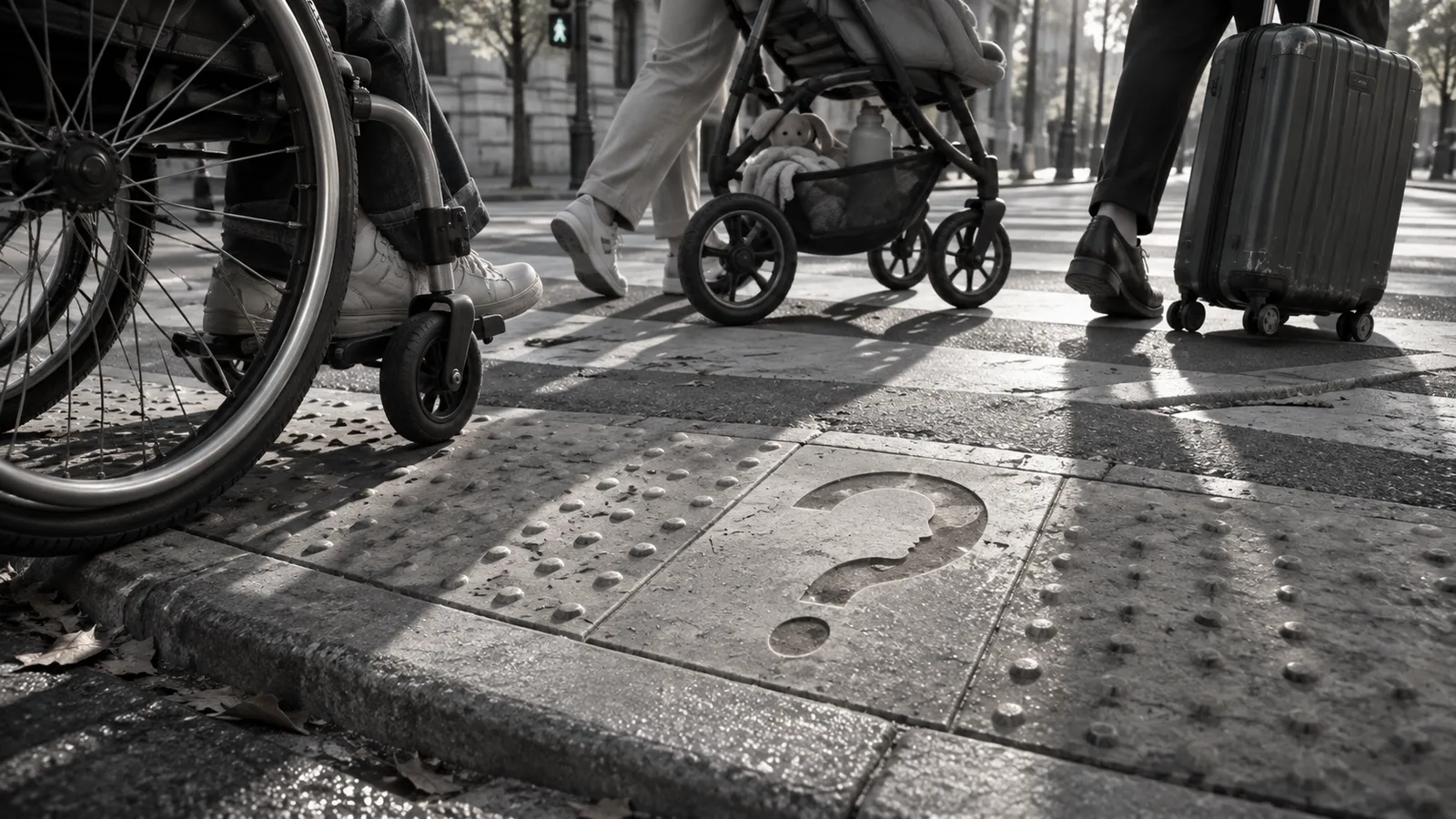
A ramp cut into a kerb for wheelchair users became the route for pushchairs and suitcases too. The same spillover runs through captions, websites and classrooms, by three routes, and it thins out as goals move away from the barrier.
What is the curb-cut effect?
The curb-cut effect is the pattern in which a change made to remove a barrier for one group helps many others. Kerb ramps won by disabled activists now serve people with pushchairs, carts and luggage, captions help hearing viewers follow video, and websites built to accessibility guidelines let people without disabilities finish tasks faster.
Key takeaways
- The curb-cut effect names the spillover in which a fix made for one group, such as kerb ramps for wheelchair users, ends up helping many others.
- A fix spreads by three routes: everyone shares the barrier now and then, the fix removes effort for all, and it carries no label when built into the ordinary version.
- A review of more than one hundred studies concluded that same-language captions improve comprehension, attention and memory for viewers in general (Gernsbacher, 2015).
- Sixty-one people without disabilities finished tasks faster and more often on a highly accessible website, while low and very low accessibility did not differ (Schmutz and colleagues, 2016).
- A review of 18 classroom studies found that planning lessons for the full range of students improved the learning process for all, with effects on outcomes not yet shown (Capp, 2017).
Most of the people who roll a pushchair, a suitcase or a delivery trolley down a ramp at a street corner never think about who the ramp was built for. The dropped kerb, which American writers call the curb cut, was won by disabled activists in the 1970s, and it now serves many people who move on wheels. The curb-cut effect is the name for that spillover: a change made to remove a barrier for one group ends up easing life for many others.
How a ramp became a principle of design
Angela Glover Blackwell set out the curb-cut effect in a 2017 essay that traced the ramps back to their beginnings. She notes cuts in a Michigan city as early as 1945, and places the decisive push in Berkeley, where disabled activists pressed the city into cutting its first official ramp at an intersection in 1972. Hundreds of thousands across the country followed. Blackwell lists who turned out to use them: parents with pushchairs, workers with heavy carts, travellers with luggage, runners and skateboarders. She also cites a 2007 newspaper report of shoppers at a mall, where nine in ten pedestrians carrying nothing at all went out of their way to use the ramp.
Cliff Kuang, in User Friendly, makes the same ramp the standing argument for a shift inside design itself. For much of the twentieth century, he argues, products were measured against an average body, and the people at the edges were treated as exceptions. Inclusive design, as Kat Holmes and her colleagues practised it, reverses the order: start from the person the average leaves out, and the result tends to work better for the middle as well. Don Norman reaches a similar place in The Design of Everyday Things, where universal design rests on his observation that features made for special needs usually help everyone, and that there is no average person to design for.
Three routes carry a fix from its intended users to everyone else:
- The barrier is shared for a while. Anyone can be briefly unable to hear, see or use both hands, so a fix for a permanent limit also serves a passing one.
- The fix removes effort for all. A design that strips out friction for the person who struggles most usually strips it out for people who struggle a little.
- The fix carries no label. When a feature is built into the ordinary version of a thing, using it says nothing about the user, so people who need it and people who merely like it both take it up.
Everyone is impaired some of the time
The first route is the least obvious, because it asks people to see themselves in a group they assume they are outside. Reading a phone while walking in bright sun with one hand full of shopping is a temporary loss of vision, steadiness and grip. Researchers call this a situational impairment. Leon Barnard and colleagues tested it by varying movement, lighting and the kind of task people did on a mobile device. Ordinary changes in context substantially altered how well people performed and how hard the work felt, and the factors interacted in ways that tests at a static desk can miss.
Situational impairment is what turns a minority provision into a majority convenience. A feature that works for someone who cannot hear also works in a loud café, on a train without headphones or beside a sleeping child. The curb-cut effect depends on how often ordinary life puts people briefly in the position the fix was designed for.
Captions show how far that can reach. Morton Ann Gernsbacher reviewed the research on same-language subtitles and concluded that they benefit everyone who watches video. More than one hundred studies, in her account, find that captions improve comprehension, attention and memory. The gains are largest for viewers watching in a language that is not their first, for children and adults learning to read and for viewers who are deaf or hard of hearing, yet her case is that the benefit is general. Text that was added for one audience gives every other viewer a second channel for the same words, which helps whenever sound and attention compete.
What the curb-cut effect does on a screen
The second route, removing effort for everyone, has been tested most cleanly on websites. Sven Schmutz and colleagues built three versions of the same site, meeting accessibility guidelines to a high, low or very low degree, and gave them to 61 people without disabilities. On the highly accessible version, people finished tasks faster and more often, and they rated it better for usability, appearance, workload and trustworthiness. The low and very low versions did not differ from each other on any measure.
Partial compliance measured no better than very low compliance, and the benefit appeared only on the site that met the guidelines to a high degree. The curb-cut effect, on this evidence, behaves like a threshold: a ramp with a lip at the bottom still stops a wheelchair, and it still catches a suitcase.
The trust ratings fit a wider pattern. Things that are easy to process tend to feel safer and more credible, the reason Why We Trust Easy Names More finds an easy-to-say label drawing less suspicion than a hard one. A clearer site lowers the effort of every visit, and some of that ease is read as reliability. The question of readable type is taken up in Do Hard-to-Read Fonts Help or Hurt. On a page, the curb-cut effect is plain enough: making it easy for a reader with low vision makes it easier for a tired reader, a hurried one and one reading on a small screen.
When a design trips up many people at once, the fault usually lies with the design, the case Kuang builds at length and the argument behind When the Design Is to Blame, Not You. Accessibility guidelines are a catalogue of those faults, written by people who meet them first and hardest, which is why the curb-cut effect shows up so reliably when they are followed in full.
Where the spillover from one design thins
The third route, the missing label, explains why some inclusive designs spread and others stay in a specialist catalogue. Norman describes a vegetable peeler designed for a person with arthritis and sold as a better peeler for anyone. It succeeded where devices marked as aids for a condition are often avoided, because using them announces the condition. A built-in ramp, a caption track that anyone can switch on and a high-contrast setting all share that quality. Nobody has to declare a need to benefit, and the curb-cut effect spreads fastest through designs like these.
Teaching gives the curb-cut effect its hardest test, because learning has many causes and a classroom is not a kerb. Universal design for learning asks teachers to plan from the start for the full range of students, in place of adapting lessons afterwards for a few. Matthew Capp pooled 18 studies published between 2013 and 2016 that measured learners before and after, and found the approach effective at improving the learning process for all students. The same review found that an effect on educational outcomes had not been demonstrated.
| Where the fix was made | Who it was for | Who else gained |
|---|---|---|
| Ramps at street corners | Wheelchair users | People with pushchairs, carts, luggage and skateboards |
| Same-language captions | Deaf and hard-of-hearing viewers | Second-language viewers, people learning to read, viewers in noisy places |
| Websites built to accessibility guidelines | Users with disabilities | Users without disabilities, who were faster and more successful |
| Lessons planned for the full range of students | Students with additional needs | All students, in the learning process; outcomes not yet shown |
The spillover is clearest where the fix removes a physical or perceptual obstacle that everyone meets now and then, such as a step, a soundtrack or a cluttered page. It grows weaker as the goal moves further from that obstacle and closer to results that depend on many other things. Classroom outcomes, on the review's evidence, are still an open question, since learning depends on teaching, time, the subject and the students themselves at least as much as on whether every learner can reach the lesson in the first place.
Common questions
What is the curb-cut effect?
The curb-cut effect is the pattern in which a change made to remove a barrier for one group ends up helping many others. It takes its name from the ramps cut into street kerbs for wheelchair users, which are now used by people with pushchairs, carts, luggage and skateboards. Captions and accessible websites show the same spillover.
Do captions help people who can hear?
A review by Morton Ann Gernsbacher concluded that captions benefit everyone who watches video, drawing on more than one hundred studies showing gains in comprehension, attention and memory. The gains were largest for viewers watching in a second language and for children and adults learning to read, but the review concluded there were benefits for hearing viewers in general.
Is universal design the same as inclusive design?
They overlap. Universal design aims for one design that works for as many people as possible without adaptation. Inclusive design, as Kat Holmes describes it, starts from people a design currently excludes and works with them, on the expectation that solving their problem improves the design for others. The curb-cut effect is the spillover both approaches rely on.
Sources
Kuang, C., with Fabricant, R. User Friendly. Seed book.
Norman, D. The Design of Everyday Things.
Blackwell, A. G. (2017). The curb-cut effect. Stanford Social Innovation Review, 15(1), 28-33. doi:10.48558/YVMS-CC96 https://doi.org/10.48558/YVMS-CC96
Barnard, L., Yi, J. S., Jacko, J. A., & Sears, A. (2007). Capturing the effects of context on human performance in mobile computing systems. Personal and Ubiquitous Computing, 11(2), 81-96. doi:10.1007/s00779-006-0063-x https://doi.org/10.1007/s00779-006-0063-x
Gernsbacher, M. A. (2015). Video captions benefit everyone. Policy Insights from the Behavioral and Brain Sciences, 2(1), 195-202. doi:10.1177/2372732215602130 https://doi.org/10.1177/2372732215602130
Schmutz, S., Sonderegger, A., & Sauer, J. (2016). Implementing recommendations from web accessibility guidelines: Would they also provide benefits to nondisabled users? Human Factors, 58(4), 611-629. doi:10.1177/0018720816640962 https://doi.org/10.1177/0018720816640962
Capp, M. J. (2017). The effectiveness of universal design for learning: A meta-analysis of literature between 2013 and 2016. International Journal of Inclusive Education, 21(8), 791-807. doi:10.1080/13603116.2017.1325074 https://doi.org/10.1080/13603116.2017.1325074
Related concepts
People
More articles
- Is Shopping an Old Instinct
Shops are new and searching for good things to carry home is old. Evolutionary accounts and their critics read that gap differently, and the evidence gives each side something.
- Why We Stay With a Provider We Do Not Love
Unhappiness raises the question of leaving without settling it. Effort, money and personal ties each hold customers in place, and they do not hold them in the same way.
- Why Saving Feels Like Losing
Money moved into savings is handed to a person who is not yet here. Present bias discounts the gift, and the research on the future self explains why the recipient can feel like a stranger.
- Why Flavour Lives in the Nose
Smell reaches the nose two ways, and the one that runs up from the mouth carries most of what makes one food different from another. A cold blocks that route, and the tongue gets the blame.