Joann Peck
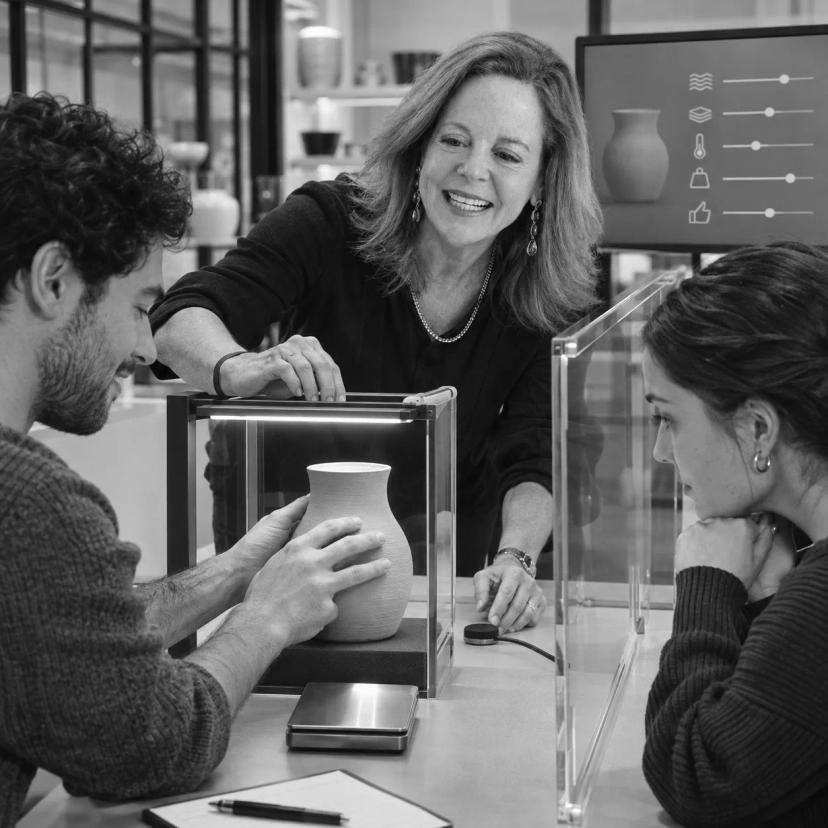
Researcher and first author of To have and to hold: The influence of haptic information on product judgments, published in the Journal of Marketing in 2003. It explains why shoppers want to touch what they buy.
Who they are
Joann Peck is known on this site through one paper, written with Terry Childers and published in the Journal of Marketing in 2003.
Key papers
To have and to hold (2003). Peck and Childers propose a framework in which the usefulness of touch information, such as texture, hardness, temperature and weight, varies by product, consumer and situation. Two experiments show that barriers to touch, such as a display case, reduce confidence and increase frustration, especially for consumers who want to touch. Written descriptions and visual images partly substitute for touch for some product types. The findings extend to internet and other non-store retailing. The paper appeared in volume 67, issue 2.
Key ideas
The paper gives an account of what online shopping removes. For products where touch matters, a screen cannot supply texture or weight, so confidence drops. Good descriptions and images help but only partly make up the difference, which is part of why some categories moved online more slowly than others.
Sources
- Peck, J., & Childers, T. L. (2003). To have and to hold: The influence of haptic information on product judgments. Journal of Marketing, 67(2), 35-48. doi:10.1509/jmkg.67.2.35.18612
Studies on this site by Peck
- Individual differences in haptic information processing: The need for touch scale
Peck (2003) · Journal of Consumer Research
- To have and to hold: The influence of haptic information on product judgments
Peck (2003) · Journal of Marketing
- It just feels good: Customers' affective response to touch and its influence on persuasion
Peck (2006) · Journal of Marketing
- The effect of mere touch on perceived ownership
Peck (2009) · Journal of Consumer Research
- In search of a surrogate for touch: The effect of haptic imagery on perceived ownership
Peck (2013) · Journal of Consumer Psychology
Articles that cite Joann Peck
- Why the Free Trial Becomes a Subscription
A free trial ends in a paid plan that begins unless someone acts. The research on defaults, ownership and renewals describes why that starting point so often holds.
- Why Touching It Makes Us Want It
What experiments say about touch, confidence and ownership, and the kinds of product where feel adds little.
- Why do we love unboxing videos?
What a viewer gets from watching a box opened that an owner gets by holding it, and why the reason for watching decides what comes next.
- Why are adults buying squishy fidget toys?
What research on touch, ownership, fiddling and adult playfulness says about the soft toys now common on adult desks.
- How People Decide What to Buy Online
A purchase on a screen is a string of small decisions. Six studies and one book show where each step helps the shopper and where it runs out.
Concepts on this site
- Affective Response to Touch
The feeling that touch produces, which can persuade even when touch tells the buyer nothing useful about the product.
- Endowment Effect
The endowment effect is Richard Thaler's 1980 observation that people demand more to give up a thing than they would have paid to acquire it. Kahneman, Knetsch and Thaler demonstrated it with coffee…
- Haptic Imagery
Imagining touching an object, which can stand in for touch when the object cannot be held.
- Haptic Information
What touch tells a buyer about a product, such as texture, hardness, temperature and weight.
- Loss Aversion
Loss aversion is Daniel Kahneman and Amos Tversky's finding that people weigh losses more heavily than equivalent gains, first formalised inside prospect theory in 1979 and named as a standalone…
- Need for Touch
Individual differences in how much people prefer to take in information through touch.
- Psychological Ownership
The feeling that something is yours, held whether or not it legally is. It raises what you think the thing is worth. It was the obvious candidate for what self-made objects gain once effort looked…
- Touch and Perceived Ownership
Touching an object raises the sense of owning it.