What the Crib Actually Decides
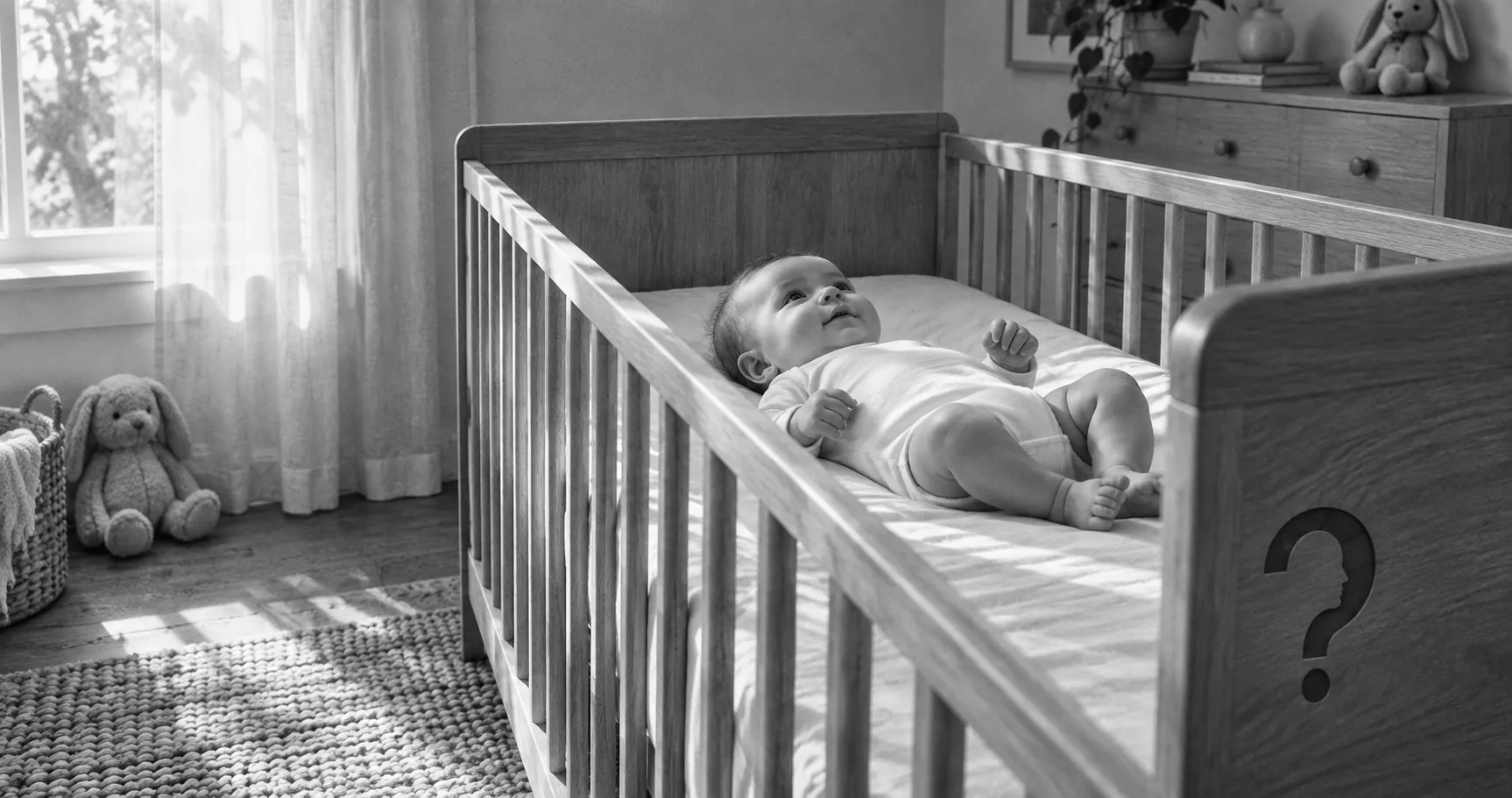
The adult attachment questionnaire and the infant laboratory measure have been compared directly, and they do not overlap
Key takeaways
- Attachment theory is real science. Babies form a bond with whoever responds to them, that bond is visible in a laboratory, and how the adults behave moves it.
- When two long-running studies were reanalysed in 2023 with the method fixed in advance, a baby's classification predicted school results about as well as it predicted emotional life. That is not what the theory says should happen.
- What the evidence does not support is the popular version, that the pattern you formed as a baby sets how you love as an adult.
- Short, practical programmes that help a parent read a baby's signals do improve the bond, and they beat long intensive ones.
- There are two different adult measures in this field, an hour-long interview and a questionnaire. Compared head to head across nearly a thousand adults, they share under one part in a hundred. They are not the same thing.
This article describes research. It is not clinical advice, and nothing in it is a way to diagnose yourself, your partner or your child. If any of it worries you, a qualified therapist is the right person to talk to.
[Attachment theory](https://thewhyweproject.com/articles/what-is-attachment-theory) starts with a claim about survival, made by John Bowlby in the 1960s. A baby cannot feed itself, warm itself or run away from anything. A baby that keeps an adult close therefore lives longer than one that does not, and Bowlby's argument was that the machinery for keeping that adult close is built in, the way hunger is built in.
Rudolph Schaffer and Peggy Emerson tested it first, in 1964, by following sixty babies in working-class Glasgow homes through their first eighteen months.
The central finding supported Bowlby, and it is still the most useful thing in this article. Babies attached to the adult who responded to them. Not the adult who fed them, and not the adult who was simply around the most. Responsiveness was the currency.
The second finding complicated him. Bowlby had argued that one bond sits above the others in a hierarchy and does most of the work. Schaffer and Emerson found that by eighteen months only about one baby in eight was attached to a single person, and that most had several attachments, some five or more. Bowlby never claimed other bonds do not exist, so this is not a refutation. It does mean the ranking he proposed was not obviously there in the data.
Worth saying, because the popular version of attachment theory still rests on the idea of one formative relationship, and the early evidence was already untidier than that.
The study had two limits. The data came from mothers' own diaries rather than from trained observers, so a mother was reporting on her own behaviour and her own bond. And it was one city, one social class, in 1964, when fathers rarely did routine childcare.
1970: the playroom
Mary Ainsworth built the instrument that made attachment measurable, and it is a small piece of theatre.
A mother and her one-year-old are shown into an unfamiliar playroom with toys. A stranger comes in. The mother leaves. The mother comes back. It happens twice and the whole thing takes about twenty minutes. What the observers care about is not the crying. It is the reunion: what the baby does in the first seconds after the door opens.
Some babies go to the mother, settle quickly and return to the toys. Ainsworth called that secure. Some barely acknowledge her, staying with the toys with an indifference that turns out to be effortful. She called that avoidant. Some cannot settle at all, wanting to be held and pushing away at the same time. She called that resistant. A fourth pattern, where the baby does something contradictory or briefly freezes, was identified in 1990 by Mary Main and Judith Solomon and called disorganised. It appears in roughly one baby in seven in ordinary samples, and in considerably more where families are under serious strain.
The famous proportions, about two thirds secure, roughly a fifth avoidant, roughly a tenth resistant, come from 106 babies. They were white, middle-class and American, in the early 1960s. Those numbers are still quoted as facts about human infants.
They travel less well than people assume. When Marinus van IJzendoorn and Pieter Kroonenberg pooled thirty-two studies from eight countries in 1988, secure was the most common pattern everywhere, which is the part usually reported. The part usually left out is that two samples from the same country differed from each other about one and a half times as much as countries differed from each other. One German sample differed from another German sample as much as it differed from a kibbutz sample. National attachment profiles are mostly an artefact of small samples.
Heidi Keller pressed the harder version of that objection in 2018. The procedure assumes two things: a child who is wary of strangers, and an adult who follows the child's lead. Both are local rather than universal.
Among the Beng in Côte d'Ivoire and the Nso in Cameroon, being picked up by an unfamiliar adult is ordinary, and a baby's stress hormones fall rather than rise. In parts of South Madagascar an infant's main social partners are other children under five, so there is no single adult for the procedure to remove. Researchers on the other side of the argument point out that security is still the most common pattern in the non-Western samples they have studied, and that responsive parenting still predicts it. What is in question is whether the procedure measures the same thing everywhere.
Run the Strange Situation on the same babies six months apart, at twelve months and again at eighteen, and the two results agree only weakly. Chris Fraley's 2002 review put that agreement at about a tenth of the variation between babies, across nearly nine hundred of them. A measure that does not reliably agree with itself over six months is then asked to carry a prediction across twenty years.
1987: the newspaper
Cindy Hazan and Phillip Shaver wanted to know whether adult romantic love worked the way infant attachment does. They wrote a love quiz: three short paragraphs, one describing comfort with closeness, one a fear of being abandoned, one discomfort with intimacy. Readers picked the one that sounded most like them. It ran in a Denver newspaper and 620 people posted their answers in.
The proportions came back looking remarkably like Ainsworth's. A little over half secure, a quarter avoidant, a fifth anxious. That resemblance launched the adult attachment industry, and it is why your online quiz result uses the same three words as a laboratory classification for one-year-olds.
The measures have improved a great deal since, and modern adult attachment questionnaires do predict real things about how people behave in relationships. What the resemblance did not establish, and what nobody checked for twenty years, is whether the adult thing and the infant thing are the same thing.
By now there are three instruments in this field, built by different people for different questions.
| What it asks | What it measures | Who it is about | |
|---|---|---|---|
| Strange Situation | How a one-year-old behaves at reunion | The state of one relationship, now | Infants |
| Adult Attachment Interview | Describe your childhood, with examples | How coherently you can tell that story | Adults |
| Self-report questionnaire | Which description sounds like you | How you feel about closeness now | Adults |
2007: the adult measures meet
The developmental tradition has its own adult instrument and it is nothing like a quiz. The Adult Attachment Interview takes about an hour. A trained interviewer asks an adult to describe their childhood relationships and then to produce specific memories backing each description. What gets scored is not the childhood. It is whether the account holds together: whether someone can say "my mother was loving" and then recall something that shows it, and whether a person who reports real harm can talk about it steadily rather than either dismissing it or being pulled back into it.
So the field has two adult measures, from two traditions. One asks how coherently you can narrate where you came from. The other asks how you feel in relationships now. For two decades people assumed they were two windows onto one thing.
In 2007 Glenn Roisman and colleagues checked. They pooled every study that had run both instruments on the same people, nearly a thousand adults, and then ran a fresh study using the best available version of each.
The overlap was, in their own words, trivial to small. Under one part in a hundred of what one measure captures is shared with the other. Only a single thread rose above negligible, a weak link between avoidance on the questionnaire and a dismissing style in the interview.
The comparison does not show that either measure is worthless. It shows that the hour-long interview used by the developmental researchers and the questionnaire used by the relationships researchers are measuring different things. An article that cites Bowlby and Ainsworth at the top and hands you a quiz at the bottom is joining two bodies of work whose own adult instruments do not agree with each other.
2023: the test fixed beforehand
Two studies have followed children from infancy into adulthood: one in Minnesota that deliberately recruited families under strain, and one much larger American study running across many sites.
In 2023 a team led by Paul Caldo did something unusual with both. They registered exactly what they would test, and how, before running any of it. Then they asked how well a baby's Strange Situation classification predicts how that person turns out.
It predicts, weakly. Once ordinary differences in family background are accounted for, the link between infant attachment and emotional outcomes accounts for somewhere between one and two parts in a hundred of the differences between people. That is the kind of effect that is real across thousands of people and invisible in any one of them.
It also predicted something the theory did not expect. Infant attachment forecast academic results about as well as it forecast emotional life, and in the Minnesota study slightly better. The theory says this measure is specifically about emotional and social development. A measure that predicts arithmetic as well as it predicts intimacy is probably picking up something broader about a child's life than the theory describes.
On the direct question, whether the infant classification predicts adult romantic life, there is no strong finding anywhere in the studies that followed people forward. Everything sits in the same small range.
The evidence that holds up
Attachment security is one of very few things in psychology that behaves as though the environment really is doing the work. When Caroline Bokhorst and colleagues ran the Strange Situation on twins in 2003, they found effectively no genetic contribution to a baby's classification and a very large contribution from the shared family environment, and a larger American twin study reached the same conclusion in 2008. For most psychological traits that pattern runs the other way round. Whatever the Strange Situation is measuring, it is measuring the household rather than the child's inheritance.
And what the adults do matters, in the modest way real effects usually do. Marianne De Wolff and Marinus van IJzendoorn pooled the studies that observed parents and then classified the babies. Sensitivity to a baby's signals, meaning noticing a signal, reading it correctly and responding promptly, accounts for about six parts in a hundred of the differences in security. Their own description is "moderately strong", and they add that sensitivity is an important but not exclusive condition. Set that against the one or two parts in a hundred that infant classification manages twenty years later, and the shape of this field becomes clear: what is happening now explains several times more than what happened decades ago.
In 2003 Marian Bakermans-Kranenburg and colleagues pooled seventy trials of programmes designed to improve the bond. The ones that worked were short, practical and focused on behaviour: a handful of sessions, often with video of the parent and baby played back so the parent can see the signals they are missing. Long, intensive, insight-oriented programmes did worse, which is why the paper is called "Less is more". The improvement in security was small, and because families were assigned to the programmes at random, it was caused rather than merely observed.
So this is changeable, and the good evidence for changing it is all at the baby end rather than the adult end.
At the adult end, one popular idea needs a correction. "Earned secure" is usually taken to mean somebody who had a hard childhood and overcame it. In 2002 Roisman and colleagues tested that against a group who had been followed since infancy. The adults who now narrated a difficult childhood coherently had not, on the record, had harder childhoods. Observed at the time, they had received some of the most supportive parenting in the sample. The label tracks how a person tells the story now rather than what actually happened. As for therapy, a review of fourteen studies found attachment security rising afterwards, but most of those studies had no comparison group, and people tend to improve over time in uncontrolled studies of almost anything. The evidence is encouraging and unproven.
What is still open
The infant work has held up. The bond is caused by how the people around a baby behave, it is one of the few findings in psychology where the environment clearly does the work rather than genes, and it can be improved by teaching those people to read a baby better. The infant measure itself agrees with itself only weakly across six months, predicts adulthood weakly, and predicts school results about as well as feelings, and the two adult instruments have been compared directly and found to be measuring different things.
An adult attachment questionnaire is a description of how someone feels about closeness at the moment. The studies that could connect that description to the first year of life have not found the connection.
The study that would settle how much of adult attachment is carried forward from infancy and how much is made by the current relationship would follow the same people through several relationships, measuring at each stage. It has not been run.
Sources
Bowlby, J. (1969/1982). Attachment and Loss, Vol. 1: Attachment. 2nd edition, Basic Books.
Schaffer, H. R., & Emerson, P. E. (1964). 'The development of social attachments in infancy.' Monographs of the Society for Research in Child Development, 29(3, Serial No. 94.
Ainsworth, M. D. S., & Bell, S. M. (1970). 'Attachment, exploration, and separation: illustrated by the behavior of one-year-olds in a strange situation.' Child Development, 41(1), 49-67.
Ainsworth, M. D. S., Blehar, M. C., Waters, E., & Wall, S. (1978). Patterns of Attachment. Lawrence Erlbaum.
Main, M., & Solomon, J. (1990). 'Procedures for identifying infants as disorganized/disoriented during the Ainsworth Strange Situation.' In Greenberg, Cicchetti & Cummings (Eds.), Attachment in the Preschool Years, 121-160.
van IJzendoorn, M. H., & Kroonenberg, P. M. (1988). 'Cross-cultural patterns of attachment: a meta-analysis of the strange situation.' Child Development, 59(1), 147-156.
Keller, H. (2018). 'Universality claim of attachment theory: children's socioemotional development across cultures.' PNAS, 115(45), 11414-11419.
Fraley, R. C. (2002). 'Attachment stability from infancy to adulthood: meta-analysis and dynamic modeling of developmental mechanisms.' Personality and Social Psychology Review, 6(2), 123-151.
Hazan, C., & Shaver, P. (1987). 'Romantic love conceptualized as an attachment process.' Journal of Personality and Social Psychology, 52(3), 511-524.
Roisman, G. I., Holland, A., Fortuna, K., Fraley, R. C., Clausell, E., & Clarke, A. (2007). 'The Adult Attachment Interview and self-reports of attachment style: an empirical rapprochement.' Journal of Personality and Social Psychology, 92(4), 678-697.
Caldo, P. D., Magro, S. W., Raby, K. L., Groh, A. M., Vandell, D. L., Booth-LaForce, C., Fraley, R.
De Wolff, M. S., & van IJzendoorn, M. H. (1997). 'Sensitivity and attachment: a meta-analysis on parental antecedents of infant attachment.' Child Development, 68(4), 571-591.
Bokhorst, C. L., Bakermans-Kranenburg, M. J., Fearon, R. M. P., van IJzendoorn, M. H., Fonagy, P., & Schuengel, C. (2003). 'The importance of shared environment in mother-infant attachment security: a behavioral genetic study.' Child Development, 74(6), 1769-1782.
Bakermans-Kranenburg, M. J., van IJzendoorn, M. H., & Juffer, F. (2003). 'Less is more: meta-analyses of sensitivity and attachment interventions in early childhood.' Psychological Bulletin, 129(2), 195-215.
Roisman, G. I., Padrón, E., Sroufe, L. A., & Egeland, B. (2002). 'Earned-secure attachment status in retrospect and prospect.' Child Development, 73(4), 1204-1219.
Taylor, P., Rietzschel, J., Danquah, A., & Berry, K. (2015). 'Changes in attachment representations during psychological therapy.' Psychotherapy Research, 25(2), 222-238.
Groh, A. M., Fearon, R. P., Bakermans-Kranenburg, M. J., van IJzendoorn, M. H., Steele, R. D., & Roisman, G. I. (2014). Attachment and Human Development, 16(2), 103-136.
A note on the definition of attachment usually attributed to page six of Bowlby, J. (1969), Attachment and Loss, Vol.