Why does “high protein” now sell everything?
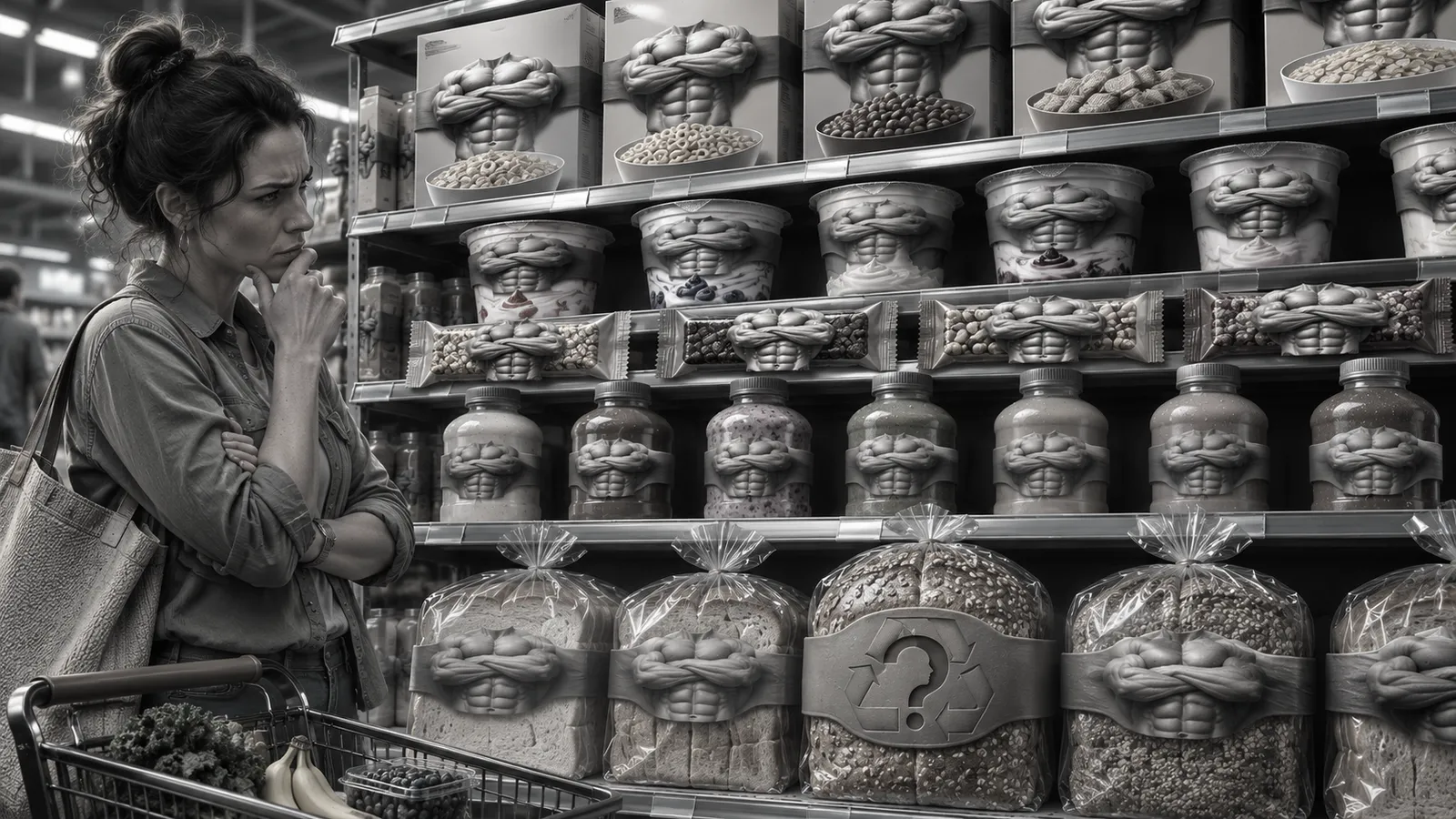
What experiments on food labels show about why one nutrient word lifts a whole shelf, where it fails, and how it reaches the tasting.
Answer to the question
Why does “high protein” now sell everything?
High protein sells because it works as a cue. In a protein bar experiment with 274 participants, the word in a product title raised perceived healthfulness, and research on the unhealthy equals tasty intuition shows a treat can carry it. A 2026 experiment with 218 participants found no general halo, so the effect depends on the product and the shopper.
Key takeaways
- In four experiments, learning how healthy a food was led people to judge the less healthy item as tastier, to enjoy it more while eating it and to choose it more when a pleasure goal was salient (Raghunathan, Naylor and Hoyer, 2006).
- In an experiment with 274 participants, a nutrient word in a protein bar's title raised perceived healthfulness, while the same information as a front claim raised only perceived protein content (Fernan, Schuldt and Niederdeppe).
- A traffic light warning label raised perceived sugar and calories in that experiment but did not offset the title's effect on perceived healthfulness.
- In an online experiment with 218 participants, a high protein label produced no general halo; labelled products were seen as more additive-laden and more processed, and attitudes toward protein products moderated the response (Capuano, Durand and Besson, 2026).
- In a study with 129 consumers tasting identical cheeses, health labels shaped expected and perceived flavour, and one expectation gap was gone after tasting (Schouteten and colleagues, 2015).
This article is general information about research on food labels and shopper psychology. It is not nutrition or dietary advice. If you have questions about your own diet, speak to your GP or a registered dietitian. Medical review:.
Long before high protein reached every shelf, a paper in the Journal of Marketing reported four experiments in which shoppers told how healthy a food was judged the less healthy item to taste better, enjoyed it more while eating it, and chose it more often when pleasure was the goal. That is the finding behind the unhealthy equals tasty intuition, and it sets a puzzle for a label that now sits on cereal, ice cream, crisps and coffee. If virtue and pleasure pull against each other in the mind, why does high protein sell both at once?
High protein reads as a cue more than a recipe
A label tells a shopper what a product contains, but shoppers read it as a message about what the product is. Mark Schatzker builds a related argument about flavour in The Dorito Effect. In his account a flavour is a cue that once travelled with real content in a food, and modern food makers can attach the cue to products that do not carry the content.
The book is about flavour, not protein, and the argument is the author's own, yet its structure carries over: a cue on the pack can say more than the recipe behind it, and shoppers act on the cue.
Experiments on protein bars show the cue at work. Catherine Fernan, Jonathon Schuldt and Jeff Niederdeppe put the same nutrient information in two places for 274 participants, either as a claim on the front of the pack or as part of the product title. Both raised how much protein people thought the bar held. Only the title raised how healthy the bar seemed overall, and it did so partly by lifting guesses about other good qualities the pack never mentioned, such as fibre and iron.
The vault holds this as the protein halo concept.
A traffic light warning label then raised perceived sugar and calories, yet it did not cancel the lift in perceived healthfulness. The halo had spread beyond the claim itself, a pattern the vault covers in What is the halo effect and in the health halo concept. In plain terms, a product name that includes high protein is a stronger cue than a claim printed beside it, and the cue reaches qualities nobody wrote down. Colour can do the same job on a pack, as Does Green Packaging Look Healthier shows for a calorie label, so a single word is one cue among several that shoppers combine.
The same word can also backfire for some shoppers
A sceptic's first thought is that no label can be that persuasive, and the second is that the effect may run the other way for some shoppers. Both thoughts are fair, and the second has a direct test. Carla Capuano, François Durand and Théo Besson tested a high protein label in an online experiment with 218 participants who rated five food products, some labelled and some not. They found no general halo. Labelled products were instead seen as containing more additives and as more industrially processed, a horn-like effect, the mirror image of a halo.
Two further results matter for anyone selling with high protein. The label changed estimates of calories and sugar mainly for the higher-calorie products, so what it did depended on the item underneath it. And the shopper's own attitude toward protein products moderated the response, while a personal drive for muscularity did not.
The same two words land differently on different people.
That fits the idea that a label is read through what each shopper already believes.
| Study | Participants | What the cue did |
|---|---|---|
| Fernan, Schuldt and Niederdeppe, protein bars | 274 | Title raised perceived healthfulness; a front claim did not |
| Capuano, Durand and Besson, five products | 218 | No general halo; labelled items seen as more processed |
| Schouteten and colleagues, one cheese | 129 | Health labels shaped expected and perceived flavour |
| Raghunathan, Naylor and Hoyer, food choices | Four experiments | Less healthy items judged tastier |
A virtue word can sit comfortably on a treat
The remaining question is why the word sells foods that shoppers already treat as indulgent. Raghunathan, Naylor and Hoyer found the link between unhealthy and tasty at an implicit level, present even among people who did not endorse it, and strongest when a pleasure goal was in mind. A product that carries high protein on its pack and still reads as a treat can offer both. The shopper gets a reason to say yes and the expectation of enjoyment in a single purchase, which is a stronger offer than either alone.
That gives the label a job. On a product that already reads as dessert, high protein adds a second reason to buy, and the reason travels with the word whatever the recipe is. On a product that does not read as a treat, the halo and horn results suggest the same word can raise questions about processing. The label may sit most comfortably where the treat is already present.
Many shelves already carry claims about sugar, fat and calories, and a high protein claim adds a reason to buy without changing what the product is.
Expectation is formed before the first bite, from shape, plate and wording, a theme developed in Food Branding Psychology: Taste Starts With the Eye, and it can carry through to what is experienced. Joachim Schouteten and colleagues asked 129 consumers to rate four labelled versions of the same cheese before and after tasting, though the cheeses were identical. The version labelled light was expected to be less enjoyable and was rated lower in liking, while the gap for the reduced-salt version, present in expectation, was gone once people had tasted it.
Those labels promise less, and a high protein label promises more, so the result cannot be applied to it directly. It does show that a word on a pack reaches the tasting as well as the choice at the shelf.
Labels also moved perceived saltiness in the direction each implied, so the wording reached the judgement of the food itself.
Common questions
Why does “high protein” now sell everything?
Research on labels suggests the word acts as a cue that lifts perceived healthfulness and fits the unhealthy equals tasty intuition, so a product can read as both a treat and a sensible choice. It does not work equally on everyone.
Does a high protein label always make food look healthier?
No. In one experiment with 218 participants, labelled products were seen as more processed and carried no general halo. Attitudes toward protein products shaped the response.
Does the name on a pack matter more than a claim?
In a study of protein bars, the product title raised perceived healthfulness while a nutrient claim raised only perceived protein content.
Can a label change how food tastes?
In a study with 129 consumers, health labels on identical cheeses shaped expected and perceived flavour, and some expectation gaps disappeared after tasting.
Sources
Schatzker, M. The Dorito Effect. Seed book; vault hub Books/The Dorito Effect (Schatzker).
Raghunathan, R., Naylor, R. W., & Hoyer, W. D. (2006). The unhealthy = tasty intuition and its effects on taste inferences, enjoyment, and choice of food products. Journal of Marketing, 70(4), 170-184. doi:10.1509/jmkg.70.4.170 https://doi.org/10.1509/jmkg.70.4.170
Fernan, C., Schuldt, J. P., & Niederdeppe, J. (2018). Health halo effects from product titles and nutrient content claims in the context of protein bars. Health Communication, 33(12), 1425-1433. doi:10.1080/10410236.2017.1358240 https://doi.org/10.1080/10410236.2017.1358240
Capuano, C., Durand, F., & Besson, T. (2026). Halo or horn? The role of prior attitudes in shaping consumer responses to high-protein food labels. Food Quality and Preference, 148, 106095. doi:10.1016/j.foodqual.2026.106095 https://doi.org/10.1016/j.foodqual.2026.106095
Schouteten, J. J., De Steur, H., De Pelsmaeker, S., Lagast, S., De Bourdeaudhuij, I., & Gellynck, X. (2015). Impact of health labels on flavor perception and emotional profiling: A consumer study on cheese. Nutrients, 7(12). doi:10.3390/nu7125533 https://doi.org/10.3390/nu7125533