The Courage Problem
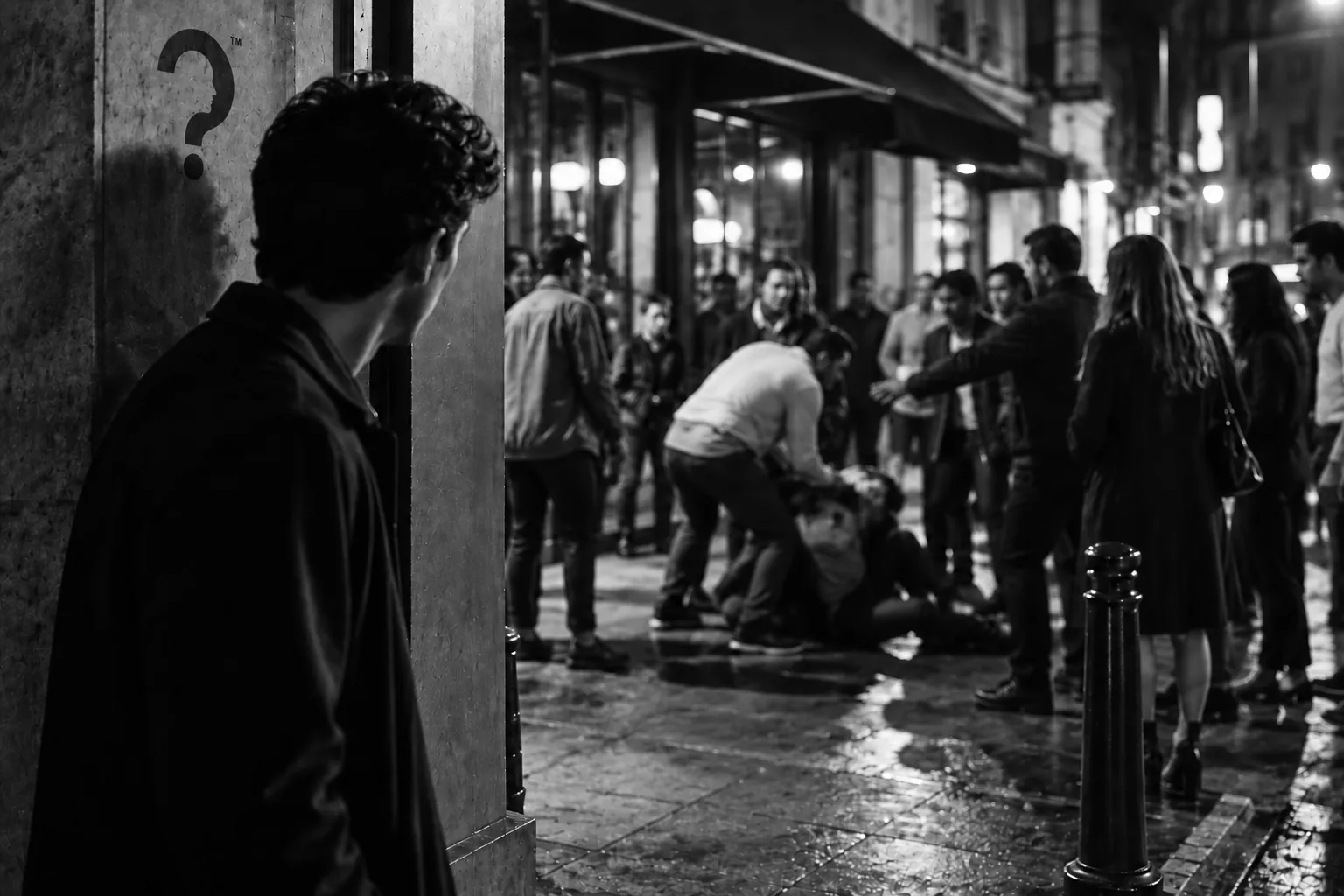
The founding story of the bystander effect does not survive its own archive, and people intervene in nine out of ten real fights
Answer to the question
Do bystanders really stand by and do nothing?
Mostly no. The Kitty Genovese story behind the bystander effect does not survive the police files, which show neighbours calling the police and one man driving the attacker off. Philpot and colleagues' CCTV study of 219 real conflicts found someone intervened in nine out of ten, and more bystanders made intervention more likely, though what sets the person who acts apart remains unmeasured.
Key takeaways
- The founding story of the bystander effect does not survive its own archive. Manning, Levine and Collins went to the trial record and police files in 2007 and found no evidence for 38 witnesses, none that witnesses watched the murder, and none that they did nothing.
- At least two neighbours called the police. One man shouted and drove the attacker off. A friend held Kitty Genovese as she died.
- Darley and Latané's 1968 experiments were sound and the laboratory effect is real. What failed was the story attached to them.
- Philpot and colleagues examined CCTV of 219 real public conflicts in Amsterdam, Cape Town and Lancaster. Someone intervened in nine out of ten, and more bystanders present made intervention more likely rather than less.
- Mark Levine is an author on both the paper that dismantled the parable and the one that measured the reality, thirteen years apart.
In 1964 Kitty Genovese was murdered in Queens. In 1968 John Darley and Bibb Latané ran the experiments that explained why nobody helped her. In 2007 Rachel Manning, Mark Levine and Alan Collins checked whether anybody had.
Read the archive before the textbook
They had not, and the reason is that the question was wrong. What everybody had spent forty years explaining, thirty-eight neighbours watching a murder from their windows and deciding one by one to do nothing, is not what happened that night.
Manning, Levine and Collins published in American Psychologist in 2007, working from the trial record, police files and press reports. Three claims had carried the story for forty years: that there were 38 witnesses, that they watched the murder, and that they did nothing. None of the three is supported.
The figure of 38 appears nowhere in the police records. The attack happened in two parts about ten minutes apart, and the fatal second one took place in a vestibule that almost nobody could have seen into. At least two neighbours telephoned the police. One man shouted from a window and drove the attacker off, which is why there was a second attack at all. A friend came down and held her while she died.
The parable of the indifferent city was assembled by a newspaper and adopted by a discipline that had a use for it.
Keep the experiment, discard the story
None of that touches Darley and Latané. Their work is good experimental psychology and the effect they found is real: put one person with a staged emergency and they act, add bystanders and the probability that any given individual acts falls, through diffused responsibility and through everyone reading everyone else for a cue.
That finding replicated and entered every textbook. What travelled with it was the Genovese story as its illustration, and the illustration was false while the experiment was sound.
Count what people actually do
Philpot and colleagues went to the video. Their 2020 paper in American Psychologist analysed CCTV recordings of 219 public conflicts in the entertainment and business districts of Amsterdam, Cape Town and Lancaster, three cities differing sharply in perceived public safety.
Someone intervened in nine out of ten incidents, usually several people. The rate held across all three countries. And a greater number of bystanders present was associated with a greater likelihood that somebody stepped in, reversing the effect as it is taught.
The laboratory measured the probability that a given individual acts. The street measures the probability that anybody does. Fifty years of teaching collapsed those two questions into one.
Both results stand, and the reconciliation is arithmetic. Each additional bystander may be individually less likely to move while the group as a whole becomes more likely to contain someone who will.
Ask what the cameras could not see
Which is where the useful question starts, because the footage records outcomes and nothing else.
The coders could see how many people were present, what the conflict looked like, and who moved. They could not see who had been drinking, who knew the people fighting, who worked the door for a living, or who had done this before. Any of those would explain intervention without needing a disposition at all. A nightlife district at two in the morning is full of professional obligation and prior acquaintance.
So the honest position after Philpot is that intervention is common and unexplained. Something distinguishes the person who moves from the person beside them who does not, and the design cannot say what. The oldest candidate has a name, and psychology has been shy of it.
Read Aristotle again, properly
Courage is the first of the moral virtues Aristotle treats in Book III of the Nicomachean Ethics, and the ordering is often reported as a ranking. It is not. He does not say courage makes the other virtues possible; that formulation is modern and attaches to his name because it sounds like him.
What he does say is narrower and more useful. Courage is a mean between cowardice and rashness, concerned specifically with fear and confidence, and its fullest expression is facing death in battle. The virtue only shows itself when the stakes are real. A man who is unafraid because nothing is at risk is not demonstrating anything.
Measure the act, not the answer
Psychology can measure courage. The trouble is where it has done so.
The most-cited behavioural work is Norton and Weiss (2009) in the Journal of Anxiety Disorders. Thirty-two participants with elevated spider fear completed a self-report courage measure, then faced a display of four taxidermied tarantulas with an instruction to bring a hand as close as they were willing. Courage scores predicted approach distance even after controlling for how frightened of spiders people were.
It is a real result and the authors are unusually careful with it. Their own title calls it a proof-of-concept pilot study.
Thirty-two people and a dead spider is the strongest behavioural evidence the field has that self-reported courage predicts what a person does.
So the verdict, and it is more encouraging than the topic suggests. The bystander effect's founding story was false, the effect itself is narrower than advertised, and people help far more often than the discipline spent fifty years implying. What is missing is the middle: any substantial body of work that measures a person before they face a real cost and then watches what they do when they face it.
That gap reaches outside the journals. Every institution that says it wants people to speak up, report misconduct or intervene is relying on a disposition nobody has characterised under the conditions that matter. They run training on it and write it into values statements. If they wanted to know who actually has it, the only validated instrument was tested on people looking at a spider that could not move.
Sources
Manning, R., Levine, M. & Collins, A. (2007). "The Kitty Genovese Murder and the Social Psychology of Helping: The Parable of the 38 Witnesses." American Psychologist, 62(6), 555-562. No evidence for 38 witnesses, that witnesses observed the murder, or that they remained inactive.
Darley, J. M. & Latané, B. (1968). The bystander intervention experiments.
Philpot, R., Liebst, L. S., Levine, M., Bernasco, W. & Lindegaard, M. R. (2020). "Would I Be Helped? Cross-National CCTV Footage Shows That Intervention Is the Norm in Public Conflicts." American Psychologist. N = 219 incidents in Amsterdam, Cape Town and Lancaster; intervention in nine of ten; more bystanders associated with greater likelihood of intervention.
Aristotle, Nicomachean Ethics, Book III. Courage as a mean between cowardice and rashness, treated first among the moral virtues.
Norton, P. J. & Weiss, B. J. (2009). "The role of courage on behavioral approach in a fear-eliciting situation: a proof-of-concept pilot study." Journal of Anxiety Disorders. N = 32.