Prime Time Never Died, It Started Charging Admission
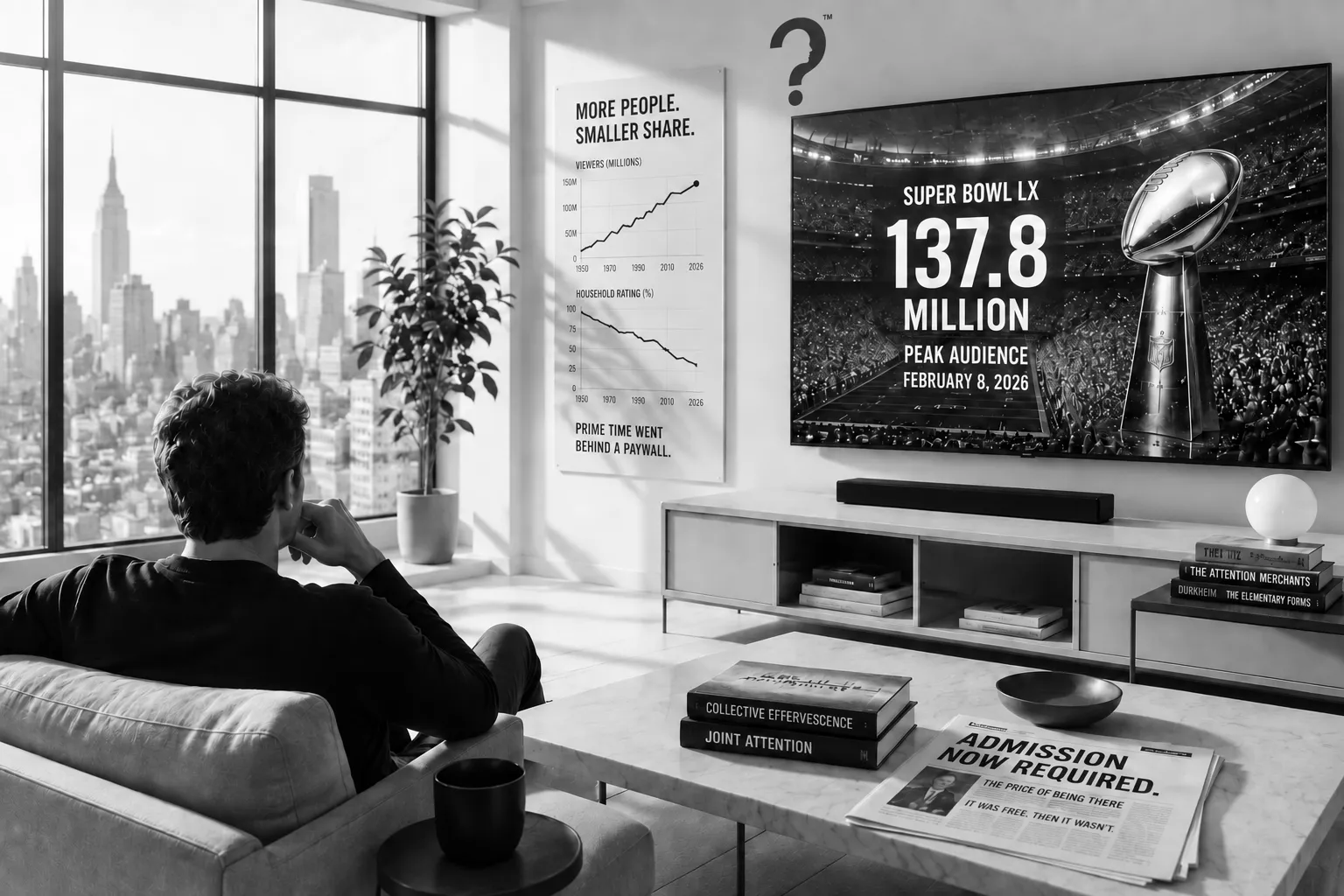
The free version of mass simultaneous attention declined. The mechanism was made scarce on purpose and sold back
Key takeaways
- 137.8 million people in the United States were watching Super Bowl LX at the same moment late in the second quarter on 8 February 2026. Nielsen records it as the highest peak audience in American television history.
- That same broadcast drew a 39.7 household rating. I Love Lucy drew 71.7 on 19 January 1953, and Elvis Presley on The Ed Sullivan Show drew 82.6 in September 1956. The absolute number is at a record and the proportion has roughly halved.
- Pollstar's 2025 year-end analysis found grosses and ticket sales falling while averages rose. Stadium tickets went up 18.3 per cent to $216.13 and the average stadium gross reached $7.11 million a show, a 19 per cent increase on 2024.
- Live Nation booked a record $25.2 billion in 2025, concerts alone at $20.9 billion. The company also reports that get-in prices held flat against 2024 and that 75 per cent of its US tickets sold for under $100.
- The Competition and Markets Authority found no evidence that Ticketmaster used dynamic pricing for the Oasis on-sale. What it found was seats labelled "platinum" and sold at nearly 2.5 times the standard price without adequate explanation that they carried no additional benefit.
137.8 million.
That is how many people in the United States were watching the same thing at the same moment late in the second quarter of Super Bowl LX, on 8 February 2026. Nielsen has never measured a higher peak.
Mass simultaneous attention did not fragment away with cable and streaming. The free, advertising-funded version of it declined. The mechanism underneath it got picked up, made scarce on purpose, and sold directly to the people who wanted it most. Prime time went behind a paywall, and the price went up.
The mechanism has a name. Tim Wu calls it joint attention: people attending to the same thing at the same time, together, get a different cognitive result from the same number of people attending separately. It develops in infancy, before language, when a baby learns to follow a caregiver's gaze. Durkheim named the felt version collective effervescence, and it is why a stadium and a Sunday service run on the same equipment. Everything below rests on it, and the laboratory evidence for it is two strangers at a table.
Ratings
The Super Bowl LX average was 125.6 million, which makes it the second most-watched programme ever behind Super Bowl LIX at 127.7 million the year before. Both figures sit above anything the broadcast era produced in raw headcount.
Set them against the proportions and the picture inverts. Super Bowl LX drew a 39.7 household rating. On 19 January 1953, the I Love Lucy episode in which Lucy has her baby drew 71.7 per cent of American television households, a figure that stood as a record until Elvis Presley's first appearance on The Ed Sullivan Show in September 1956 took 82.6 per cent. Eisenhower's inauguration, the morning after the Lucy episode, managed 67.7.
Both readings are true and the tension between them is the whole subject. More people watch the biggest thing than ever have. A far smaller share of the country does. The gap between those two sentences is the audience that stopped showing up for free, and the question worth asking is where it went rather than whether it left.
Fragmentation
The standard answer is that it dispersed, and that answer has the better documentary record.
Tim Wu's history of the period is its strongest version. Prime time was an invention with a date: Amos 'n' Andy in 1929, and the innovation was not the comedy but serialisation, cliffhangers built to return the same audience to the same hour tomorrow. Wu describes the result as a mass ritual of shared attention, and he does not mean it as a figure of speech. Irna Phillips ran the same trick on daytime and produced the soap opera. William Paley turned it into CBS's ratings dominance from 1955 to 1976.
Then it came apart, on purpose. Jonathan Robbin's PRIZM system sorted American neighbourhoods into forty lifestyle clusters with names like Money and Brains, Shotguns and Pickups, Bohemian Mix. Cable made narrowcasting practical: MTV, BET, Bravo and the Playboy Channel each built for a slice rather than a nation, and Rupert Murdoch and Barry Diller assembled Fox out of the audiences the big three had left alone. Wu's reading of the remote control is that it was sold as viewer sovereignty and delivered channel surfing, sustained aimless flipping with no intention behind it.
None of that is wrong. The free mass audience really did break up, and it is not coming back on those terms. The older claim that television made public life a branch of entertainment is the subject of an article on whether [Amusing Ourselves to Death was right](https://thewhyweproject.com/articles/was-amusing-ourselves-to-death-right).
The fragmentation account explains what happened to the version of mass attention that was given away. It does not explain what happened to the demand for it.
Price
That demand is visible in the accounts of the companies selling it, though those are company and trade figures rather than research, and should be read as such.
Live Nation reported record revenue of $25.2 billion for 2025, with concerts at $20.9 billion, up 10 per cent. Pollstar's year-end analysis of the same period found something more specific and more useful: grosses and ticket sales fell while averages rose. Stadium tickets went up 18.3 per cent to an average of $216.13. The average stadium show grossed $7.11 million, 19 per cent more than in 2024. The top-tour average ticket landed at $132.62, the second-highest on record. Fewer people, paying more, for the events at the largest scale.
Sphere in Las Vegas took $379 million from 1.7 million tickets in 2025, which makes it the highest-grossing arena in the world on a building whose entire proposition is that you had to be inside it.
The counterweight comes from Live Nation itself, which reports that get-in prices held flat against 2024, tracked below inflation, and that 75 per cent of its US tickets sold for under $100. A company describing its own pricing is not a disinterested source, but the claim is checkable and it is not trivial: the floor did not move. The ceiling did. What rose in price was specifically the premium, visible, unrepeatable version of being there.
Platinum
Which brings up the case everyone thinks they know, and where the popular account is wrong in a way worth correcting.
When Oasis tickets went on sale in August 2024, queues ran for hours and prices moved, and the story that hardened was that Ticketmaster had used dynamic pricing to raise them mid-sale. The Competition and Markets Authority investigated and did not find that. It reported no evidence that dynamic pricing was used in the Oasis on-sale at all.
What it did find was a labelling problem. Certain seated tickets were sold as "platinum" at nearly 2.5 times the price of equivalent standard tickets, without adequately explaining that platinum conferred no additional benefit. Ticketmaster gave undertakings, voluntarily and with no admission of liability: fans get 24 hours' notice when tiered pricing is in use, and the company reports to the regulator for two years.
The correction matters beyond pedantry. The dynamic-pricing story blames an algorithm reacting to demand. What the regulator described was a word applied to an ordinary seat and priced on the buyer's belief that the moment was scarce and that a better version of it existed. No algorithm is required for that. A label will do.
Mechanism
The two strangers at a table are not a figure of speech.
Noam Mairon and colleagues at Berkeley sat 42 undergraduates down in pairs, at opposite sides of a table, each about 90 centimetres from a shared screen, silently counting pictures of flowers for around ten minutes. They measured attention and memory behaviourally and by EEG, and found no amplifying effect of shared attention on either. Their statistics do not merely fail to turn something up. They come down on the side of there being nothing there, which is a stronger and rarer result than an empty-handed study. That is positive evidence for the null, not a failure to find anything.
The one solid social effect ran the other way, and it was a very large one, the kind of gap you would notice without measuring it. Accuracy was higher alone, 94.4 per cent, than shared, 86.3 per cent. Having a second person at the table made people worse at the task, which is ordinary social facilitation and distraction.
Mairon and colleagues mark their own limits. They never asked participants how anything felt, and the amplification findings they were testing against, Garriy Shteynberg's, concern self-reported emotion under mediated co-presence. The door is open on feeling and closed on performance.
So nothing there establishes that 137.8 million strangers in separate rooms are doing what a psychologist would call joint attention. Two people at one table for ten minutes is the evidence. The stadium is the extrapolation, and if it fails, the four sections above survive as economics and lose their explanation.
Practice
If your product has a moment when a large number of people experience the same thing at the same time, that moment is the part of it that cannot be time-shifted, and the market evidence says it is the part people are still paying more for while paying less for everything else. Price it as the scarce thing it is, before optimising it away for convenience. Convenience is what the free version was built around, and the free version is the half of this that actually died.
Sources
Nielsen (2026). Super Bowl LX final viewership, Big Data + Panel measurement: 125.6 million average, 39.7 combined household rating, 80 household share. Broadcast 8 February 2026 on NBC, Peacock and Telemundo.
NBC Sports / NFL (2026). Super Bowl LX peak audience of 137.8 million late in the second quarter, reported as the highest peak viewership in US television history. Super Bowl LIX (2025) remains the highest average at 127.7 million.
"Lucy Goes to the Hospital", I Love Lucy, broadcast 19 January 1953: 71.7 rating. Elvis Presley's first appearance on The Ed Sullivan Show, 9 September 1956: 82.6.
Wu, T. (2016). The Attention Merchants. Knopf. Amos 'n' Andy and serialisation, 1929.
Pollstar (2025). Year-end business analysis: grosses and ticket sales fell while averages rose; stadium tickets up 18.3 per cent to an average of $216.13; average stadium gross $7.11 million a show, up 19 per cent on 2024; top-tour average ticket $132.62, the second-highest on record.
Live Nation Entertainment (2026). Full-year 2025 results: record total revenue of $25.2 billion, concerts $20.9 billion, up 10 per cent.
Sphere Entertainment Co. (2026). Full-year 2025 results: $379 million from 1.7 million tickets at Sphere Las Vegas, reported as the highest-grossing arena in the world; Sphere Entertainment revenue $1.22 billion, up 8 per cent. Company reporting.
Competition and Markets Authority (2025). Ticketmaster undertakings following the Oasis on-sale investigation.
Mairon, N., Nahum, M., Stolk, A., Knight, R. T. & Perry, A. (2020). "Behavioral and EEG Measures Show no Amplifying Effects of Shared Attention on Attention or Memory." Scientific Reports, 10, 8458.
Scaife, M. & Bruner, J. S. (1975). "The capacity for joint visual attention in the infant." Nature, 253, 265-266.
Durkheim, E. (1912). The Elementary Forms of Religious Life.